A grow tent is the one “room” where you do not just remove humidity — you steer it to a target that changes as the plants grow. Plants transpire a lot of water into a small sealed space, so a grow tent needs active humidity control: higher for seedlings, lower for flowering, with a dehumidifier pulling out the excess so wet buds never get the chance to grow mold. The right tool is whatever holds your stage target — and growers track VPD, not humidity alone.
Why grow tents fill with moisture
Plants release water vapor through their leaves — transpiration — and a tent packed with them in a small, sealed volume loads the air fast. Add watering, damp growing media, and limited air exchange, and humidity climbs steadily as the canopy fills out. That is a problem because the EPA’s rule is blunt: mold needs moisture, and sustained high humidity is what lets it grow (EPA — A Brief Guide to Mold, Moisture and Your Home). In a grow tent that shows up as the two things every grower dreads — bud rot and powdery mildew — both of which take hold when the air stays too damp, especially around dense flowers.
Target humidity by growth stage
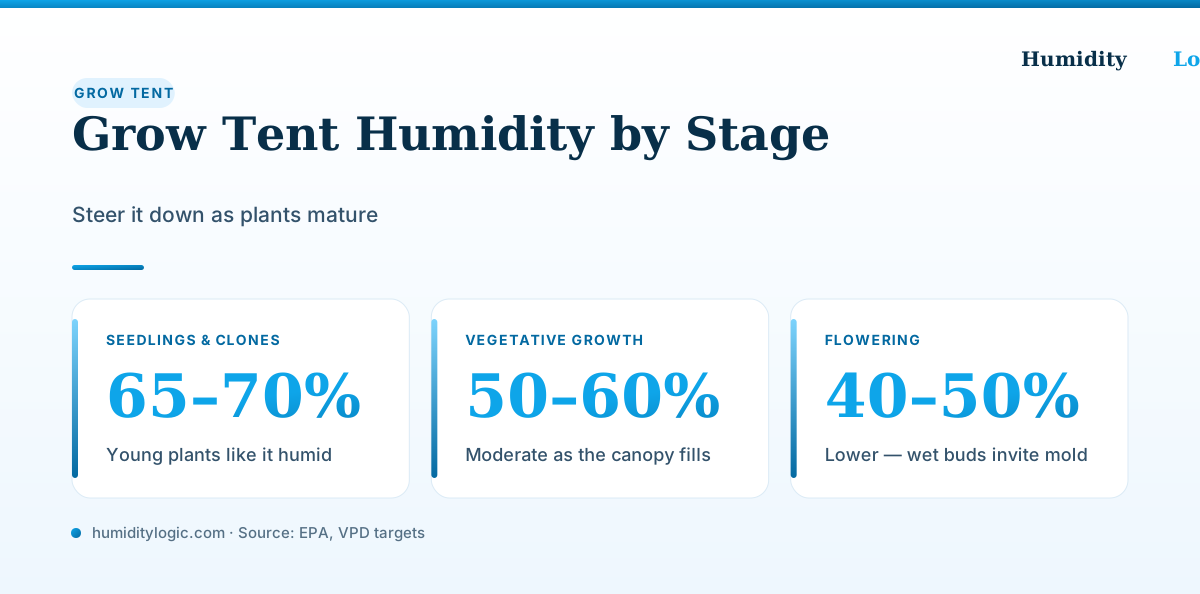
Unlike a basement, a grow tent’s ideal humidity moves through the cycle. Widely used starting points:
- Seedlings & clones: high, commonly around 65–70% RH. Young plants have tiny root systems and lean on humid air.
- Vegetative growth: moderate, roughly 50–60% RH.
- Flowering: lower, around 40–50% RH, because wet buds are where rot and mildew start. This is the stage most growers fight humidity hardest — the plants are transpiring the most just when you want the air driest.
Treat these as ranges to dial in, not laws, and always keep an eye on the EPA’s wider 60% mold ceiling for anything outside the canopy. For a reference across valuables and spaces, see our ideal humidity guide.
Track VPD, not just humidity
Experienced growers target vapor pressure deficit (VPD) rather than a humidity number, because the same RH behaves very differently at different temperatures — 55% at 20°C is not the same “pull” on the plant as 55% at 28°C. VPD rolls temperature and humidity into one figure for how strongly the air draws moisture from the leaf. Common targets run roughly 0.4–0.8 kPa for seedlings and clones, 0.8–1.2 kPa in veg, and 1.2–1.6 kPa in flower. Put your tent’s temperature and RH into the VPD calculator to see where you land and which way to push.
When you need a dehumidifier (and when a humidifier)
Which tool you need depends on stage and climate:
- Flowering, or a humid climate / dense canopy: you will usually be fighting too much moisture, and a dehumidifier is the answer — it pulls transpired water out so you can hold the lower flower target and keep bud rot away.
- Early veg, seedlings, or a very dry climate: you may need to add moisture with a humidifier instead.
Measure first and let the VPD reading decide — do not assume. A dehumidifier with a built-in humidistat lets you set the target and leave it; ENERGY STAR notes all certified units include one (ENERGY STAR — Dehumidifiers).
Sizing and airflow
Size a grow-tent dehumidifier to the moisture load, which scales with plant count and watering, not just tent dimensions — a dense flowering room can need surprising capacity for its size. Measure your humidity, start with the dehumidifier size calculator, and step up if the unit cannot hold your target. Pair it with good airflow: oscillating fans keep a still, humid layer from settling on leaves and buds, which is where condensation and the mechanism behind mold — warm, humid air on a cooler surface — gets going (EPA Mold Course, Chapter 2). An exhaust fan venting the tent also carries moisture out.
Match the humidity to the stage, watch VPD, and let a right-sized dehumidifier hold the flower target — and the grow stays clean instead of fighting mildew. For other controlled spaces with a specific humidity set-point, see the wine cellar guide.
Frequently asked questions
What humidity should a grow tent be?
It changes by stage. Seedlings and clones like it humid (commonly around 65–70% RH), vegetative growth a bit lower (roughly 50–60%), and flowering lower still (around 40–50%), because wet buds invite mold. Growers usually track vapor pressure deficit (VPD) rather than humidity alone, since VPD combines temperature and humidity into one number.
Why is my grow tent so humid?
Plants transpire — they release water vapor through their leaves — and a tent packed with them in a small sealed space fills with moisture fast. Watering, wet media, and limited air exchange add to it. The bigger and denser the canopy, the more water goes into the air, which is why humidity climbs as a grow matures.
Do I need a dehumidifier in a grow tent?
Often yes, especially in flower, when you want lower humidity but the plants are transpiring the most. A dehumidifier pulls the excess moisture out so you can hold your target and keep bud rot and powdery mildew away. In very dry climates or early veg you may instead need a humidifier — measure first and let VPD guide you.
What size dehumidifier for a grow tent?
Size to the moisture load, which scales with how many plants you run and how much you water, not just the tent dimensions. A small tent may only need a compact unit, while a dense flowering room can need surprising capacity. Measure the humidity, start with our sizing calculator, and move up if it cannot hold your target.
What is VPD and why does it matter more than humidity?
Vapor pressure deficit (VPD) combines temperature and relative humidity into a single figure for how strongly the air pulls moisture from the plant. The same humidity feels very different at 20°C versus 28°C, so growers target a VPD range by stage rather than a humidity number alone. Our VPD calculator converts your temperature and RH into kPa.
Sources & references
Every figure on this page is checked against these published sources. Last reviewed November 6, 2026.