A wine cellar is the one space on this site where you can easily do too much. Wine wants a fairly damp 50–70% relative humidity, so a cellar needs humidity control toward a target — not the maximum drying a normal dehumidifier delivers. Over-dry it and the corks shrink and let air in, ruining the wine you were trying to protect. The job is to hold the band, whether that means removing moisture or adding it.
The target: 50–70%, steady, and cool
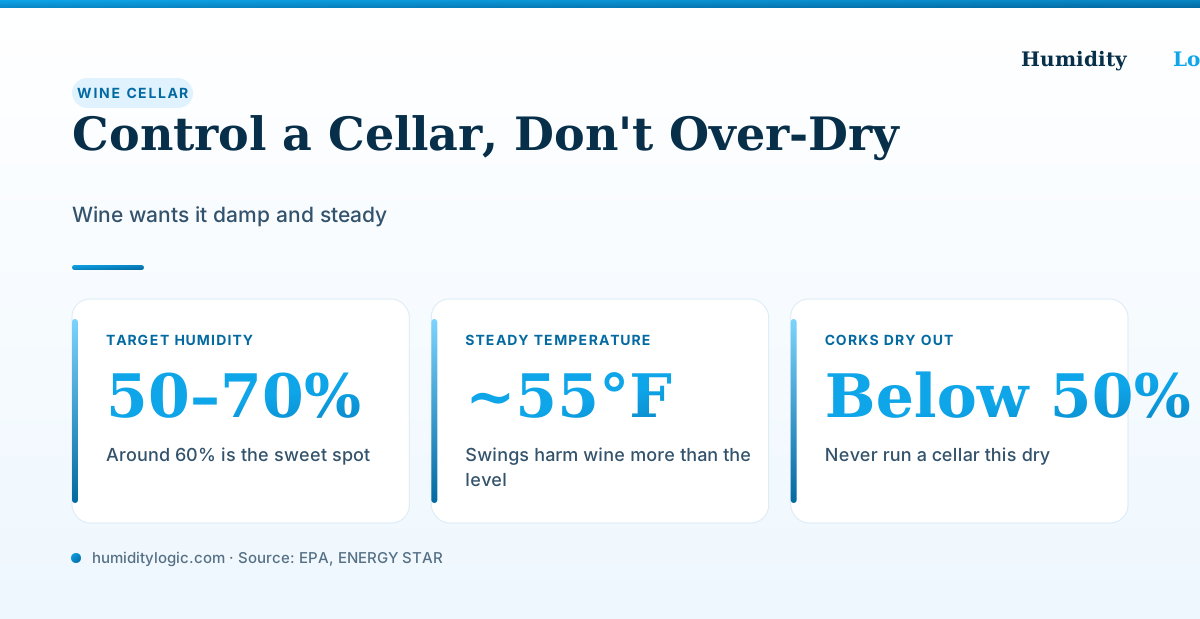
Wine storage asks for conditions most of the house never sees: a cool, steady temperature around 55°F and a relative humidity of roughly 50–70%, with about 60% a common sweet spot (ideal humidity guide). That is deliberately damper than the EPA’s 30–50% home baseline, because the humidity is doing a specific job — keeping the cork moist so it stays sealed. Just as important as the number is steadiness: wine dislikes swings in temperature and humidity far more than a stable reading at the edge of the range.
Why over-drying is the real danger
Most cellar advice assumes you are fighting damp, but in a wine cellar the opposite mistake is worse. Drop the humidity below about 50% and the corks begin to dry out, shrink, and pull away from the glass, letting air seep in and oxidize the wine over months and years. A standard dehumidifier set to a normal home target of 40–50% — or run flat out — will quietly dry a cellar too far. So if you use a dehumidifier in a cellar, set it conservatively and never below about 55–60%. The point is control to a band, not maximum removal.
If your cellar is too humid
A converted basement cellar can run above 70%, where mold starts on labels, corks, and wooden racks. Here a dehumidifier helps — but aim to bring it down into the band, not out of it:
- Set the humidistat to hold around 60%, not lower. ENERGY STAR notes every certified unit has a built-in humidistat for exactly this kind of set-point control (ENERGY STAR — Dehumidifiers).
- Fix any bulk water or seepage first — a dehumidifier cannot out-run a wet wall. The basement playbook in basement humidity applies.
- Improve airflow so damp air does not stagnate against cool bottles and walls, the condensation mechanism the EPA describes (EPA Mold Course, Chapter 2). Above 70%, keep an eye out for mold, since even a wine cellar must respect that moisture grows it (EPA — A Brief Guide to Mold, Moisture and Your Home).
If your cellar is too dry
Actively cooled cellars, especially in winter, often run too dry rather than too damp — the cooling wrings moisture out of the air. Below about 50% you need to add moisture: a humidifier, a simple pan of water, or a dedicated humidity source will bring it back toward 60% and keep the corks sealed. The lesson: measure with a hygrometer before you assume which way your cellar errs. Many people install a dehumidifier when they actually needed a humidifier.
The proper solution: a wine-cellar cooling unit
For a purpose-built cellar, a dedicated wine-cellar cooling system manages temperature and humidity together, holding both in the target band automatically. That is the right tool for a serious collection. A standalone dehumidifier or humidifier is a sensible, lower-cost fix for a converted basement, closet, or spare-room cellar where you only need to nudge one variable — just make sure you are correcting toward 50–70%, not past it.
Measure first, hold the band steady, and correct gently in whichever direction your cellar drifts — and the wine ages the way it should. For other spaces with a specific humidity set-point rather than “as dry as possible,” see the grow tent guide and the full ideal humidity guide.
Frequently asked questions
What humidity should a wine cellar be?
Aim for roughly 50–70% relative humidity, with about 60% a common sweet spot, alongside a steady cool temperature near 55°F. That band keeps corks from drying out while staying low enough to limit mold on labels and racks. Steady is as important as the exact number — wine dislikes swings.
Can a dehumidifier be too much for a wine cellar?
Yes. A standard dehumidifier set low can over-dry a cellar, and below about 50% the corks begin to dry, shrink, and let air into the bottles, which ruins wine over time. The goal in a cellar is control to a target, not maximum drying — so set any dehumidifier conservatively and never run it down to 30–40%.
My wine cellar is too humid and growing mold. What do I do?
A damp basement cellar above about 70% can grow mold on labels, corks, and woodwork. Run a dehumidifier set to hold around 60% — not lower — improve airflow, and fix any bulk water or seepage first. The aim is to bring it down into the 50–70% band, not to dry it out completely.
What if my wine cellar is too dry?
Dry cellars — common with active cooling in winter — need moisture added, not removed. Below roughly 50% you want a humidifier, a pan of water, or a humidity source to bring it back toward 60% so corks stay sealed. Measure with a hygrometer first; do not assume a cellar is damp.
Do I need a special wine-cellar cooling unit?
A dedicated wine-cellar cooling system manages both temperature and humidity together and is the proper solution for a purpose-built cellar. A standalone dehumidifier or humidifier is a reasonable fix for a converted basement or closet cellar where you only need to nudge one variable toward the target.
Sources & references
Every figure on this page is checked against these published sources. Last reviewed November 11, 2026.