Stored belongings often sit untouched for months, which is exactly how long it takes damp to quietly ruin them. Most storage units have no power, so keeping stored items dry is usually a job for desiccants and smart packing, not an appliance — a vapor barrier, sealed bins off the floor, and moisture absorbers that hold the items’’ microclimate under 60%. Where a unit does have power or climate control, a dehumidifier makes it easy.
Why storage units get damp
A standard storage unit, especially a ground-floor concrete one, has two moisture problems. The slab wicks water up out of the ground — the DOE describes this capillary and vapor movement through concrete as a primary moisture path (DOE Building America — Moisture Flow) — and the unit swings with the outdoor weather, so humid air drifts in and condenses on cool items. Cardboard and fabric soak that moisture up and mildew; metal rusts; wood warps. The EPA’s rule is the whole story: mold needs sustained moisture, so controlling it is the way to protect what you store (EPA — A Brief Guide to Mold, Moisture and Your Home).
First decide: do you need climate control?
The cheapest way to keep sensitive items safe is often to rent the right kind of unit. A climate-controlled unit holds temperature and humidity steady, which is worth paying for if you are storing anything that moisture or heat can ruin:
- Wood furniture, which warps and cracks with humidity swings
- Electronics, photos, documents, and artwork
- Leather, fabric, instruments, and anything upholstered
For sealed bins of sturdy, non-sensitive goods on a short stay, a standard unit plus the steps below is usually enough.
No power? Build a dry microclimate
Most standard units have no outlet, so you cannot run a dehumidifier — but you can control the small volume of air around your belongings:
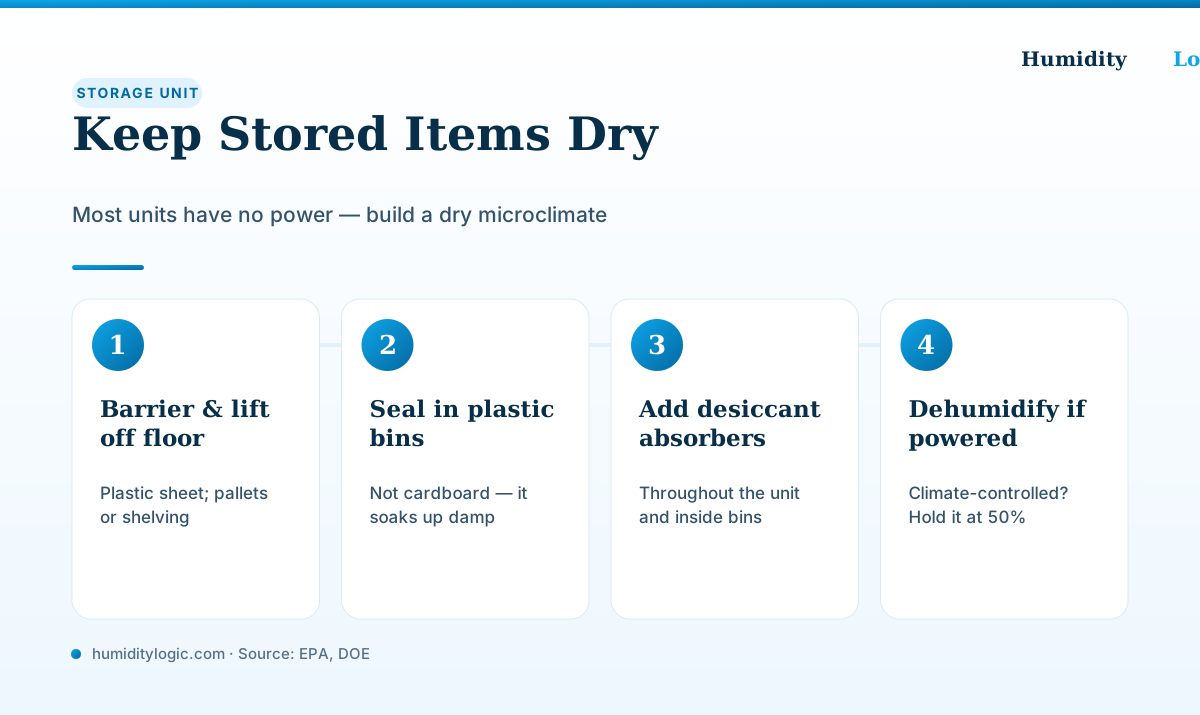
- Lay a vapor barrier (heavy plastic sheeting) over the concrete floor to block moisture wicking up from the slab.
- Lift everything off the floor on pallets, boards, or shelving so air circulates underneath and nothing sits on cold, damp concrete.
- Pack in sealed plastic bins, not cardboard. Cardboard is a moisture sponge and a mold magnet; rigid totes with lids keep damp air off the contents.
- Add desiccant moisture absorbers — rechargeable tubs or disposable calcium-chloride pots — throughout the unit and inside bins of sensitive items. Replace or recharge them on a schedule, and check on the unit periodically.
- Leave small gaps between boxes and away from walls so air is not trapped against cool surfaces where it condenses, the mechanism the EPA describes (EPA Mold Course, Chapter 2).
The goal is simply to hold the items’ microclimate under 60% relative humidity for the whole stay.
When you do have power
Some units — climate-controlled lockers, garage-style drive-up units with an outlet, or a storage room on your own property — let you run a dehumidifier, which is far more reliable than desiccants over a long stay. Treat the space as damp and size by area and dampness, leaning up because a concrete unit with a slab and exterior wall runs humid. Put the numbers into the dehumidifier size calculator, set the humidistat to 50%, and run a hose to a drain so no one has to empty a tank between visits — see continuous drainage. ENERGY STAR notes every certified unit has a humidistat, so it only runs when needed (ENERGY STAR — Dehumidifiers).
Check before you store
Make sure everything goes in dry — a single damp item or box can seed mildew across a sealed unit over months. Dry furniture, clean and fully dry fabrics and upholstery, and never store anything slightly damp. For the general playbook on killing a musty smell if one does start, see how to get rid of a musty smell.
Rent the right unit, build a dry microclimate with a vapor barrier, sealed bins, and desiccants, and power a dehumidifier where you can — and your belongings come out exactly as they went in. For other long-term, often-unpowered spaces, see the boat and gun safe guides.
Frequently asked questions
Can I put a dehumidifier in a storage unit?
Only if the unit has a power outlet, which most standard units do not. Where power is available (or in a climate-controlled unit), a dehumidifier run to a drain holds humidity down. In the far more common no-power unit, you rely on desiccant moisture absorbers, a sealed vapor barrier, and smart packing instead.
Do I need a climate-controlled storage unit?
For anything moisture- or temperature-sensitive — wood furniture, electronics, photos, documents, leather, instruments, artwork — climate control is worth it, because it holds humidity and temperature steady and keeps mold and warping away. For sealed plastic bins of sturdy goods on a short stay, a standard unit with desiccants is often enough.
How do I keep moisture out of a storage unit without power?
Lay a vapor barrier over the floor, keep everything up off the concrete on pallets or shelving, pack in sealed plastic bins instead of cardboard, and place desiccant moisture absorbers throughout. The goal is to keep the stored items' microclimate under 60% relative humidity so mold never starts.
Why do my stored items get damp and moldy?
A storage unit, especially a ground-floor concrete one, wicks moisture up from the slab and swings with the outdoor weather, so humid air condenses on cool items and cardboard. Cardboard and fabric soak it up and mildew; metal rusts. Sealing items, lifting them off the floor, and adding desiccants breaks that cycle.
What size dehumidifier for a storage unit with power?
Treat it as a damp space and size by area and dampness, leaning up because a concrete unit with a slab and an exterior wall runs humid. A small-to-mid unit covers a typical locker; set the humidistat to 50% and drain it continuously so no one has to empty a tank between visits.
Sources & references
Every figure on this page is checked against these published sources. Last reviewed November 9, 2026.