If the kitchen fogs the windows or grows mildew in the corners, the cause is almost always cooking moisture that has nowhere to go. The fastest way to reduce kitchen moisture is to vent cooking steam outdoors and make less of it — run a ducted range hood, keep lids on pots, and manage the dishwasher, the gas stove, and the surfaces where water collects. Here is the full checklist, in roughly the order of impact.
This is the tactical companion to our kitchen humidity control overview, which covers the targets and the why. Below is the hands-on how.
1. Vent the range hood outdoors — and actually use it
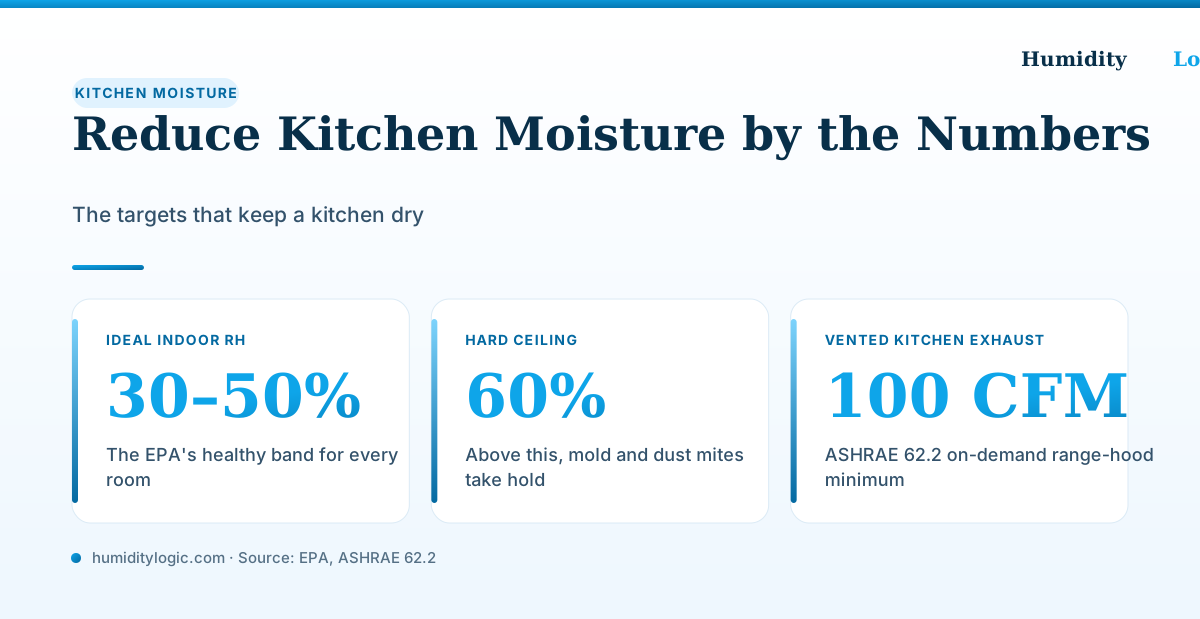
A hood that ducts to the exterior is the single most effective thing in the room. It pulls steam out at the source, which is exactly what the residential ventilation standard ASHRAE 62.2 is built around — a vented kitchen exhaust of about 100 CFM on demand (ASHRAE Standards 62.1 & 62.2). Switch it on when you start and leave it running a few minutes after you finish, the way the EPA advises venting moisture-producing activity to the outdoors.
One trap: many hoods recirculate — they filter air and blow it back into the room, doing nothing for humidity. If yours has no duct outside, it is a grease filter, not a moisture remover.
2. Cover your pots and pans
A lid turns a steam fountain into a trickle. A covered pot releases a fraction of the vapor an open one does and reaches a boil faster, so it is cheaper on energy too. Covering the big offenders — pasta water, stock, anything at a rolling boil — makes an outsized difference.
3. Turn the heat down once it is cooking
A rolling boil that could be a gentle simmer is pure extra steam. Match the burner size to the pot, and drop the heat as soon as the food is up to temperature. You lose nothing on the plate and put far less water in the air.
4. Manage the dishwasher
The hot wash and heated-dry cycles vent warm, moist air into the room — most people never notice because it happens behind a closed door, but the moisture still ends up in the kitchen. Run the vented hood while it is going, or use the “air dry”/heat-free option many models have, which releases far less vapor. Crack the door only after the cycle finishes and the steam has settled.
5. Know that a gas stove adds its own water
Burning natural gas produces water vapor as a combustion byproduct, on top of the steam from whatever you are cooking. The EPA flags unvented gas combustion as a source of both moisture and pollutants indoors (EPA — Combustion Pollutants and Indoor Air Quality). That is one more reason a gas kitchen especially wants a hood that vents outside — it clears the combustion moisture and the combustion gases in one move.
6. Dry the surfaces where water collects
Moisture that lands and sits becomes the next problem. Wipe down counters and the area around the sink, squeegee or towel standing water, and fix a dripping tap or a slow leak under the sink — a constant drip is a constant top-up. The EPA’s guidance is blunt: fix moisture problems and dry wet materials quickly, because mold can start within a day or two of a surface staying wet (EPA — A Brief Guide to Mold, Moisture and Your Home).
7. Keep the kettle and small appliances in check
An electric kettle, a rice cooker with the lid cracked, a slow cooker venting all day — each is a small steam source. Put lids on, and run the hood if several are going at once. None is a crisis alone, but in a small kitchen they lift the baseline.
8. Watch the plants and the trash
A cluster of houseplants on the windowsill adds moisture through transpiration and watering, and a damp or food-filled trash can raises local humidity and feeds that mildew smell. Neither rivals the stove, but in a tight, poorly vented kitchen they add up — empty the bin regularly and do not overwater.
9. Add a dehumidifier only if the room stays damp
If the kitchen still sits above 60% after all of the above — usually because it is open to a damp basement or a humid living space — a dehumidifier closes the gap. Size it for the whole connected area, not just the kitchen, using the dehumidifier size calculator, and set it near 50%.
How to tell it is working
Keep a hygrometer on the counter. A normal kitchen spikes while you cook and then settles back under 60% within the hour; if it stays high, revisit the venting first — that is where the biggest wins are. The condensation mechanism the EPA describes, warm humid air meeting a cold surface (EPA Mold Course, Chapter 2), is also your early-warning system: fog on the windows means the moisture is winning, and it is time to run the fan harder. If the windows are the recurring symptom, see condensation on the inside of windows.
See it in 3D. Explore the kitchen in The Humidity House, our interactive 3D home — click the stove, hood, and sink to see each moisture source in context, and read the kitchen humidity control overview for the targets behind this checklist.
Frequently asked questions
What is the fastest way to reduce kitchen moisture?
Turn on a range hood that vents outdoors and keep lids on your pots. Venting removes steam at the source before it spreads, and covering pots cuts how much steam you make in the first place. Those two together handle the bulk of cooking moisture in most kitchens.
Does boiling water really add that much humidity?
Yes. Boiling and simmering turn liquid water directly into vapor that goes straight into the room air — an uncovered pot can release steam for the entire cook time. A gas burner adds a little more: burning natural gas produces water vapor as a combustion byproduct on top of the steam from the food.
Can houseplants and the trash make a kitchen humid?
A little. A cluster of houseplants adds moisture through transpiration and from watering, and a damp or food-filled trash can raises local humidity and feeds mildew smells. Neither is a major source next to cooking, but in a small or poorly vented kitchen they add to the baseline.
Should I open a window or use the exhaust fan?
Use the vented exhaust fan first — it removes moist air reliably whatever the weather. Open a window only when the outdoor air is drier than the kitchen air; on a humid day, opening up just pulls more moisture in. The fan is the dependable option year-round.
How do I know if my kitchen is too humid?
Put a hygrometer on the counter. If it sits above 60% relative humidity for long stretches, or you see fog on the windows, water on the walls, or mildew in the corners, there is too much moisture. The EPA target is under 60%, ideally 30–50%.
Sources & references
Every figure on this page is checked against these published sources. Last reviewed October 4, 2026.