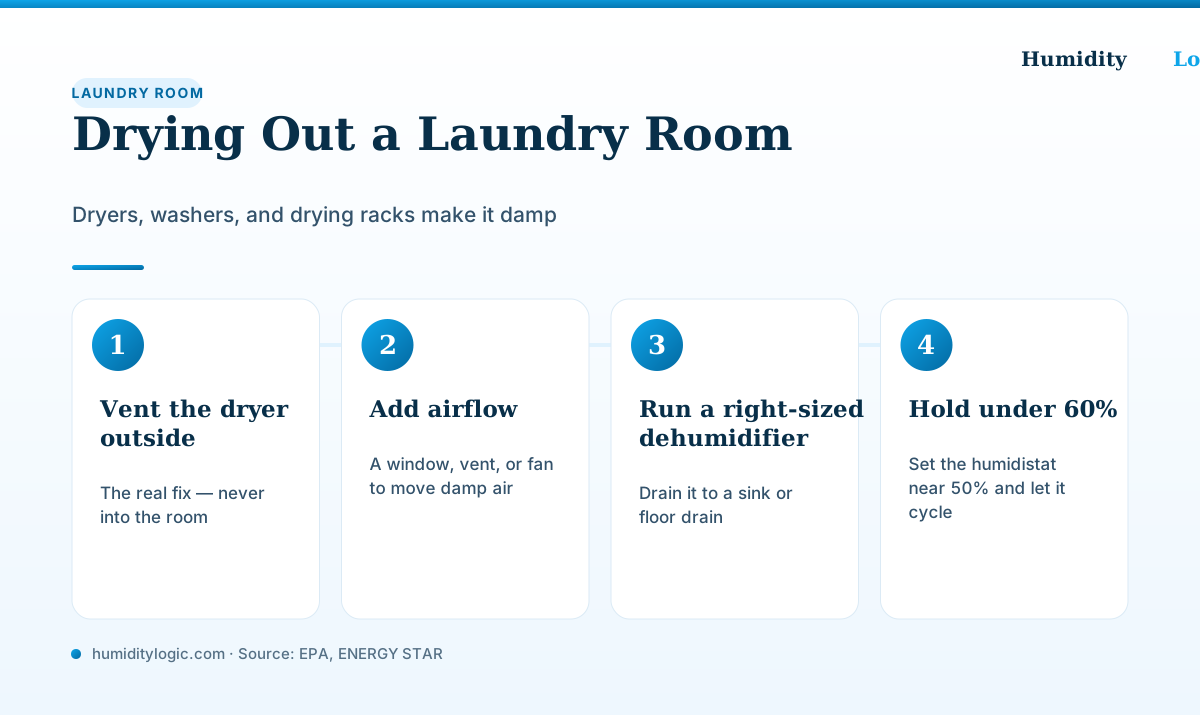
A laundry room packs several of a home’s biggest moisture sources into one small space, so it is one of the first rooms to go damp. A laundry room dehumidifier helps when the room stays above 60% relative humidity or smells musty — but only after the dryer vents outdoors, which is the real fix. Get the venting right first, then size a dehumidifier for the room’s area and dampness to hold it under 60%.
Why laundry rooms get so humid
Three things, often stacked in a room the size of a closet:
- The dryer. A clothes dryer pulls several pounds of water out of every wet load. Ducted outdoors, that water leaves the house; leaking from a loose or damaged duct, it ends up in the room. ENERGY STAR notes that proper exhaust venting is part of running a dryer efficiently and safely (ENERGY STAR — Clothes Dryers).
- The washer. A front-loader’s door gasket and drum hold water between loads, and warm wash water raises local humidity. Leaving the door shut on a damp drum is how that musty washing-machine smell starts.
- Drying clothes on a rack. Air-drying a load indoors releases its water straight into the room — a wet load holds roughly 1.5–2 litres (about 2 quarts) of water that all evaporates into the air. In a laundry room with the door shut, that is a lot of moisture with nowhere to go.
All of it then condenses on the coldest surfaces — the window, the exterior wall, cold water pipes — exactly as the EPA describes, and that film of water feeds mold (EPA — A Brief Guide to Mold, Moisture and Your Home).
Fix the dryer vent before anything else
This is non-negotiable and comes before any dehumidifier. The dryer must exhaust to the outdoors through an intact, well-sealed duct. A vent that is disconnected, crushed, clogged with lint, or terminating in the basement or crawl space is pumping litres of water vapor into the house every load — no dehumidifier can keep up with that. The EPA’s whole-home guidance is to vent moisture-producing appliances like dryers outdoors, not into the living space.
With a gas dryer there is a second reason: venting indoors also releases combustion gases into the room. Always vent a gas dryer outside, and have the duct checked if you are not sure where it ends up. A quick test — go outside while the dryer runs and feel for warm, moist air at the vent hood; if nothing is coming out, the duct is blocked or disconnected.
When a dehumidifier earns its place
Once the dryer vents outside, see where the room settles. If a hygrometer still reads above 60% — common in a basement laundry, a laundry closet with no window, or a room where you regularly hang washing to dry — a dehumidifier closes the gap. It is also the right tool if the room doubles as damp storage, or if you deliberately air-dry clothes indoors and want to speed it up without soaking the room (see using a dehumidifier for drying clothes).
Set its built-in humidistat to around 50% and let it cycle — ENERGY STAR notes every certified unit has one, so it is not running around the clock (ENERGY STAR — Dehumidifiers).
What size dehumidifier for a laundry room?
Do not size by “it’s a small room.” Size by area and how damp it is. ENERGY STAR’s moisture bands run from “damp” (musty smell, roughly 20–30 pints a day for a moderate room) up to “wet” (sweating walls or floor, 30–50 pints a day). A typical dedicated laundry room lands in the damp-to-very-damp range, so a 20–30 pint unit usually covers it; a basement laundry that also stores boxes and sees a cold slab can need 30–50 pints.
Rather than guess, plug the square footage and dampness into our dehumidifier size calculator, which uses the AHAM moisture-condition method. For the reasoning behind the numbers, see what size dehumidifier do I need.
Cold basement laundry? Mind the temperature
Many laundry rooms sit in the basement, and temperature decides which type of dehumidifier works. A standard compressor unit pulls water onto a cold coil, and in a cool room that coil frosts over — below about 50°F these units “spend more and more of their time defrosting themselves rather than dehumidifying” (Meaco). A desiccant unit uses a moisture-absorbing wheel instead and holds its capacity in the cold, which makes it the better choice for an unheated basement laundry. If the room stays warm year-round, a compressor with auto defrost is fine. The full comparison is in our desiccant dehumidifier guide.
Setup and placement
Put the unit central to the room with clear space around its intake and outlet, and run it to a continuous drain — a nearby floor drain, sump, or utility sink — so you are not emptying a bucket after every wash day. Our continuous drainage guide and drain hose setup cover the plumbing. Keep it clear of the dryer’s exhaust path and clean the filter often, since a laundry room is full of lint that clogs filters fast.
Put the pieces together: vent the dryer outside, add airflow, and let a right-sized dehumidifier hold the room under 60%. The washer, the dryer, and the drying rack stop turning your laundry room into the dampest corner of the house.
See it in 3D. The laundry sits in the basement of The Humidity House, our interactive 3D home — click the washer-dryer to see why venting matters. For related rooms, see basement humidity and kitchen humidity control.
Frequently asked questions
Do I need a dehumidifier in the laundry room?
You need one if the room stays above 60% relative humidity or smells musty even after the dryer is vented outdoors — common in a basement laundry or a small, closed closet. If the dryer vents outside and the room has decent airflow, a dehumidifier is optional. The first fix is always the dryer vent, not the dehumidifier.
What size dehumidifier do I need for a laundry room?
Most laundry rooms are small but damp, so a 20–30 pint/day unit covers a typical room, and a 30–50 pint model suits a larger or basement laundry that doubles as storage. Size by floor area and dampness with our calculator rather than by the room being "small" — a wet basement laundry needs real capacity.
Why does the dryer need to vent outside?
A clothes dryer removes several pounds of water from every load, and that moisture has to go somewhere. Vented outdoors, it leaves the house. Vented or leaking indoors, it dumps litres of water vapor (and lint) into the room, which is a guaranteed way to make a laundry room damp — and with a gas dryer, indoor venting also releases combustion gases.
Will a dehumidifier work in a cold basement laundry?
A desiccant dehumidifier will, because it does not rely on a cold coil and holds capacity in cool rooms. A standard compressor unit starts icing up and defrosting instead of drying once the space drops below about 50°F, so choose a desiccant model or a compressor with auto defrost for an unheated basement laundry.
Where should I put a dehumidifier in the laundry room?
Central to the room with clear airflow around the intake and outlet, and ideally draining continuously to a nearby floor drain, sump, or utility sink so you never empty a bucket. Keep it off the path of the dryer exhaust and away from lint sources that can clog the filter.
Sources & references
Every figure on this page is checked against these published sources. Last reviewed October 6, 2026.