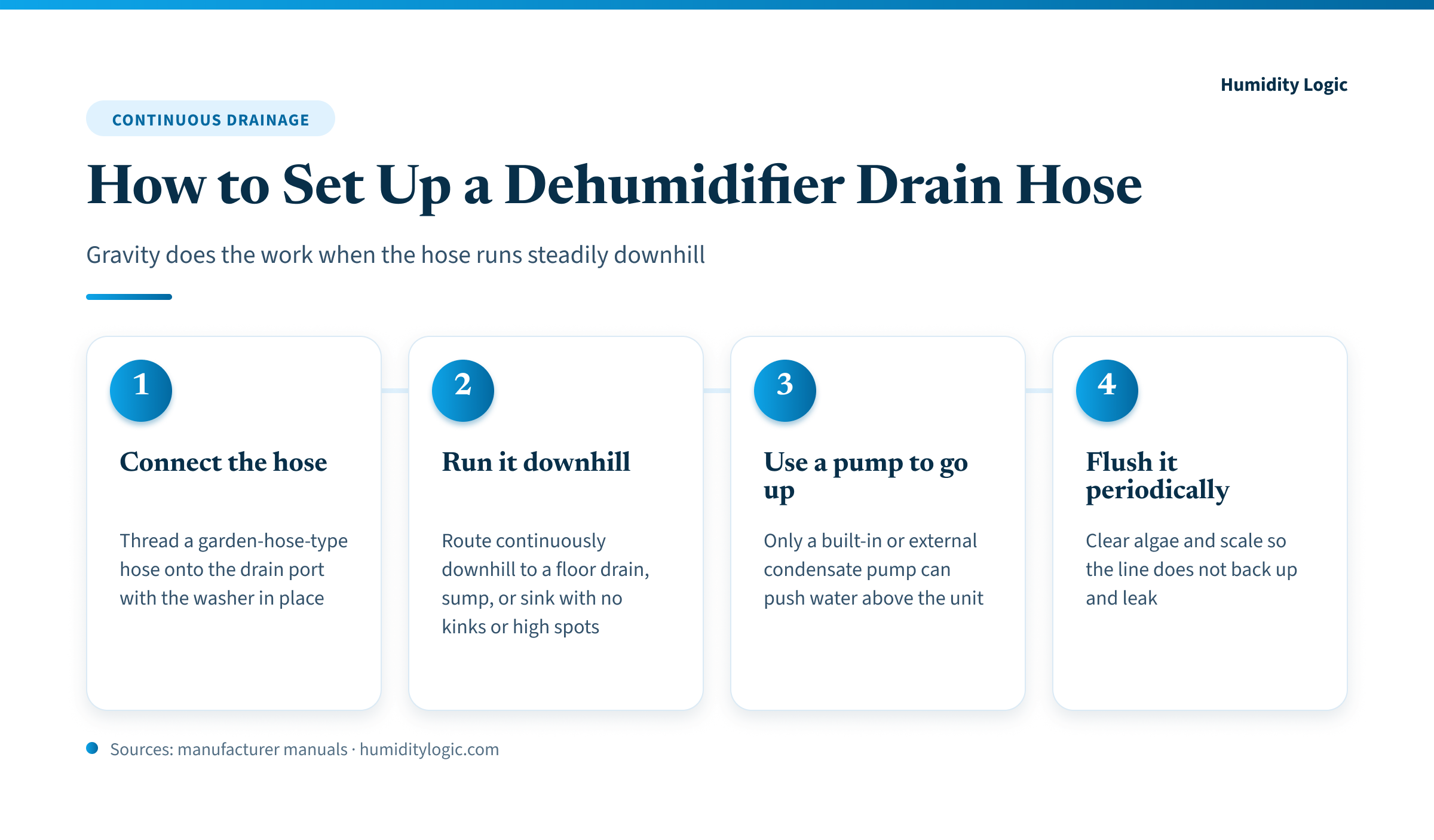
To set up continuous drainage, thread a standard garden-hose-type hose onto the dehumidifier’s drain port with the rubber washer in place, then run that hose continuously downhill to a floor drain, sump pit, or sink – no kinks, no sags, no uphill sections. Gravity does all the work, so there is no motor to fail. Add a condensate pump only when you must send water up, because gravity cannot lift water to a drain that sits above the unit.
How does continuous drainage actually work?
A refrigerant dehumidifier pulls humid air across cold coils, moisture condenses, and that water has to go somewhere. Left alone, it fills the removable bucket and the unit shuts off until you empty it. Continuous drainage swaps the bucket for a hose so the condensate flows away on its own and the machine never stops for a full tank.
The key idea is simple: water only flows downhill. A gravity drain hose has no pump and no electricity – it just gives the water a downhill path to a drain. That makes it the most reliable draining method, with nothing to burn out or wear down, which is exactly why manufacturers and installers favor it whenever a low drain is available. It also pairs naturally with good placement, since where you put the dehumidifier determines whether a downhill drain is even within reach.
Good destinations, in rough order of preference, are a floor drain, a sump pit, or a laundry or utility sink whose drain sits below the unit. A floor drain is ideal because it is almost always the lowest point in the room. A sump pit works well in a basement and simply carries the water out with the rest of the sump discharge. A sink is fine as long as the hose end stays hooked over the rim and below the drain port – never submerge the hose end in standing water, or you invite backflow and odors.
What do I connect the hose to?
Most 30-to-70-pint residential units – Frigidaire, GE, hOmeLabs, Midea, and the rest – put a 3/4-inch female garden hose thread (GHT) drain port on the back or side, usually hidden behind a rubber plug or cap. Pop out the plug and you can thread on a standard garden hose by hand.
A few tips make the joint leak-free:
- Keep the washer. A rubber washer sits inside the coupling and seals the connection. Best Dehumidifier Choice describes the routine plainly: place the washer inside the coupling, then screw the hose fitting onto the dehumidifier.
- Do not overtighten. Hand-tight plus about a quarter turn is enough. The port is plastic, and cranking on it cracks the threads. A few wraps of plumber’s (Teflon) tape on the threads add insurance against seeping.
- Use a large-bore hose. Frigidaire’s support guidance recommends a 1/2-inch-or-larger garden hose or a purpose-made dehumidifier hose, warning that small-diameter hoses clog easily.
If your model has a built-in pump, it will instead have a narrow discharge tube (often 3/8 inch), which is a different setup covered in dehumidifiers with a pump.
How steep does the hose have to slope?
This is where most gravity drains succeed or fail. The hose has to run downhill the entire way from the drain port to the drain. Frigidaire’s own instruction is blunt: make sure the hose is below the connection on the unit, and it should lie flat and as straight as possible with no kinks. Engineer Fix suggests a working target of about 1/4 inch of drop for every 10 feet of horizontal run.
Two practical moves help you hit that slope:
- Raise the unit. Setting the dehumidifier on a sturdy shelf, table, or a couple of cinder blocks gives the water a head start and makes a downhill path easier to achieve across the room.
- Support the hose. Secure the line along its length so it cannot sag between the unit and the drain. Sags create low spots where water collects, and a full low spot forms a trap the gravity flow cannot push past.
Keep the run as short and direct as possible. GE tells owners to cut the hose to the shortest length that reaches the drain and lay it flat on the ground. Standard drain hoses run 6 to 8 feet; extensions to roughly 25 feet work fine as long as the slope stays consistent and there are no uphill sections.
When do I actually need a pump?
Gravity has one hard limit: it cannot move water upward. If the only available drain – a laundry sink, a window well, a standpipe – sits above the dehumidifier’s drain port, no amount of hose routing will get water there. That is the one job a pump exists to do.
You have two options. A dehumidifier with a built-in pump collects condensate internally and, when the reservoir fills, kicks on a small motor that forces water up and out through a narrow tube; typical models lift water about 15 to 16 vertical feet. Or you can add an external condensate pump beside an existing unit: the dehumidifier gravity-drains a few inches down into the pump’s reservoir, and the pump handles the lift. Either way, reach for a pump only when you must send water up – if any downhill drain is available, the plain gravity hose is simpler and more dependable. The full trade-off is laid out in our guide to dehumidifiers with a pump.
What are the most common drain hose mistakes?
Nearly every continuous-drain failure traces back to one of these:
- Uphill runs or high spots. The single most common error. Any section that rises, even briefly, traps water and stalls the flow – and trapped water can form a siphon the gravity system cannot overcome, so it backs up into the bucket instead.
- Kinks and sags. A pinched or drooping hose does the same thing as an uphill run. Use a no-kink or flexible-PVC hose and support it so it stays straight.
- Algae and scale clogs. Standing condensate grows sludge and algae, and hard water leaves mineral scale, both of which narrow the line. Frigidaire and other makers advise flushing the hose with clean water every couple of months to keep it clear – a routine that fits naturally into general dehumidifier maintenance.
- A loose or washer-less joint. Skip the washer or under-tighten the coupling and the connection weeps. If you spot puddles at the unit, this is a prime suspect – see why a dehumidifier leaks water.
- Assuming no water means it is working. If the reservoir stops filling entirely, the problem may be upstream of the hose; our guide to a dehumidifier not collecting water covers those causes.
Leaving the collection bucket seated is worth repeating: GE notes the bucket should stay in place even during continuous draining, so it catches overflow if the line ever clogs.
Is my space even a candidate for gravity draining?
Before you buy a hose, confirm two things: that a drain sits at or below the unit’s port, and that the dehumidifier is sized for the space so it is not running nonstop and producing more condensate than a marginal drain path can handle. If you are not sure the unit matches the room, run the numbers with our dehumidifier size calculator first. A correctly sized unit draining downhill to a nearby floor drain is the quietest, most maintenance-free humidity setup there is – set it, flush the line a few times a year, and forget it.
Frequently asked questions
What size hose does a dehumidifier drain port use?
Most 30-to-70-pint residential dehumidifiers have a 3/4-inch female garden hose thread (GHT) drain port, so a standard garden hose threads right on. Frigidaire recommends a 1/2-inch-or-larger-diameter hose because small-bore lines clog easily. Keep the rubber washer inside the coupling to seal the joint, and hand-tighten only about a quarter turn past snug so you do not crack the plastic port.
Does the drain hose have to run downhill the whole way?
Yes. Gravity draining only works if every inch of the hose sits lower than the drain port, with no uphill sections and no sagging low spots. A common target is at least 1/4 inch of drop per 10 feet of run. If the hose rises anywhere along its path, water pools, backs up, and eventually trips the full-bucket sensor or leaks at the connection.
Can I drain a dehumidifier without a floor drain?
Sometimes. If a sink, sump pit, or lower level sits below the unit, run the gravity hose there. If the only drain is above the unit -- common in a finished basement -- gravity cannot lift water, so you need a built-in or external condensate pump to push it up and out.
Why is my dehumidifier draining slowly or backing up?
The usual causes are an uphill section or sag in the hose, a kink, or a clog. Sludge, algae, and mineral scale build up inside the line over time and restrict flow. Detach the hose, flush it with clean water (a little vinegar helps with scale), confirm the whole run slopes downhill, and check that the washer is seated so the joint does not weep.
Do I still need the bucket if I use a drain hose?
On many units, yes. GE, for example, notes the collection bucket must stay in place even when you drain continuously, because it catches overflow if the hose ever backs up. Leaving the bucket seated is cheap insurance against a clogged or kinked line quietly flooding the floor.
Sources & references
Every figure on this page is checked against these published sources. Last reviewed August 1, 2026.