A dehumidifier with a pump pushes collected water up and out — to a utility sink, a ground-level window, or a sump pit — instead of relying on gravity or a bucket you empty by hand. You need one when no drain sits below the unit, as in most basements and crawl spaces. Typical built-in pumps lift water about 15 feet vertically.
What does the pump in a dehumidifier actually do?
The pump solves exactly one problem: water flows downhill, and your drain usually isn’t downhill.
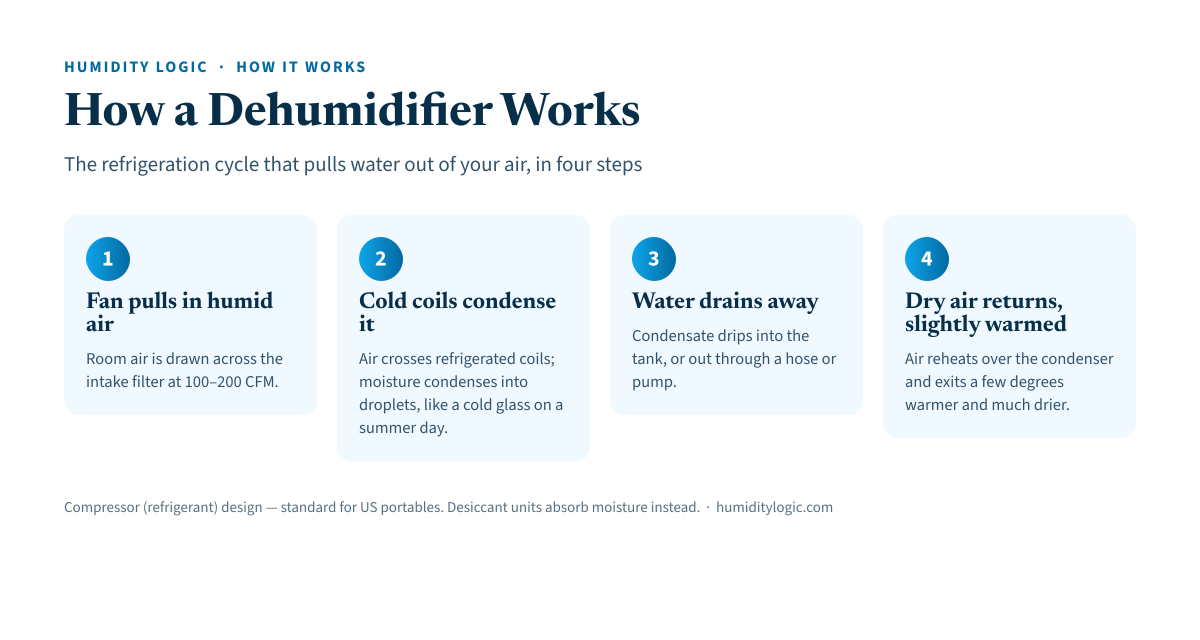
Every refrigerant dehumidifier makes water the same way — a fan pulls humid air across cold coils, moisture condenses, and the condensate has to go somewhere. (The full cycle is covered in how a dehumidifier works.) In a pump model, that condensate collects in a small internal reservoir instead of the removable bucket. When the reservoir fills, a float switch trips and a small electric pump kicks on for a few seconds, forcing the water out through a narrow discharge tube — typically a 3/8-inch line, not a garden hose. Then it shuts off and waits for the next fill.
That’s the whole trick. The pump doesn’t dry air faster, doesn’t add capacity, and doesn’t change the machine’s pint rating. It changes where the water can go: sideways across a room, up over a foundation wall, out a basement window, or into a laundry sink four feet off the floor.
When do you need a pump — and when is it overkill?
The honest answer: most people who buy pump models don’t need the pump, and many who skip it end up hauling a bucket up the stairs twice a day.
Work through the three questions in order:
1. Is there a drain at or below the level of the dehumidifier? A floor drain, a sump pit, a shower stall on the same slab. If yes, gravity does the work for free — go to option two below.
2. Is the only drain higher than the unit? A utility sink, a window to the outside, a standpipe. The moment the water has to travel up, gravity is useless and you need a pump — built-in or external.
3. Will anyone be around to empty a bucket? In a lived-in bedroom, a bucket is a minor chore. In a vacation home, a rental, or a basement nobody visits, a full bucket silently shuts the machine off — dehumidifiers stop running when the tank is full — and humidity climbs right back while you’re away. Unattended spaces need continuous drainage of some kind, full stop.
Here’s how the four drainage setups compare:
| Setup | Cost | Where water can go | Fails when… | Best for |
|---|---|---|---|---|
| Bucket | Free (included) | Wherever you carry it | You forget to empty it — unit shuts off | Occasional use in occupied rooms |
| Gravity hose | ~$10 (garden hose) | Downhill only, no low spots | Hose kinks, sags, or clogs | Basements with a floor drain or sump pit |
| Built-in pump | +$30–$60 on the unit price | Up ~15–16 ft and out | Tube clogs with scale/biofilm; pump wears | Basements and crawl spaces with no low drain |
| External condensate pump | $40–$70 add-on | Up 15–20+ ft, model-dependent | Same clog risks; extra connection to check | Adding lift to a dehumidifier you already own |
If you’re setting up a basement unit from scratch, the basement dehumidifier guide walks through placement and drainage together — and it’s worth sizing the unit before you decide anything about drainage, since an undersized machine fails you no matter how the water leaves.
How far can a built-in pump push water?
About 15 to 16 vertical feet — and that number is smaller than it sounds once real plumbing gets involved.
GE rates its pump-equipped dehumidifiers at 16 vertical feet and specifically warns against using tubing longer than the 16-foot hose supplied with the unit. Most residential brands land in the same 15–16 foot range. That’s comfortably enough to lift water from a basement floor to a first-floor sink or out a ground-level window, which is what the spec was designed for.
Two things quietly erode that rating:
- Horizontal distance counts against you. Friction in a long flat run reduces the effective lift. A pump rated for 16 feet of pure vertical rise will not push water 10 feet up and then 30 feet across. Keep the total run short and the vertical portion early in the run.
- The rating assumes a clean tube. Mineral scale and biofilm narrow the discharge line over months of use, and a half-blocked 3/8-inch tube loses head pressure fast. A pump that “used to reach the sink” usually has a dirty tube, not a dying motor.
Route the hose with a continuous rise to its highest point, then downhill or level to the termination — never up, over, down, and back up. Every extra high point is a place for an air lock.
What about gravity drain — the free option?
If your drain is below the unit, a gravity hose beats a pump on every axis: it’s nearly free, silent, and has no moving parts to fail.
Almost every dehumidifier — pump or not — has a continuous-drain port threaded for a standard 3/4-inch garden hose. Screw a hose on, bypass the bucket, and condensate trickles out passively as it forms. The requirements are strict but simple:
- The entire hose run must slope downhill. Water will not travel through a section that rises, even slightly.
- No kinks, no loops, no low bellies where water pools and stagnates.
- Keep the hose short. Manufacturers (GE among them) recommend cutting it to the minimum length that reaches the drain, laid flat on the floor.
- Don’t jam the hose end tight into a standpipe or drain — leave an air gap so a backed-up drain can’t siphon into the machine.
Elevating the dehumidifier on a sturdy platform or cinder blocks buys you slope if the floor is dead level. If water is ending up on the floor instead of in the drain, the hose run is the first suspect — see why a dehumidifier leaks water for the diagnostic order.
How do dehumidifier pumps fail?
Pumps are the wear item on an otherwise long-lived appliance — and they almost never fail the way people expect.
The dramatic failure (burned-out pump motor) is rare. The common failures are mundane:
- Clogged discharge tube. The number-one issue. Condensate carries dissolved minerals and feeds biofilm; the narrow tube scales shut over a season or two. Flushing the tube with warm water and diluted vinegar every few months prevents most of it.
- Stuck float switch. Debris or slime keeps the float from rising, so the pump never triggers — the reservoir overfills and the unit shuts down or overflows.
- Airlocked or over-lifted hose. A run routed above the rated lift, or with multiple high points, leaves the pump running against a column of water it can’t move.
- Freeze damage. A discharge line routed outdoors through an unheated wall can freeze in winter, blocking flow and stressing the pump.
Worth knowing: on nearly every model, a failed pump doesn’t kill the machine. Switch to bucket mode or a gravity hose and the dehumidifier keeps working — or pair it with an external condensate pump and restore the lift for well under a hundred dollars.
The bottom line
Buy the pump when the water has to go up; skip it when the water can go down. A basement with a floor drain wants a $10 gravity hose. A basement without one — or any space you won’t visit weekly — wants a pump, built-in or external, with the hose run kept short, mostly vertical, and flushed a couple of times a year. Get the drainage decision right once and the machine disappears into the background, which is exactly where a dehumidifier belongs.
Frequently asked questions
How high can a dehumidifier pump push water?
Most built-in condensate pumps lift water about 15 to 16 vertical feet — GE, for example, rates its pump models at 16 feet with the supplied hose. That is enough to reach a basement utility sink or ground-level window from the floor. Long horizontal runs eat into that rating, so keep the hose as short and direct as possible.
Do I need a pump if I have a floor drain?
No. If a floor drain, sump pit, or sink drain sits level with or below the dehumidifier, a plain gravity hose does the same job with nothing to break. Connect a standard garden hose to the continuous-drain port, run it downhill with no kinks or low spots, and skip the pump entirely.
Can I add a pump to a dehumidifier that does not have one?
Yes. An external condensate pump (roughly $40–$70) sits beside the unit; the dehumidifier gravity-drains a few inches down into the pump reservoir, and the pump pushes water up and out through its own tubing. It is the standard fix for an existing unit in a space with no low drain, and it is replaceable independently of the dehumidifier.
Why is my dehumidifier pump not pumping water out?
The usual culprits are a clogged discharge tube (mineral scale or biofilm buildup), a kinked or too-long hose, a stuck float switch, or a hose end mounted higher than the pump can lift. Detach the tube, flush it with warm water and a little vinegar, confirm the run is under the rated lift, and test again before assuming the pump motor has failed.
Does a dehumidifier with a pump use more electricity?
Barely. The pump is a small motor that runs only for a few seconds when the internal reservoir fills, so its energy use is trivial next to the compressor. The real operating-cost decision is sizing the unit correctly, not the pump.
Sources & references
Every figure on this page is checked against these published sources. Last reviewed July 21, 2026.