A dehumidifier works in four steps: a fan pulls humid room air into the unit; the air crosses cold evaporator coils, where water vapor condenses into liquid; that condensate drips into a tank or drain hose; and the now-dry air passes over warm condenser coils before returning to the room slightly warmer than it came in.
That’s the whole trick — the same refrigeration cycle that runs your fridge and air conditioner, rearranged so the “cold side” and “hot side” sit in the same airstream. Everything else on the spec sheet follows from that one idea, so let’s walk through it slowly.
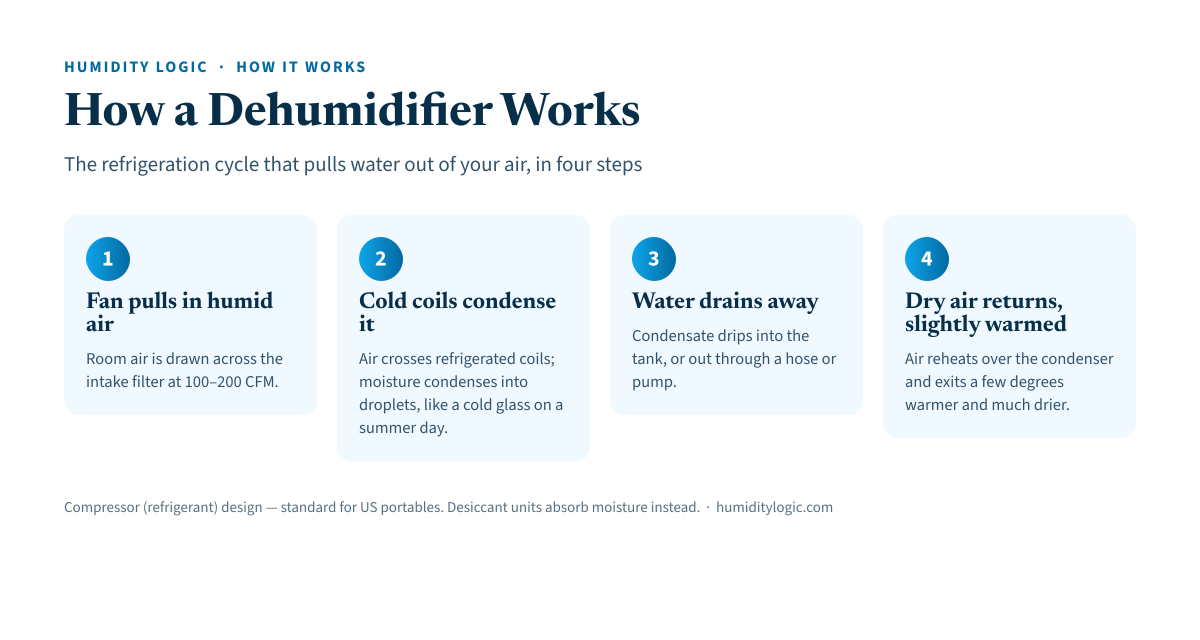
What happens inside a dehumidifier, step by step?
A dehumidifier is a cold glass of iced tea with a fan behind it. On a muggy day, water beads up on the outside of the glass because the glass surface is colder than the air’s dew point — the temperature at which air can no longer hold all of its water vapor. A dehumidifier manufactures that cold surface on purpose, then forces air across it all day long.
Here is the full loop:
- Intake. A fan draws humid room air through a filter and into the cabinet. The filter isn’t there to purify your air — it just keeps dust off the coils so they stay efficient.
- Condensation. The air passes over the evaporator coils, which the refrigeration system holds well below the air’s dew point. Water vapor gives up its heat, changes phase, and beads onto the metal exactly like the iced-tea glass.
- Collection. Gravity does the rest. Condensate runs down the coils into a removable tank, or out through a gravity drain hose (or condensate pump) if you’ve set one up. A float switch shuts the unit off before the tank overflows.
- Reheat and return. The cold, dried air then flows across the condenser coils — the hot side of the same refrigeration circuit — and exits the unit a few degrees warmer and noticeably drier than it entered.
Driving that loop is a compressor, which squeezes refrigerant vapor into a hot, high-pressure gas. That gas dumps its heat at the condenser coils, condenses into a liquid, then sprays through an expansion device into the evaporator coils, where the sudden pressure drop makes it flash-boil and turn frigid. The refrigerant loops around continuously; the water only moves one way — out of your air.
A humidistat supervises the whole operation. Set it to a target relative humidity — 45–50% is a comfortable, mold-hostile range for most homes — and the unit cycles the compressor on and off to hold that line rather than drying the air endlessly.
Why does the air come out warm?
Because a dehumidifier has nowhere to send heat except back at you. An air conditioner cools your room only because its condenser sits outside, dumping heat into the yard. A portable dehumidifier is that same machine folded into one box: the heat removed at the cold coil, the heat released when water vapor condenses, and the waste heat from the compressor and fan motor all exit into the room.
The result is exhaust air that’s warmer than what went in, and a room that trends a little warmer overall. In a damp basement in spring, that’s a feature. In a hot attic apartment in August, it’s worth knowing before you buy — a dehumidifier makes air feel more comfortable by drying it, not by cooling it.
Why does it stop working in a cold room?
Cold rooms starve the machine of its raw material. The physics cuts against you twice:
- Cold air holds less water. At 50°F, air at 60% RH contains far less actual water vapor than 80°F air at the same reading. Less vapor available means fewer pints condensed per day, no matter what the box promised.
- The coils frost over. The evaporator must run colder than the air’s dew point, and in a chilly room that pushes coil temperature below freezing. Condensate turns to frost, frost blocks airflow, and removal drops toward zero while the unit keeps burning electricity.
In practice, compressor dehumidifier capacity collapses below roughly 65°F, and most units include a defrost cycle that pauses dehumidifying to melt the coils. Many stop operating altogether near 41°F. If your basement unit runs constantly but the tank stays empty, frost is the first suspect — see our guide to why a dehumidifier freezes up before assuming it’s dead.
For genuinely cold spaces — an unheated garage, a crawl space in winter — the answer isn’t a bigger compressor unit. It’s a different technology.
How is a desiccant dehumidifier different?
A desiccant dehumidifier skips refrigeration entirely. Instead of condensing water on a cold surface, it soaks water up with a slowly rotating wheel coated in a moisture-adsorbing material (typically zeolite — chemically similar to the silica gel packets in shoe boxes). Room air passes through one section of the wheel and leaves its moisture behind. Meanwhile, a heater warms a separate airstream that passes through another section of the wheel, baking the captured moisture back out; that warm, wet air is condensed and drained, and the regenerated section rotates back into service.
No compressor, no refrigerant, no cold coil — so there’s nothing to frost over.
| Compressor (refrigerant) | Desiccant | |
|---|---|---|
| Removes water by | Condensation on cold coils | Adsorption onto a rotating wheel |
| Best operating range | Above ~65°F | Effective down to ~33°F |
| Cold-room behavior | Capacity collapses; many stop near 41°F | Capacity holds steady |
| Heat added to room | A few degrees | Noticeable — typically 10–15°F warmer exhaust |
| Noise character | Compressor hum plus fan | Fan only; usually quieter |
| Typical home use | Basements, living areas, whole-home | Garages, crawl spaces, boats, cold climates |
The rule of thumb: warm and damp favors compressor; cold and damp favors desiccant. The desiccant’s heater output — that 10–15°F of added warmth — is a bonus in an unheated space and a liability in a warm one, and it generally costs more per pint in electricity. For the full breakdown, see our compressor vs. desiccant comparison.
What do the numbers on the box actually mean?
The pint rating is the number everyone reads and almost no one reads correctly. A “50-pint” dehumidifier does not remove 50 pints from your basement every day. It removed 50 pints per 24 hours in a laboratory test — under the current U.S. Department of Energy procedure (based on AHAM DH-1-2019), that test runs at 65°F and 60% relative humidity. Your room’s conditions will differ, and so will your results.
There’s a historical wrinkle, too. Before the 2019 standard, units were tested in warmer air (80°F/60% RH), which holds much more water. The same physical machine therefore carried a rating roughly 30% higher under the old test — yesterday’s “70-pint” unit and today’s “50-pint” unit are close cousins. If you’re comparing a new model against a listing or review from before 2019, mentally deflate the older number before you conclude the new one is weaker.
The other numbers worth decoding:
- Tank size (often 1–2 gallons) is not capacity. A 50-pint unit with a 1.8-gallon bucket can fill it multiple times a day in a damp space, which is why continuous drainage via hose matters more than bucket volume.
- Wattage tells you the operating cost. A typical 50-pint unit draws about 550W while the compressor runs — roughly a window air conditioner’s appetite. At the U.S. average electricity rate, that’s in the neighborhood of $2 per day if it ran nonstop, though a properly sized unit cycles off once it hits your setpoint. Plug your rate and runtime into our electricity cost calculator for a real number.
- Integrated Energy Factor (IEF) measures liters of water removed per kilowatt-hour — the efficiency stat that actually matters. Higher is better, and ENERGY STAR–certified models use about 20% less energy than conventional units for the same water removed.
Matching the pint rating to your square footage and dampness level is its own decision — our guide to what size dehumidifier you need walks through it room by room.
What are the most common misconceptions?
“It cools the room.” It doesn’t — it warms it slightly, as covered above. Dry air feels cooler because your sweat evaporates more readily, which is why a dehumidified 78°F room beats a swampy 75°F one. But the thermometer moves up, not down.
“It purifies the air.” The filter protects the coils from dust; it is not a HEPA filter and does not meaningfully remove allergens, smoke, or VOCs. A dehumidifier fights allergens indirectly — by holding humidity below the ~60% threshold where dust mites and mold flourish — not by scrubbing particles.
“Bigger is always better.” An oversized unit short-cycles: it slams the humidity down, shuts off, and lets it rebound, wearing the compressor with frequent starts. A right-sized unit runs longer, steadier cycles and holds humidity more evenly.
“It should fill the tank every day.” In a well-controlled space, collection should taper off. A dehumidifier’s job is to remove the moisture that infiltrates; once the room is at setpoint, it only needs to keep pace. A tank that fills relentlessly for weeks signals a moisture source — a foundation leak, an unvented dryer, a crawl-space problem — that no appliance can out-pump forever.
“Set it as low as it goes.” Chasing 30% RH costs real electricity for no comfort gain and can over-dry wood floors and furniture. Hold 45–50% and let the humidistat do its job.
The bottom line
A dehumidifier is refrigeration pointed at water vapor instead of at you: fan in, condense on the cold coil, drain the water, reheat and return. Understand that loop and every spec-sheet number and quirky behavior — the warm exhaust, the winter frost, the tank that won’t fill — stops being mysterious and starts being predictable.
Frequently asked questions
Does a dehumidifier cool the room like an air conditioner?
No — it actually warms the room slightly. Both the heat pulled out of the air at the cold coil and the heat generated by the compressor and fan are released back into the room. Expect the exhaust air to be several degrees warmer than the intake air.
Can I drink the water a dehumidifier collects?
No. The condensate forms on coils that are never cleaned to drinking-water standards, and the open tank can harbor bacteria and mold spores. It is fine for watering non-edible plants or flushing, but not for drinking or cooking.
Should a dehumidifier run all the time?
Ideally no. A correctly sized unit pulls the room down to your target humidity, then cycles off until the humidistat detects moisture creeping back up. A unit that runs 24/7 and never reaches its setpoint is either undersized for the space or fighting an unresolved moisture source.
Why does my 50-pint dehumidifier collect far less than 50 pints a day?
The 50-pint rating comes from a standardized test at 65°F and 60% relative humidity. In a drier or cooler room, there is simply less water vapor available to condense, so daily collection drops. Removing less than the rated maximum in normal conditions is expected behavior, not a defect.
What humidity level should I set my dehumidifier to?
Aim for 30–50% relative humidity, with 45–50% as a comfortable target for most homes. Below 30% the air gets uncomfortably dry, and above 60% you are back in the range where mold and dust mites thrive.
Sources & references
Every figure on this page is checked against these published sources. Last reviewed July 21, 2026.