Buy a compressor dehumidifier for any space that stays warm, and a desiccant dehumidifier for any space that gets cold. The 65°F rule: above 65°F, a compressor unit removes more water per watt; below 65°F, a desiccant unit wins because it never relies on cold coils that ice over. Basements, garages, and bedrooms each land on a different side of that line.
How Does a Compressor Dehumidifier Work?
A compressor dehumidifier is a small refrigeration circuit pointed at your air. A fan pulls humid room air across cold evaporator coils, the air drops below its dew point, and moisture condenses onto the coils and drips into a tank or drain hose. The now-dry air passes back over the warm condenser coils and returns to the room a couple of degrees warmer than it entered. If you want the longer version of that refrigeration loop, our guide to how a dehumidifier works walks through each component.
This design has one structural dependency: the coils must be meaningfully colder than the room air. In a 75°F basement, that is easy, and a compressor unit will pull 20–50 pints per day with excellent efficiency. In a 50°F garage, the coils have to run near or below freezing to condense anything, frost builds up, and the machine starts spending much of its runtime melting its own coils instead of drying your air. That failure mode is common enough that we wrote a separate guide to a dehumidifier freezing up.
How Does a Desiccant Dehumidifier Work?
A desiccant dehumidifier has no compressor, no refrigerant, and no cold coils. Instead, it uses a slowly rotating honeycomb wheel — the rotor — coated with an adsorbent material, typically zeolite or silica gel. As room air is drawn through the rotor, water molecules bind to the surface of the desiccant and the air leaves the machine dry.
The rotor then turns through a second, smaller air path called the regeneration sector. There, an internal heating element blows hot air through the saturated section of the wheel, driving the captured moisture off the desiccant. That moist, hot air is cooled, the water condenses into the tank, and the refreshed section of the rotor rotates back into the incoming airstream. The cycle is continuous: adsorb, regenerate, repeat.
Because the process is chemical adsorption rather than condensation on a cold surface, extraction barely changes as the room gets colder. A desiccant unit pulls close to its rated capacity at 40°F, a temperature where a basic compressor unit without auto-defrost has effectively stopped working — though many modern compressor models add automatic defrost and keep going down to around 41°F. The regeneration heater also means the exhaust air comes out noticeably warm — typically 10–15°F above room temperature.
What Is the 65°F Rule?
If you remember one number from this comparison, make it 65°F. That is the practical crossover point where the two technologies trade places.
Above 65°F, physics favors the compressor. Warm air holds more moisture, the coils condense water easily, and the machine extracts more pints per kilowatt-hour than any desiccant can, because the desiccant is always paying the energy cost of its regeneration heater. Below 65°F, the compressor’s advantage erodes and then collapses: extraction rates fall, frost forms, and defrost cycles eat runtime. The desiccant, meanwhile, keeps removing moisture at a nearly flat rate all the way down to around 33°F.
The rule of thumb is about the temperature of the space when the unit is running — not the season, and not the rest of the house. A finished basement that sits at 68°F year-round is a compressor space even in a cold climate. A detached garage that swings between 35°F and 60°F from October to April is desiccant territory even in a mild one.
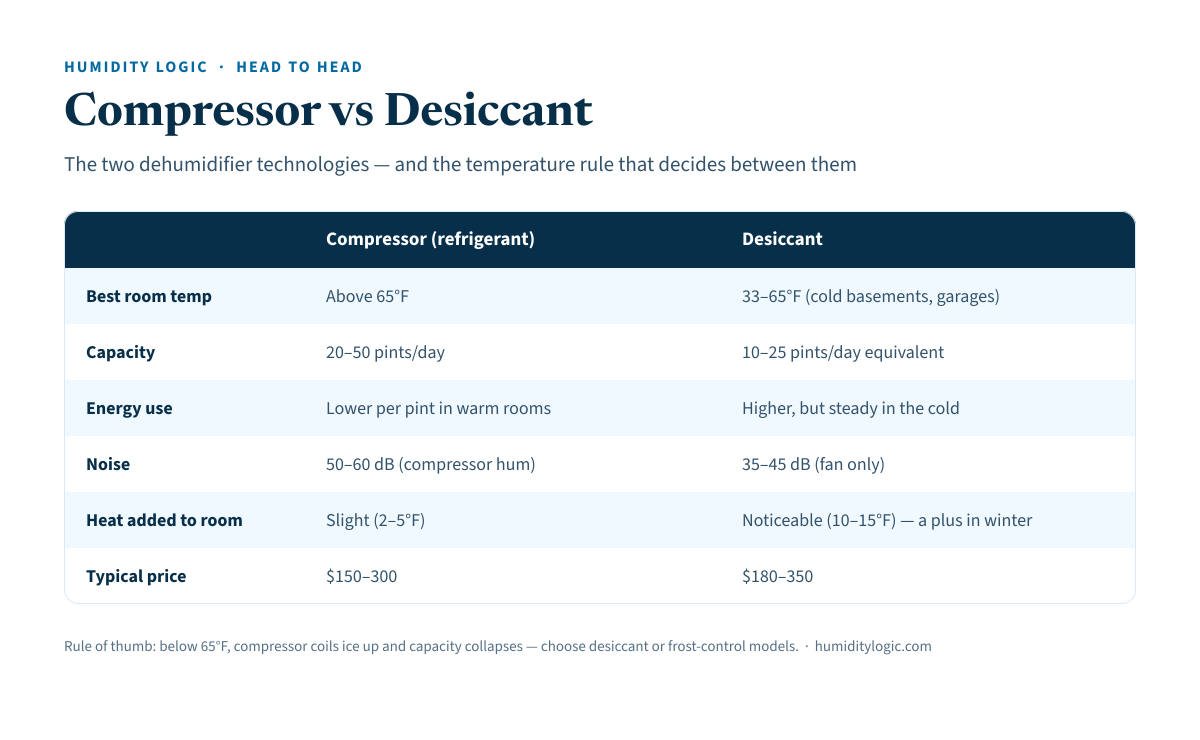
Compressor vs Desiccant: How Do the Numbers Compare?
| Compressor | Desiccant | |
|---|---|---|
| Best temperature range | Above 65°F | 33–65°F |
| Typical capacity | 20–50 pints/day | 10–25 pints/day equivalent |
| Energy use | Lower per pint in warm air | Steady in cold air |
| Noise | 50–60 dB | 35–45 dB |
| Heat added to room | 2–5°F | 10–15°F |
| Typical price | $150–300 | $180–350 |
Two clarifications keep this table honest. First, capacity ratings are not directly comparable: compressor units are rated at warm, humid test conditions they may never see in your actual space, while desiccant output stays close to its rating across its whole range. A 20-pint desiccant in a 50°F crawl space can out-collect a 35-pint compressor sitting beside it. Second, “energy use” depends entirely on temperature — which is why the decision framework below starts with the thermometer, not the spec sheet.
Which One Uses Less Energy?
In a warm room, the compressor — and it is not close. A mid-size compressor unit typically draws 300–700 watts and converts that into a lot of water when the air is 70°F and humid. A desiccant unit draws a steady 300–600 watts regardless of conditions because the regeneration heater is always on, so in warm air you pay heater-level wattage for less extraction.
In a cold room, the ledger flips. The compressor’s watts increasingly go to defrost cycles rather than dehumidification, so its cost per pint climbs sharply, while the desiccant’s stays flat. The desiccant’s 10–15°F of added heat is also not pure waste in a cold space — it is warmth you would otherwise be paying your furnace to provide, and it nudges the space further from the condensation conditions that caused your moisture problem in the first place.
Which One Is Quieter?
The desiccant, consistently. With no compressor motor, its only moving parts are a fan and a slow rotor, which puts most models in the 35–45 dB range — between a whisper and a quiet library. Compressor units run 50–60 dB, roughly the level of a window AC or a conversation, with a low mechanical hum that some people tune out and light sleepers do not. If the unit will run overnight in or near a bedroom, that 15 dB gap is the difference between forgetting the machine exists and hearing it cycle at 3 a.m.
Which Should You Buy for Your Space?
Basement that stays above 65°F: compressor. This is the highest-volume dehumidifier use case in the US, and it is exactly what compressor units are built for — big capacity, low cost per pint, and the noise stays behind a closed basement door. Size it with our dehumidifier size calculator rather than guessing; oversizing wastes money and undersizing runs the unit ragged.
Unheated garage, crawl space, or workshop: desiccant. Anywhere that drops below 65°F for weeks at a time, the desiccant is the only type that will actually do its job in January, and its added heat helps protect tools and stored items from condensation. Our garage dehumidifier guide covers placement and drainage for these spaces.
Bedroom or office where noise matters: desiccant. At 35–45 dB it is quiet enough to sleep next to. In a warm climate, weigh the 10–15°F of added heat; running it in the evening before bed is a common compromise.
Whole-home or large open area above 65°F: compressor. Capacity is the constraint here, and 20–50 pints per day at a lower running cost beats what any portable desiccant can deliver.
Space that swings across the line seasonally: match the problem season. If moisture peaks in a humid 75°F summer, buy a compressor. If it peaks with winter condensation in a 45°F space, buy a desiccant.
The Bottom Line
Neither technology is better — they are tuned for different air. Check the temperature of the space during the months you actually have a moisture problem, apply the 65°F rule, and let capacity, noise, and price break any remaining tie. Warm and wet: compressor. Cold and damp: desiccant.
Frequently asked questions
Can I use a desiccant dehumidifier in a warm room?
Yes, it will still pull moisture, but it costs more to run than a compressor unit in warm air and it adds 10–15°F of heat to the room. Above 65°F, a compressor model removes more water for less electricity, so a desiccant only makes sense in warm rooms when noise matters more than efficiency.
Why does a desiccant dehumidifier blow warm air?
A desiccant unit uses an internal heater to bake moisture back out of its zeolite or silica gel rotor, and some of that heat leaves with the exhaust air. The outlet air runs roughly 10–15°F warmer than the room, which is a bonus in a cold garage in January and a drawback in a warm bedroom in July.
Do desiccant dehumidifiers use more electricity than compressor models?
Per hour, usually yes — the regeneration heater keeps a desiccant unit drawing a steady 300–600 watts, while a comparable compressor unit draws less in warm air. The comparison flips below about 65°F, where a compressor wastes energy on defrost cycles and its extraction rate collapses while the desiccant keeps working at full output.
Which type lasts longer?
Desiccant units have fewer failure points: no compressor, no refrigerant circuit, and no coils to ice over or leak. Compressor units are proven and repairable, but the compressor itself and refrigerant leaks are the common end-of-life failures. In cold environments especially, repeated freeze-defrost cycling shortens a compressor unit's life.
Is a desiccant dehumidifier better for a bedroom?
For light sleepers, usually. Desiccant units run at roughly 35–45 dB because they have no compressor hum — just a fan and a slowly turning rotor. The trade-off is the added heat, so in a warm climate you may prefer a quiet compressor model and run it before bedtime instead of overnight.
Sources & references
Every figure on this page is checked against these published sources. Last reviewed July 21, 2026.