If you are deciding between a moisture absorber and a dehumidifier, the answer comes down to how much space you are trying to dry: absorbers suit tiny enclosed spaces; a dehumidifier handles whole rooms — match the tool to the space. A moisture absorber, a passive tub of calcium chloride crystals or silica gel, quietly pulls a little water from the still air in a closet, safe, or stored RV. A dehumidifier is a powered appliance that removes far more moisture and holds an entire room at a set humidity. Neither one kills mold; both only control the moisture that mold needs.
The two get confused because both are sold to “fix humidity,” and absorber tubs are even shelved as dehumidifiers in some stores. But one is a few ounces of salt working on the air right beside it, and the other is an appliance that processes the air in a whole room. Pick the wrong one and you either waste money running an appliance where a tub would do, or leave a damp room untouched.
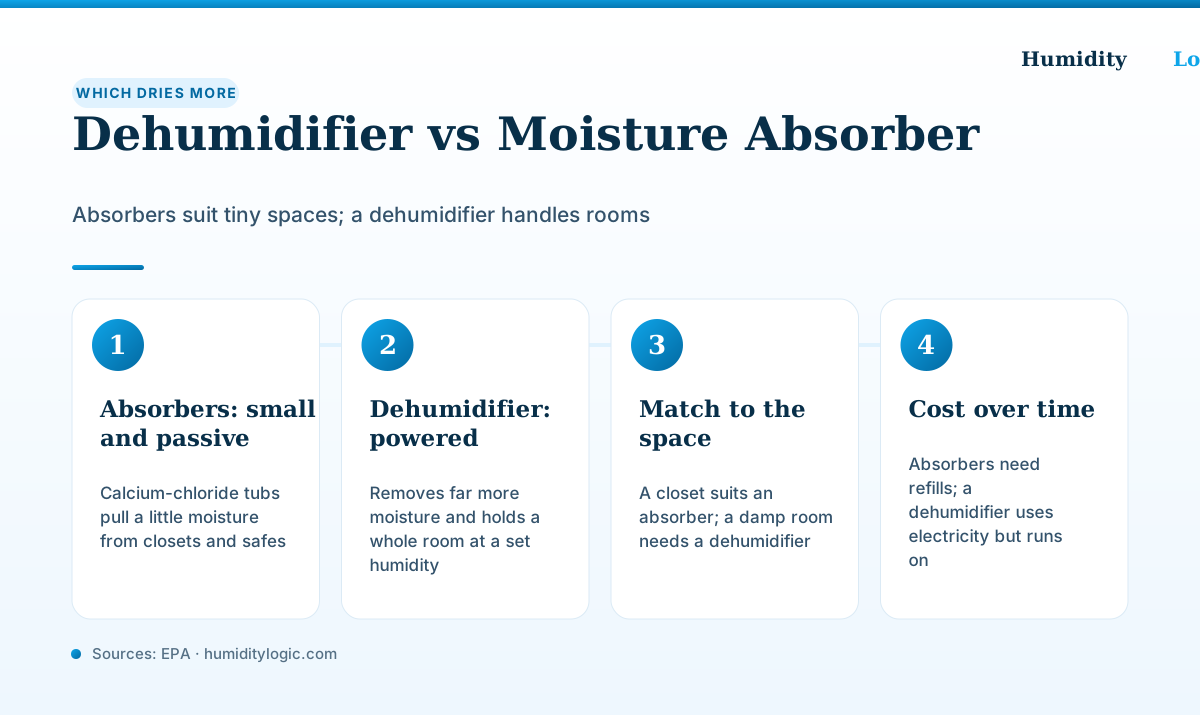
How does each one actually remove moisture?
A moisture absorber works by passive absorption, with no moving parts. The most common type uses calcium chloride, a hygroscopic salt. According to the manufacturer of the best-known brand, DampRid’s crystals absorb excess moisture and gradually dissolve into a liquid brine, a saltwater solution that collects in the bottom of the container. Silica gel packets and desiccant tubs do something similar, trapping water vapor in the material itself. Either way, there is no fan and no electricity, so the absorber only affects the still air right around it and works slowly.
A dehumidifier is active. A fan pulls room air across a refrigerated coil, water vapor condenses onto the cold surface, and the water drips into a tank or out through a drain hose while drier air blows back into the room. Because it moves air continuously, it reaches the whole room rather than just the layer of air touching a container. Most portable units are rated by how many pints of water they pull per 24 hours, and ENERGY STAR describes capacities from about 20 to 30 pints for a damp room up to 50-plus pints for a large, wet space.
That difference, passive absorption versus active refrigeration, is the whole story. It decides how much water each removes, how large a space it can hold, and what it costs over time.
Moisture absorber vs dehumidifier: the core comparison
| Factor | Moisture absorber | Dehumidifier |
|---|---|---|
| How it works | Passive crystals or silica gel | Fan pulls air across a cold coil |
| Power needed | None | Standard outlet |
| Best space | Small, enclosed, low airflow | Whole rooms, basements |
| Coverage | Air right around the tub | An entire room |
| Moisture capacity | A few ounces over weeks | 20-50+ pints per day |
| Holds a room under 60% RH? | No | Yes |
| Upkeep | Refill crystals (~every 45 days) | Empty tank or drain to a hose |
| Up-front cost | Low (a few dollars) | Higher (appliance) |
| Ongoing cost | Buying refills | Electricity |
| Noise | Silent | Fan noise |
When is a moisture absorber the right choice?
An absorber earns its place in small, sealed spaces where running an appliance would be overkill or impossible: a coat or linen closet, a gun safe, a storage bin, a cabinet under a sink, or an RV or boat put away for the season with no power. In a small enclosed volume with stagnant air, the crystals can meaningfully cut the dampness that causes musty odors and mildew on stored clothing. Because they need no outlet and make no noise, they fit spots a dehumidifier never could. Our guide to a closet moisture absorber walks through the options for exactly this kind of space.
The trade-offs are capacity and upkeep. A calcium chloride absorber’s active ingredient needs replacing every 45 days or so depending on your humidity levels, though the container lasts for years, and each tub only holds so much water before the crystals turn to brine that has to be poured out. Because it depends on still air, an absorber cannot keep up in an open or drafty room; the moisture it captures is constantly replaced by more coming in, so it empties fast and the humidity barely moves. It should also be kept out of reach of children and pets, since the brine is a concentrated salt solution. If you are weighing absorber types against each other, charcoal vs DampRid compares two of the most common small-space options.
When do you need a dehumidifier instead?
Once you are trying to dry an actual room, you need active airflow, and that means a powered dehumidifier. A row of absorber tubs cannot hold a 300-square-foot basement below the mold line, but a properly sized dehumidifier can keep the whole space under 60 percent relative humidity indefinitely. The EPA recommends keeping indoor humidity below 60 percent, ideally between 30 and 50 percent, and a dehumidifier is the tool built to sit at that setpoint and maintain it. If you are not sure your space qualifies as genuinely damp, what is considered high humidity explains where the problem line falls.
Sizing matters here. Too small a unit runs constantly and never catches up; the right capacity holds the target with room to spare. To match pint capacity to your room’s size and dampness, run the dehumidifier size calculator or read what size dehumidifier do I need. Efficiency is worth a look too, since a dehumidifier runs for hours at a time: an ENERGY STAR certified model removes the same water while using 20 percent less energy than a conventional unit.
For the specific question of a passive tub versus an appliance in a borderline space, DampRid vs dehumidifier: which is better works through the decision in more detail.
What about running cost over time?
This is where people often talk past each other. An absorber has almost no running cost beyond buying refill crystals every month or so, and it uses no electricity, so for a closet or a stored boat it is genuinely cheaper. A dehumidifier costs more up front and adds to your power bill because it runs continuously. But comparing them on cost alone hides the real point: they are not sized for the same job. A dollar of absorber crystals will never dry a basement, and running a dehumidifier inside a small sealed safe would be wasteful. The cheaper option is whichever one actually fits the space, not whichever has the lower sticker price.
Over a year, an absorber means a steady trickle of refill purchases and regular emptying, while a dehumidifier means electricity plus emptying a tank or setting up a drain hose. Both need attention; neither is truly set-and-forget.
Does either one stop mold?
No, and this is the most important thing to get straight. Neither a moisture absorber nor a dehumidifier kills mold or removes existing growth; both only control moisture. The EPA states plainly that the key to mold control is moisture control, and that mold needs moisture to grow. Keep humidity down and you deny mold the water it needs to spread. Let it climb and mold returns regardless of which tool you own.
So both are preventive, not curative. If you already see or smell mold, you have to clean it, fix the water source, and then use a moisture tool to keep the conditions from coming back, an absorber for a small enclosed spot or a dehumidifier for a room.
The bottom line
A moisture absorber and a dehumidifier are not really rivals; they cover different scales of the same problem. Reach for an absorber when the space is small, enclosed, and without power, like a closet, safe, or a stored RV, and you want a cheap, silent tub you refill every month or so. Reach for a dehumidifier when you need to dry a whole room or basement and hold it under 60 percent relative humidity, and you have an outlet to run it. No absorber replaces a dehumidifier in a genuinely damp room, and no dehumidifier is worth running inside a sealed safe. Many homes use both, each doing the job it is built for. Whichever you choose, remember the shared limit: they manage moisture, they do not kill mold.
Frequently asked questions
Is a moisture absorber the same as a dehumidifier?
No. A moisture absorber is a passive tub of calcium chloride crystals or silica gel that quietly soaks up water from the still air around it, with no fan and no power. A dehumidifier is an electric appliance that pulls room air across a cold coil and wrings the moisture out, then blows drier air back. They work at completely different scales, so one is not a smaller version of the other.
Can a moisture absorber replace a dehumidifier in a damp room?
No. A calcium chloride tub only captures a few ounces of water over days or weeks from the air right next to it, so in an open, damp room the moisture it removes is constantly replaced by more. It cannot hold a whole room to a target humidity. For a genuinely damp room or basement you need a powered dehumidifier that moves air and can remove 20 to 50 pints a day.
How much moisture does each one remove?
A moisture absorber removes a small, fixed amount, roughly the water a single tub can hold before its crystals dissolve into brine over about 45 days. A dehumidifier removes far more on an ongoing basis. ENERGY STAR describes capacities from about 20 to 30 pints a day for smaller damp rooms up to 50-plus pints for large, wet spaces, day after day as long as it has power.
Which is cheaper to run over a year?
It depends on the space. A moisture absorber has almost no running cost beyond buying refill crystals every month or so, and needs no electricity, which makes it cheap for a closet or a stored RV. A dehumidifier costs more up front and uses electricity continuously, but it is the only practical option for a whole room. Comparing them by cost alone misses that they cover different sized spaces.
Will either one stop mold?
Neither kills mold; both only control the moisture that lets mold grow. The EPA states that the key to mold control is moisture control, and that mold needs moisture to grow. An absorber can cut dampness inside a small enclosed space, and a dehumidifier can hold a room under 60 percent relative humidity, but existing mold still has to be cleaned and the water source fixed.
Sources & references
Every figure on this page is checked against these published sources. Last reviewed August 13, 2026.