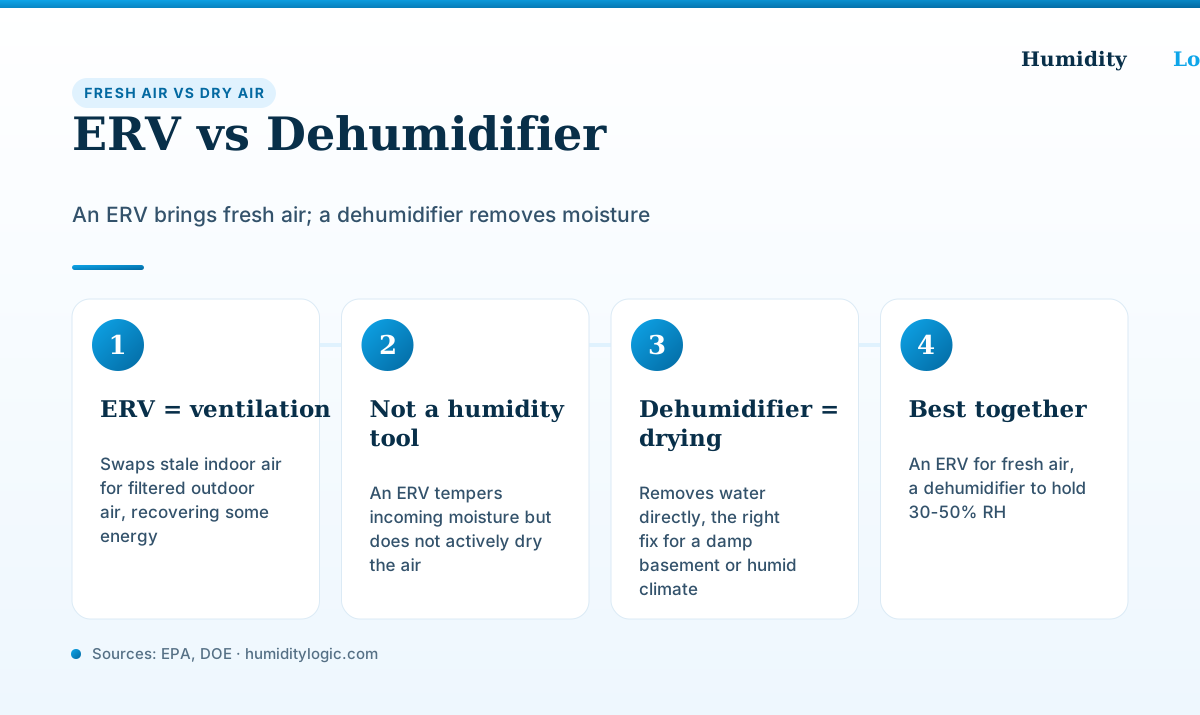
If you are trying to decide between an ERV and a dehumidifier, the key is that they are not really competitors: an ERV brings in fresh air and tempers its moisture, while a dehumidifier actively removes moisture to hold a set humidity — they solve different problems and often work best together. An energy recovery ventilator is a ventilation device. Its job is to swap stale indoor air for fresh filtered outdoor air, recovering much of the heating or cooling energy in the outgoing air, and transferring some moisture between the two streams along the way. A dehumidifier does not ventilate at all; it pulls water vapor out of the air already in your home so you can hold a target relative humidity. Confusing the two leads people to buy the wrong machine — so let’s separate what each one is actually for.
What does an ERV actually do?
An energy recovery ventilator is a fresh-air machine. It runs two air streams past each other through a core: it exhausts stale indoor air and draws in fresh outdoor air at the same time, in balanced amounts. The clever part is the core itself, which lets the outgoing air hand off most of its heat — and, in an ERV, some of its moisture — to the incoming air, so you are not simply throwing away the energy you already paid to condition. The Department of Energy explains that, “In addition to exchanging heat, ERVs transfer a certain amount of water vapor; this helps the humidity inside the home stay more constant.” Most energy recovery systems recover roughly 70 to 80 percent of the energy in the air they exhaust.
Notice what that describes: the ERV is managing ventilation — the exchange of indoor and outdoor air — and moderating the humidity of the air it brings in. It is not reaching into your living room and drying the air that is already there. That distinction is the whole story of this comparison.
What does a dehumidifier do differently?
A dehumidifier ignores the outdoors entirely. It draws room air across a cold coil, condenses the water vapor into liquid that drains into a tank or hose, and returns drier, slightly warmer air to the room. Because it works on the air already inside, it does not care whether it is muggy or dry outside — it removes water either way. That is why ENERGY STAR frames a dehumidifier as a device that uses “refrigeration coils, compressors, and fans to remove… moisture,” and recommends whole-home units for humid climates and homes reading consistently above about 55 percent relative humidity.
The practical difference is control. A dehumidifier lets you pick a humidity setpoint and hold it, running on demand until the air hits your target and cycling back on when it drifts. An ERV cannot do that; it only influences the moisture content of the fresh air it introduces, and it keeps ventilating whether the house is damp or dry. If your problem is a clammy basement or a house that sits above 55 percent all summer, that is a moisture-removal job, and the dehumidifier is the tool. Efficiency varies between units, which is why ENERGY STAR rates dehumidifiers by their Integrated Energy Factor — liters of water removed per kilowatt-hour — with certified models using about 20 percent less energy than conventional ones.
Why an ERV is not a dehumidifier
This is the most common misunderstanding, so it is worth being blunt: an ERV is not a dehumidifier, even the moisture-transferring kind. It reduces how much outdoor moisture comes in; it does not remove moisture that is already in the house. As HVAC engineer Allison Bailes writes at Energy Vanguard, “reducing the amount of moisture coming in is not the same at all as dehumidifying the air in the home.”
There is an important humid-climate caveat here. Because an ERV’s moisture exchange is only partial, on a muggy day the incoming air is still more humid than the air being exhausted — so the ERV can actually raise indoor humidity. Energy Vanguard puts it plainly: the ERV “will usually raise the humidity in the home when the outdoor air is more humid than indoor air.” An ERV in Houston in July is bringing in net moisture, just less of it than an ordinary vent would. That is exactly why a dedicated dehumidifier is needed to bring the level down and keep it there.
ERV vs HRV: a quick note
If you are shopping for ventilation, you will run into a close cousin: the HRV, or heat recovery ventilator. Both an ERV and an HRV are balanced ventilators that swap indoor and outdoor air while recovering energy. The only difference is moisture. An HRV transfers heat alone. An ERV transfers heat plus some water vapor, which helps keep indoor humidity more stable in both directions — less dryness in winter and less imported moisture in summer. As a rule of thumb, HRVs tend to suit cold, dry climates where you want to keep hard-won humidity indoors, and ERVs tend to suit humid or mixed climates. Neither is a dehumidifier, and neither removes moisture from your indoor air the way one does.
ERV vs dehumidifier at a glance
| ERV | Dehumidifier | |
|---|---|---|
| Primary job | Fresh-air ventilation | Moisture removal |
| How it treats humidity | Tempers incoming air, partial moisture transfer | Actively removes water from indoor air |
| Brings in fresh outdoor air? | Yes | No |
| Holds a set humidity level? | No | Yes |
| Behavior on a humid day | Can raise indoor humidity | Lowers indoor humidity |
| Best for | Air quality in tight homes | Damp basements, humid climates |
Which one do you need — or do you need both?
Start with the problem you are solving. If your house feels stuffy, stale, or shut-in — common in newer, tightly sealed homes — that is a ventilation problem, and an ERV is the efficient fix. If your house feels damp, smells musty, or reads above 55 to 60 percent on a hygrometer, that is a moisture problem, and a dehumidifier is the fix. The EPA advises keeping indoor humidity “below 60 percent (ideally between 30 and 50 percent)” and to “use air conditioners and/or de-humidifiers when needed” — an ERV alone will not reliably hold you in that band.
For many homes, especially airtight ones in humid regions, the honest answer is both. The ERV supplies fresh air and dilutes indoor pollutants; the dehumidifier does the actual drying so relative humidity stays in the healthy 30 to 50 percent range. They complement rather than replace each other. To size the fresh-air side sensibly, our air changes per hour calculator shows how much ventilation a given room really needs.
If moisture is your main concern, it is worth reading around the topic before you buy: our comparison of a dehumidifier vs ventilation covers the broader air-swap-versus-removal question, dehumidifier vs exhaust fan handles spot moisture in bathrooms and kitchens, and how to lower humidity in the house walks through the full toolkit. If you have decided a dehumidifier belongs in the mix, what size dehumidifier you need helps you match a unit to the space, and what counts as high humidity explains the numbers you are aiming to hit.
Frequently asked questions
Can an ERV replace a dehumidifier?
No. An energy recovery ventilator and a dehumidifier do different jobs. An ERV brings fresh outdoor air into the house and exhausts stale indoor air, transferring some heat and some moisture between the two streams so the incoming air is tempered rather than raw. It does not actively pull water out of your indoor air the way a dehumidifier does. On a humid day an ERV can even raise indoor humidity, because it only reduces how much moisture comes in rather than removing what is already there. If you need to hold a target humidity level, you need a dehumidifier.
What is the difference between an ERV and an HRV?
Both are balanced mechanical ventilators that swap stale indoor air for fresh outdoor air while recovering most of the energy in the air being exhausted. The difference is moisture. A heat recovery ventilator (HRV) transfers heat only. An energy recovery ventilator (ERV) transfers heat plus a portion of the water vapor between the two air streams, which, as the Department of Energy notes, helps indoor humidity stay more constant. HRVs tend to suit cold, dry climates; ERVs are usually the better pick in humid or mixed climates.
Does an ERV dehumidify the air in a humid climate?
Not really. In a humid climate an ERV reduces how much outdoor moisture enters compared with a plain fresh-air vent, but reducing incoming moisture is not the same as removing moisture. Because the water-vapor exchange is only partial, incoming air is still more humid than the air being exhausted, so an ERV will often nudge indoor humidity upward on muggy days. Homes in the Southeast and other damp regions typically run a dehumidifier alongside the ERV to actually hold humidity down.
Do I need both an ERV and a dehumidifier?
Many homes do, especially tight, well-sealed houses in humid climates. The ERV handles fresh air and indoor air quality, diluting carbon dioxide, odors, and other pollutants while recovering energy. The dehumidifier handles moisture, removing water so relative humidity stays in the healthy 30 to 50 percent range the EPA recommends. Because they solve different problems, running both is common rather than redundant.
What humidity level should I aim for indoors?
The EPA recommends keeping indoor relative humidity below 60 percent, and ideally between 30 and 50 percent, to limit mold and dust mites. ENERGY STAR points to the same 30 to 50 percent band as optimal. An ERV alone cannot guarantee you stay in that range because it only tempers incoming air; a dehumidifier is what lets you set and hold a specific humidity level regardless of the weather outside.
Sources & references
Every figure on this page is checked against these published sources. Last reviewed September 11, 2026.