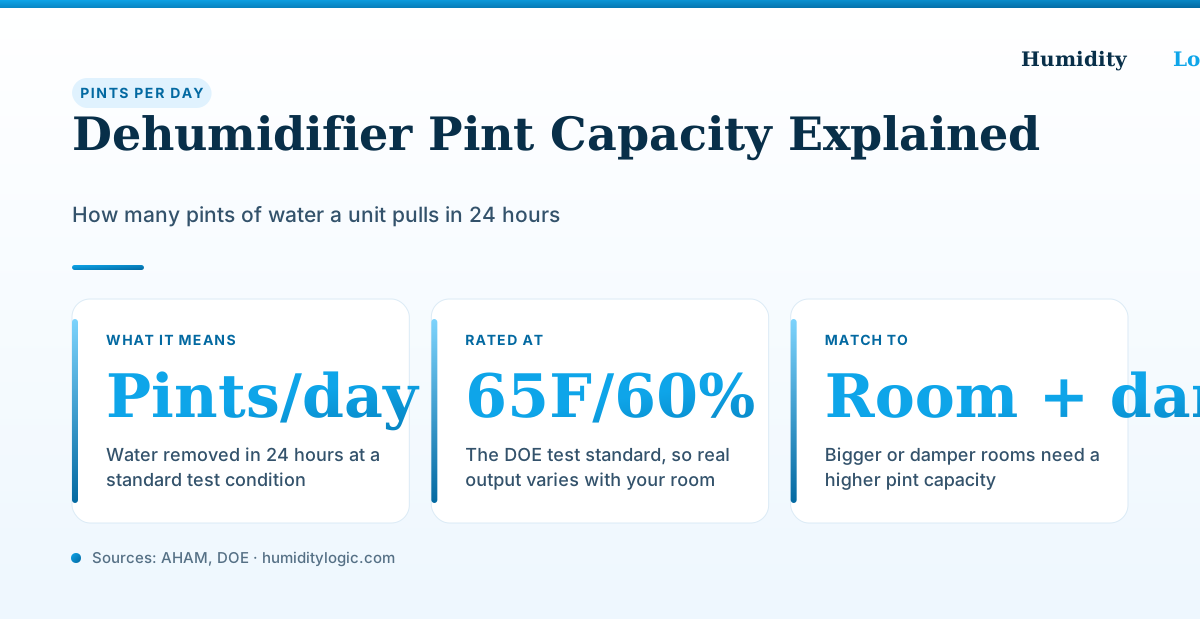
Dehumidifier pint capacity is the number of pints of water a unit removes from the air in 24 hours at a standard laboratory test condition — currently about 65°F and 60% relative humidity. It is a performance rating, not the size of the water tank, and because your basement or bedroom is rarely a perfect match for the lab, a unit almost always removes less than its label number in a cool room. That is why you size by your room and how damp it is, not by the number on the box alone.
The pint number is the single figure every dehumidifier is marketed on, yet it is one of the most misread specs in the appliance aisle. Understanding what it measures — and what it does not — is the difference between buying a unit that quietly keeps your space dry and one that runs all day and never quite gets there. If you would rather skip the reading, our dehumidifier size calculator turns your room and dampness into a target capacity for you.
What does “pint capacity” actually mean?
According to ENERGY STAR, capacity “is defined as the amount of water removed per day (24 hours) at test conditions (reported in pints/day).” In other words, a 30-pint dehumidifier is one that pulled 30 pints of water out of the air over a full day in a controlled test — not one with a 30-pint tank and not one rated for a specific room.
That last point trips up a lot of buyers. The collection bucket on a portable unit is usually only 1 to 2 pints. A machine rated at 50 pints per day does not hold 50 pints; it fills and shuts off several times a day unless you route it to a drain. So the pint number describes throughput — the rate at which the machine can dry air — rather than storage. If you want the mechanics of how that moisture is pulled from the air in the first place, see how a dehumidifier works.
What test condition is the rating based on?
Every pint rating you can buy new today comes from a federal test procedure. Portable dehumidifiers are tested under DOE’s test procedure, which incorporates the AHAM DH-1 industry standard. The test runs at a dry-bulb temperature of 65°F for portable units (whole-home models are tested at 73°F) while holding the relative humidity specified by the AHAM standard, which is 60%.
Those conditions were chosen deliberately. As ENERGY STAR puts it, portable dehumidifiers are now “tested at 65°F, rather than 80°F, to more accurately reflect expected performance in a basement setting.” Most dehumidifiers live in basements, crawl spaces, and other cool, damp corners of the house, so the standard was moved to look more like where the machines actually work.
Why did the numbers on the box drop?
If you compare an old buying guide to a current product label, the numbers will not line up — and that is by design. In 2019 the Department of Energy changed the test from the old 80°F condition to the cooler 65°F condition. Cooler air holds less moisture, so the same physical machine removes less water during the test and earns a lower pint rating.
ENERGY STAR gives the conversion directly: a portable model “previously rated at 30 pints/day now rates approximately 20 pints/day under the new testing method.” The drop is roughly 30 percent across the range, so:
| Old label (pre-2019, 80°F) | New label (post-2019, 65°F) |
|---|---|
| 30 pints | ~20 pints |
| 50 pints | ~30 pints |
| 70 pints | ~50 pints |
Nothing inside the cabinet changed — only the measuring stick did. This matters when you read older reviews or marketplace listings: if a 2017 article tells you to buy a “70-pint” unit, today’s equivalent is labeled around 50 pints. Buy a machine labeled 70 pints now and you have accidentally purchased a much larger, pricier unit than you needed.
Why is real-world output lower than the label?
The test condition is a fixed 65°F and 60% humidity, but your room is not. The colder and drier the air, the less water there is to pull out, so a dehumidifier almost always removes fewer pints per day at home than its label promises.
Three factors drive the gap:
- Temperature. Below the 65°F test point, capacity keeps falling. In an unheated basement or garage at 55°F, a standard compressor dehumidifier can lose a meaningful share of its rated output, and it may frost over on the coils unless it has an automatic defrost feature.
- Humidity level. The test assumes 60% relative humidity. Once your unit has pulled a room down toward a comfortable 45 to 50%, there is simply less moisture in the air, so the daily pint total drops even though the machine is working fine. Knowing what counts as high humidity helps you set a realistic target.
- Airflow and layout. A unit tucked in a closet, starved of airflow, or fighting a constant source of moisture will never hit its lab number.
The flip side is that a hot, muggy room above the test condition can briefly exceed the rating. But for the cool, damp spaces most people are treating, plan on real output landing below the label — and size with that headroom in mind.
What are the common pint capacities, and what do they suit?
On today’s post-2019 scale, most residential units cluster into three sizes:
- 20-pint — small, moderately damp spaces: a single bedroom, a small basement, a bathroom, or a closet. Good for taking the edge off a musty smell in a room up to a few hundred square feet.
- 30-pint — the workhorse middle. Suits medium basements, a damp main floor, or a larger room that stays humid in summer. This is where many general-purpose buyers land.
- 50-pint — larger or wetter spaces: a big basement, a space with visible damp spots, or an area under 2,000 sq ft that struggles in a wet climate. This class replaced the old “70-pint” flagship.
These are starting points, not room ratings — dampness matters as much as floor area, which is why a small but very wet space can need more capacity than a large, merely humid one.
How do I match pint capacity to my space?
ENERGY STAR’s guidance keys the number to both room size and dampness level. For a space under 2,000 square feet, the published starting ranges are:
| Dampness | Under 2,000 sq ft | Over 2,000 sq ft |
|---|---|---|
| Slightly to moderately damp (50–75% RH) | 20–30 pints | 30+ pints |
| Very damp (75–90% RH) | 25–40 pints | 40+ pints |
| Wet (90–100% RH) | 30–50 pints | 50+ pints |
Start from your dampness row, adjust up for cool below-grade rooms or a constant moisture source, and lean toward the higher end — ENERGY STAR notes it is generally “better to oversize than undersize,” since a modestly larger unit reaches your target and cycles off rather than running flat out. Our full sizing guide walks through the adjustments, and if you are weighing features alongside capacity, how to choose a dehumidifier covers the rest of the decision.
The takeaway: treat the pint number as a lab benchmark, not a promise. It tells you how one unit compares to another under identical conditions, and it points you to the right class for your space — but your room’s temperature and dampness decide what you actually get.
Frequently asked questions
What does a 50-pint dehumidifier mean?
It means the unit removed 50 pints of water in 24 hours during a standardized lab test at about 65°F and 60 percent relative humidity. It is a performance rating, not the size of the tank. A 50-pint model on today's scale is roughly what used to be labeled a 70-pint unit before the test changed in 2019.
Is pint capacity the same as the water tank size?
No. Pint capacity is how much water the machine can pull from the air in a day; the tank is usually far smaller, often 1 to 2 pints. A 50-pint unit does not hold 50 pints — it would fill and shut off several times a day, which is why continuous drainage to a hose is popular for high-capacity units.
Why does my dehumidifier remove less water than its pint rating?
The rating comes from a controlled 65°F, 60 percent humidity test. Your room is often cooler, drier, or both, and cooler air holds less moisture to remove. Compressor units also lose capacity and can frost up below about 65°F. Real-world output is normally below the label, which is why you size with headroom.
What pint capacity do I need for a basement?
For a moderately damp basement under 2,000 sq ft, ENERGY STAR's starting range is about 20 to 30 pints per day, rising to 30 to 50 pints for a wet basement with visible moisture. Add capacity for below-grade walls and cool temperatures, and confirm the number against your square footage and dampness.
Do bigger pint capacities cost more to run?
Not necessarily. A right-sized or slightly oversized unit reaches your target humidity and then cycles off, so it can use less electricity over a day than a too-small unit that runs constantly. Look at the ENERGY STAR Integrated Energy Factor to compare efficiency, not just the pint number.
Sources & references
Every figure on this page is checked against these published sources. Last reviewed September 12, 2026.