Most basements need a 30-50 pint per day dehumidifier under the post-2019 rating standard: about 30 pints for a musty 1,000 sq ft basement, up to 50 pints for a wet 2,000 sq ft one, including a +5 pint allowance for below-grade spaces. Set it to 45-50% RH, drain it to a floor drain or sump, and expect roughly $24/month in electricity at 8 hours per day.
What size dehumidifier do I need for a basement?
Size by floor area and dampness level using the post-2019 AHAM chart, then add 5 pints because a basement is below grade. A moderately damp 1,000 sq ft basement needs 25 pints per day before adjustments; a wet 2,000 sq ft basement needs 50.
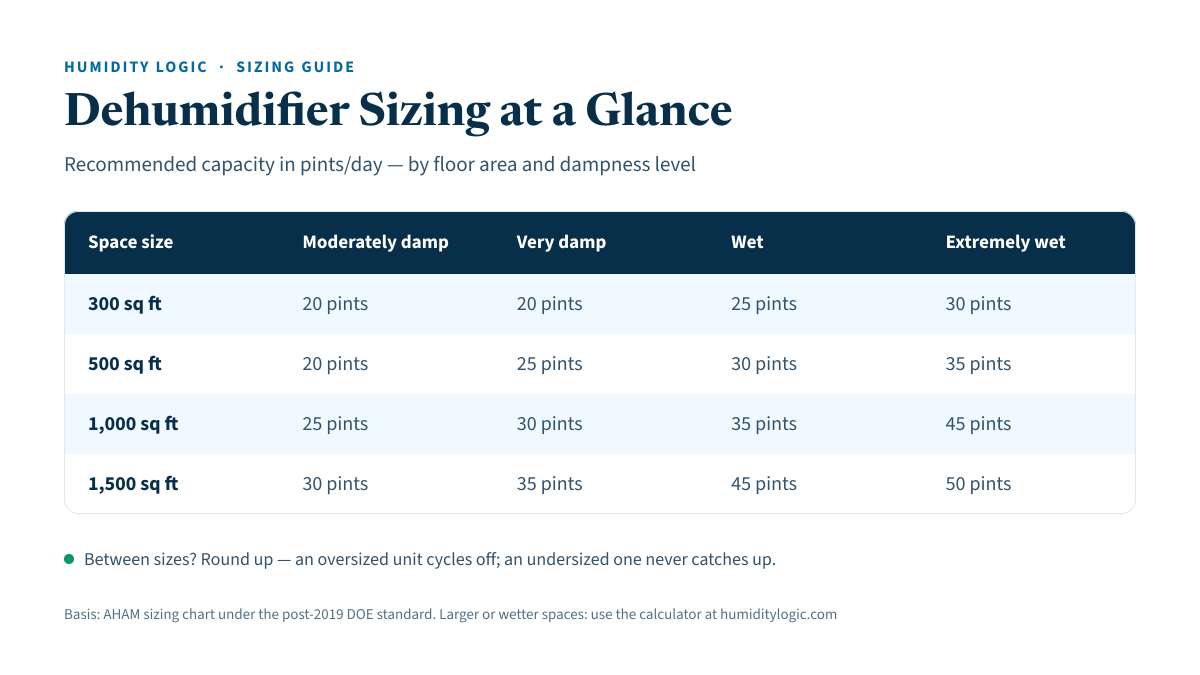
Capacity is rated in pints of water removed per 24 hours. Match your basement’s square footage to how damp it is:
| Floor area (sq ft) | Moderately damp (musty in humid weather) | Very damp (musty smell, damp spots) | Wet (seepage or condensation) | Extremely wet (standing water, laundry drying) |
|---|---|---|---|---|
| 300 | 20 | 20 | 25 | 30 |
| 500 | 20 | 25 | 30 | 35 |
| 1,000 | 25 | 30 | 35 | 45 |
| 1,500 | 30 | 35 | 45 | 50 |
| 2,000 | 35 | 45 | 50 | 60 |
| 3,000 | 45 | 55 | 60 | 70 |
Then apply two basement-specific adjustments:
- Add 5 pints because the space is below grade. Foundation walls and slabs wick ground moisture continuously, so basements carry a higher latent load than an above-grade room of the same size.
- Add another 5 pints if you dry laundry or run a washer in the basement.
Worked example: a very damp 1,500 sq ft basement starts at 35 pints, plus 5 for below grade and 5 for the laundry area, for a total of 45 pints. You would buy a 50-pint unit, the nearest standard size up. Rounding up is the right call: a larger unit reaches your target humidity faster and cycles off, while an undersized one runs constantly and still falls short on the wettest days. To skip the arithmetic, the dehumidifier sizing calculator applies the same chart and adjustments automatically.
Why do pint ratings look smaller than they used to?
Pint labels changed in 2019, and post-2019 ratings read roughly 30% lower than pre-2019 ratings for the same machine. A unit sold today as 35 pints removes about as much water as one formerly labeled 60 pints.
The US Department of Energy changed the federal test conditions from 80°F to 65°F specifically to reflect basement conditions, and ENERGY STAR notes that cooler air simply holds less water to remove. The practical consequences: ignore any sizing chart that recommends 60-70 pints for an ordinary damp basement, because it is almost certainly based on the old scale, and do not assume your failed 10-year-old “70-pint” unit must be replaced with a 70-pint model. Today’s standard portable sizes are roughly 20, 35, and 50 pints, and the chart above already uses the current scale.
Where should you place a dehumidifier in a basement?
Place the unit as close to the center of the basement as your drain plan allows, with at least 12 inches of clearance around the air intake and exhaust. Central placement lets one machine pull moist air from all corners instead of overdrying one end of the room.
A few placement rules matter more in basements than anywhere else:
- Keep it near the moisture, not the stairs. If one wall visibly seeps or one corner smells mustiest, bias placement toward that zone.
- Leave interior doors open. A dehumidifier can only treat air that reaches it; closed storage rooms and finished bedrooms stay damp unless air circulates.
- Set it on the slab, not a shelf. Cool, humid air is denser and pools at floor level, which is where the intake should be.
- Stay away from leaky windows, exterior doors, and dryer vents, where the unit wastes capacity treating incoming outdoor air.
- Check the nameplate temperature range. Placement in the coldest corner of an unconditioned basement can push the coil below its operating range, which leads directly to the frost problem covered below.
How should you set up the drain?
Use a continuous drain, not the bucket. A 35-pint unit in a damp basement can fill a typical 1.5-gallon tank twice a day, and the unit shuts off the moment the tank is full, which usually means it sits idle all workday.
You have three options, in order of preference:
- Gravity drain. Thread a hose onto the unit’s drain port and run it downhill to a floor drain, sump pit, or utility sink. The drain port must sit higher than the hose outlet, and the hose needs a continuous downward slope with no sags where water can pool and back up. This costs nothing beyond the hose and has no extra parts to fail.
- Built-in condensate pump. If your floor drain sits across the basement or you have none at all, choose a unit with an internal pump. Most can push water 15 feet or so vertically, enough to reach a laundry standpipe or exit through a rim-joist hole. Direct any exterior discharge several feet from the foundation so the water does not cycle straight back into the soil against your walls.
- Manual bucket. Acceptable only for a rarely used space you visit daily. If you rely on the bucket, position the unit where emptying it is easy, or you will stop doing it.
Whichever route you choose, check the hose run after the first 24 hours for kinks, sags, and slow drips at the port connection.
What settings should you use in a basement?
Set the humidistat to keep the basement under 55% RH in summer, which in practice means a setpoint of 45-50%. The EPA recommends keeping indoor relative humidity below 60% at all times, ideally between 30% and 50%, to prevent mold growth and dust mites.
Basements deserve the stricter end of that range because cool foundation walls raise local humidity at the surface: air at 55% RH in mid-room can hit condensation levels against a cold concrete wall. There is no benefit to going far below the target, though. Chasing 35% in a basement wastes electricity for no protective gain. Enable auto-restart if your model has it, so the unit resumes after a power blip, and rinse the filter monthly during heavy season. For the reasoning behind the numbers, see our guide to ideal indoor humidity levels.
One more setting note: hotter is not better for fan speed. High fan moves more air but low fan pulls slightly more water per pass; either is fine, so pick based on noise tolerance.
What if your basement is cold?
Below about 65°F, a basic compressor unit without auto-defrost starts losing efficiency and its coil can ice over. That 65°F figure is not a hard wall for every compressor, though: most modern compressor models include automatic defrost and keep working down to roughly 41°F, while desiccant units run down to about 33°F. So cold basements simply need a unit with frost control (auto defrost) or a desiccant dehumidifier. This matters because 65°F is a normal year-round temperature for below-grade spaces, even in summer.
Frost control pauses the compressor and runs the fan to melt ice off the coil. Without it, an iced coil removes almost no water while the unit runs constantly, a failure mode owners often mistake for a broken machine; our dehumidifier freezing up guide walks through diagnosing it. For basements that sit in the 40s and 50s °F, a desiccant unit is the better tool: its capacity barely drops with temperature, and it runs quieter, at the cost of higher energy use per pint. Sealed crawl space areas adjoining the basement follow the same cold-space logic.
How much does it cost to run a basement dehumidifier?
A 50-pint unit draws about 550 watts while dehumidifying, which comes to roughly $24 per month at 8 hours of runtime per day and the 2026 US average residential rate of 17.9¢/kWh. Smaller units and drier basements cost proportionally less.
The math: 550 W × 8 h = 4.4 kWh per day, about 132 kWh per month, times 17.9¢ per kWh gives $23.60. Your real cost depends on runtime, which is driven by how wet the basement is and how tight the space is, not just unit size. Counterintuitively, a bigger unit often costs less to run than a small one in the same basement, because it hits the setpoint and cycles off instead of grinding continuously. ENERGY STAR certified models cut consumption further at the same capacity. Plug your own rate and runtime into the electricity cost calculator for a personalized estimate.
When is a dehumidifier not enough?
A dehumidifier manages airborne moisture; it cannot fix bulk water entry, and it cannot substitute for professional mold remediation once growth exceeds about 10 square feet. The EPA advises that moldy areas larger than roughly a 3 ft by 3 ft patch call for a professional, while smaller patches are generally a safe DIY cleanup.
Treat these as signs the problem is upstream of the machine:
- Standing water, active seepage after rain, or efflorescence (white mineral crust) on walls points to grading, gutter, or drainage failures.
- A unit that runs 24/7 without ever reaching 55% suggests uncontrolled moisture entry or major air leakage, not undersizing.
- Persistent condensation on ducts and pipes in summer may need insulation, not more pints.
Fix the water source first, then let the dehumidifier hold the line. For diagnosing where basement moisture actually comes from, start with our basement humidity guide.
Frequently asked questions
What size dehumidifier do I need for a 1,000 sq ft basement?
Under the post-2019 rating standard, a 1,000 sq ft basement needs about 25 pints per day if moderately damp, 30 if very damp, 35 if wet, and 45 if extremely wet. Add 5 pints because the space is below grade, so most 1,000 sq ft basements land at 30 to 40 pints.
Should I run my basement dehumidifier all the time?
Set the built-in humidistat to 45-50% RH and leave the unit powered on; it will cycle only when humidity rises above your setting. In most US climates that means near-continuous operation from late spring through early fall and little to no runtime in winter.
Where should a dehumidifier drain in a basement?
The best setup is a continuous gravity drain: run the hose downhill to a floor drain, sump pit, or utility sink so you never empty a bucket. If no drain sits lower than the unit, use a model with a built-in condensate pump, which can push water up and out through a window or to a standpipe.
How much electricity does a basement dehumidifier use?
A typical 50-pint unit draws about 550 watts while the compressor runs. At 8 hours of runtime per day and the 2026 US average residential rate of 17.9 cents per kWh, that works out to roughly $24 per month during humid season.
What is the best humidity level for a basement?
Keep a basement under 55% relative humidity in summer. The EPA recommends keeping indoor RH below 60% at all times, ideally between 30% and 50%, to prevent mold, dust mites, and musty odors.
Sources & references
Every figure on this page is checked against these published sources. Last reviewed July 21, 2026.