If your dehumidifier runs but collects no water, work through the causes in order of likelihood: the room is already dry, the room is too cold (under ~65°F), the filter is dirty, the coils have iced over, the humidistat is set too high, or the compressor has failed. The first four cost nothing to rule out, and they explain the large majority of empty tanks.
Is the room already drier than you think?
An empty tank is often proof the machine is working, not proof it’s broken.
A dehumidifier only pulls water when the room is more humid than the target you set. As GE’s support documentation puts it plainly, the unit will not collect water if the room’s relative humidity is already below the level you dialed in. So before you suspect a fault, measure the air. A cheap hygrometer settles it in seconds: if the room reads 45% and you asked for 50%, the compressor is correctly staying off.
Below ~50% RH, extraction slows sharply for every consumer unit — there is simply less moisture in the air to condense, so drops form slowly and the tank fills at a crawl. That’s normal physics, not a defect. To confirm the machine can still pull water, set the humidistat to its lowest number, close the doors and windows, and watch for an hour. If beads appear on the coil, the hardware is fine and your room was just dry to begin with.
Is the room too cold for the compressor?
This is the single most common reason a healthy dehumidifier sits with a dry tank.
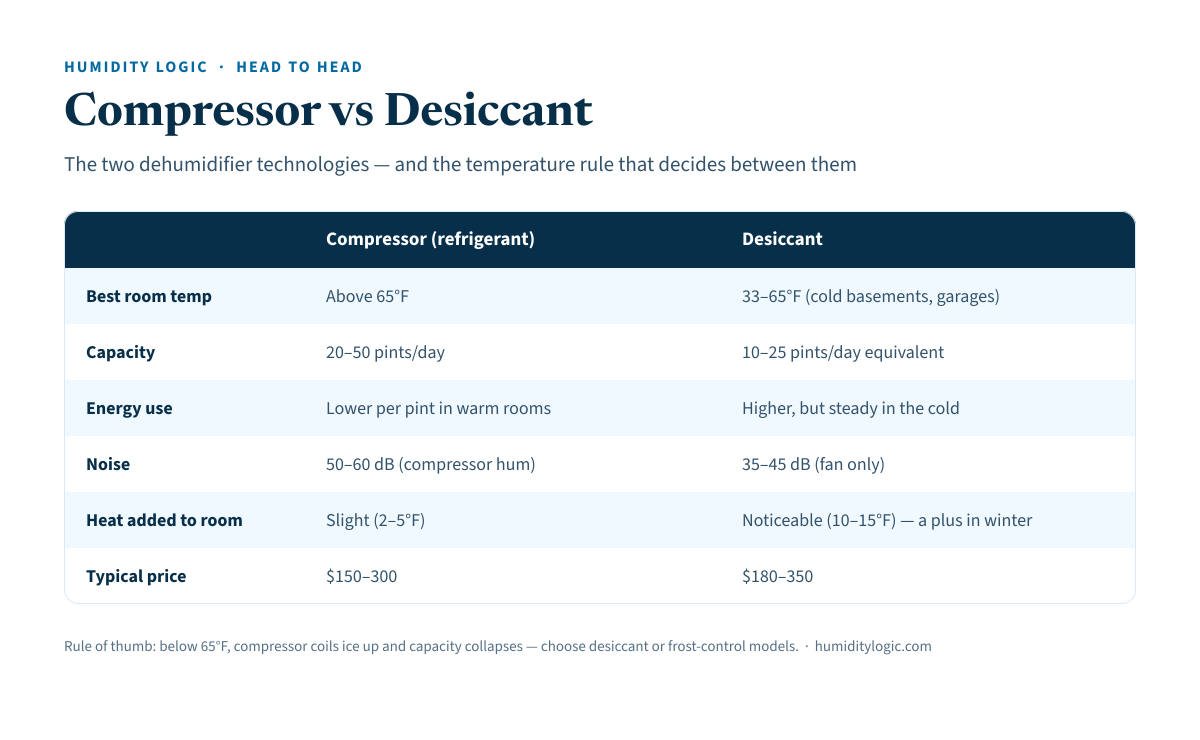
A standard compressor dehumidifier chills a coil to condense moisture, and that process falls apart in the cold. Compressor capacity collapses below ~65°F, and many units stop extracting near 41°F because the coil drops below freezing and any moisture turns to frost instead of dripping into the bucket. TCL’s own troubleshooting guidance flags temperatures under 65°F as a cause of sharply reduced collection and frost buildup.
If the empty tank is in a cool basement, garage, or crawl space, you are looking at a technology mismatch, not a malfunction. A recurring frost in a cold room means the wrong technology — the space needs a unit with real frost-control (auto-defrost), or better, a desiccant dehumidifier, which uses a moisture-absorbing wheel instead of a cold coil and keeps working from roughly 33°F to 65°F. Our compressor vs desiccant comparison lays out the trade-offs, and the garage dehumidifier guide covers cold-space picks specifically. For the physics behind the coil, see how a dehumidifier works.
Could a dirty filter or blocked airflow be starving the coil?
If the room is warm and humid but the tank stays empty, look at airflow before anything mechanical.
A clogged filter starves the coils of the air they need to condense moisture. The unit can only wring water out of air that actually reaches the coil, so a filter matted with dust chokes collection and — worse — lets the starved coil overcool and ice up, which stops extraction entirely. Both PartSelect and Fix.com list a dirty filter and restricted airflow among the first things to check when a unit stops pulling water.
The fix is free and takes five minutes:
- Wash the filter. Slide it out, rinse in lukewarm water with a drop of dish soap, and let it dry completely before reinstalling.
- Clear the grilles. Make sure nothing blocks the intake or exhaust louvers.
- Give it room. Leave at least 12 inches of clearance on every side so air can circulate freely.
- Retest for a day. Run the unit with the humidistat set low and check the tank after several hours.
Have the coils iced over?
Frost on the coil is a symptom that hides the empty tank behind it — the ice is both the cause and the evidence.
Once a layer of frost blankets the evaporator coil, it acts as an insulator and a physical wall: air can’t reach the cold metal, condensation stops, and the tank stays dry while the fan hums on. If you pull the front cover and see white frost or a solid sheet of ice instead of a wet, glistening coil, that’s your answer. Unplug the unit, let the ice melt completely on its own — several hours, sometimes overnight — then clean the filter and retest in a warmer spot.
Never chip at the ice or aim a heat gun at the coil; the thin fins bend and puncture easily. If the coil ices again in a warm room with a clean filter and strong airflow, the cause is deeper — low refrigerant or a failed sensor. Our dedicated guide to a dehumidifier freezing up walks through every icing scenario in detail.
Is the humidistat set too high — or the unit in the wrong mode?
A dehumidifier that never switches its compressor on will never collect a drop, and the fix is usually a single button.
If the target humidity is set at 60% and the room is sitting at 55%, the machine has already met its goal and the compressor stays silent. To force it to run, set the humidistat 10 points below the current reading to trigger the compressor — if the room reads 55%, dial the target down to 45% and listen for the compressor to click in shortly after the fan. If nothing happens, you’ve isolated the problem to the machine rather than the settings.
While you’re at the control panel, rule out two quick traps that mimic a failure:
- Wrong mode. Confirm the unit is in dehumidify mode, not fan-only, continuous-fan, or a laundry/dry setting that runs the blower without the compressor.
- Bucket and float. A tank that isn’t seated squarely, or a float switch stuck in the “full” position, tells the unit to stop even when the bucket is empty. Reseat the tank firmly and check that the float moves freely — a fix iFixit users report resolves many “runs but no water” cases. If you drain continuously through a hose, make sure it slopes downhill with no kinks or upward loops.
Has the compressor or capacitor failed?
When everything above checks out, the fault is mechanical — and this is where free fixes end.
Put your hand on the unit while it runs in a warm, humid room with the humidistat set low. The fan alone doesn’t cool anything; the compressor is what chills the coil. If you hear only the fan with no low compressor hum, or a hum that quits with a click after a few seconds, that points to a failed run capacitor or a dead compressor. A failed fan motor produces the opposite clue: the compressor may run, but with no air moving across it the coil ices over and collection stops anyway.
Here’s the hard part to accept: refrigerant and sealed-system repairs are not DIY. Handling refrigerant legally requires an EPA 608 certified technician, and on most portable dehumidifiers the labor and parts for a compressor or refrigerant repair cost close to — or more than — a new unit. Check your warranty first; if the machine is out of coverage and the compressor is the culprit, replacement is usually the smarter spend. Before you buy, run the numbers with our dehumidifier size calculator so the replacement is matched to the room rather than guessed at.
Quick diagnostic order
| Check | What you’re ruling out | Cost |
|---|---|---|
| Measure room RH | Room already below target | Free |
| Check room temperature | Below ~65°F, wrong technology | Free |
| Clean the filter | Starved airflow to the coil | Free |
| Inspect for coil frost | Iced-over evaporator | Free |
| Lower humidistat 10 points | Compressor never triggered | Free |
| Listen for compressor hum | Failed capacitor or compressor | Service or replace |
Run these in order and stop at the first one that fixes it. Nine times out of ten you’ll never reach the bottom row.
Frequently asked questions
Why is my dehumidifier running but not collecting any water?
In most cases the room is already at or below the humidity you asked for, or it is too cold for a compressor unit to work. Check the room with a hygrometer first, then confirm the temperature is above about 65°F. If both are fine, a clogged filter or iced coil is the next most likely cause.
What temperature is too cold for a dehumidifier to collect water?
Compressor dehumidifiers lose capacity quickly below about 65°F, and many stop extracting entirely near 41°F because the coil ices over. If your basement, garage, or crawl space sits in that cold band, the fix is not a repair — you need a desiccant model, which keeps working from roughly 33°F to 65°F.
How long should a dehumidifier run before water shows up in the tank?
In a genuinely humid room above 65°F, you should see water within a few hours and a noticeable amount within a day. If the tank is still bone-dry after running overnight with the humidistat set well below the room reading, work through the ordered checks below rather than waiting longer.
Does a clean filter really make a dehumidifier collect more water?
Yes. The unit pulls room air across a cold coil to condense moisture, and a clogged filter starves that coil of airflow, so far less water forms — and the coil can ice over on top of it. Wash the filter in lukewarm water, dry it fully, and give the unit a foot of clearance on every side.
When is a dehumidifier that won't collect water worth replacing?
The free fixes — dry room, cold room, dirty filter, high humidistat setting — solve most cases. If the fan runs but the compressor never hums, or hums and clicks off, the fault is usually a failed capacitor or compressor. On most portable units that repair costs close to a new machine, so check the warranty before paying for service.
Sources & references
Every figure on this page is checked against these published sources. Last reviewed July 21, 2026.
- GE Appliances Support — Dehumidifier Not Collecting Water
- TCL Support — Troubleshooting a Dehumidifier That Isn't Collecting Water
- PartSelect — Dehumidifier No Longer Pulling Water From Air
- Fix.com — How to Fix a Dehumidifier That Won't Collect Water
- iFixit — Dehumidifier Comes On, But No Water in the Container