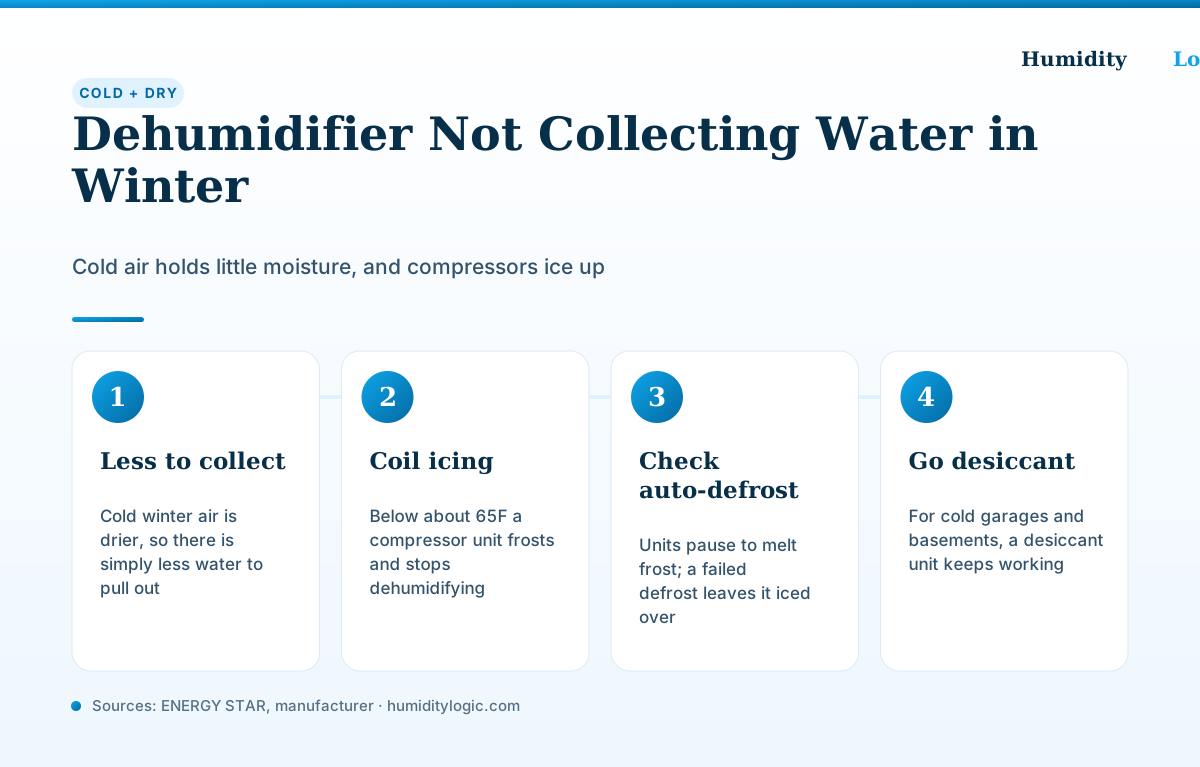
If your dehumidifier is barely collecting water in winter, it is usually working exactly as designed: cold air holds less moisture, so there is simply less to remove, and below about 65°F a compressor unit’s coil frosts over and stops dehumidifying. Both effects are normal cold-weather behavior. Before you call it broken, confirm the room is genuinely cold and dry, check that auto-defrost is doing its job — and for a cold garage or basement, switch to a desiccant unit that keeps working in the cold.
Is the empty tank normal for winter?
Most of the time, yes — an empty tank in winter is proof the machine is reading the room correctly, not proof it has failed.
A dehumidifier only pulls water when the air passing over its coil actually holds moisture. Cold air holds far less water than warm air, so a room that filled the bucket every day in July can leave it nearly dry in January even though nothing about the machine has changed. There is less moisture in the air to condense, so drops form slowly and the tank fills at a crawl. That is the physics of the season, not a defect.
The room’s relative humidity matters just as much as its temperature. A dehumidifier will not extract anything if the room is already drier than the level you dialed in. As GE’s support documentation puts it plainly, the unit will not collect water if the room’s relative humidity is already below the humidistat setting. Winter air indoors is often naturally dry — heating systems drive indoor humidity down — so the compressor may be correctly staying off.
The fastest way to settle it is a cheap hygrometer. If the room reads 40% and you set the unit for 50%, the machine is right to stay idle. If it reads 60% and the tank is still bone-dry, then temperature or icing is the more likely culprit, and the sections below walk through those.
Why does cold make a compressor dehumidifier ice up?
A compressor dehumidifier works by pulling room air across a refrigerated coil that runs close to freezing on purpose: moisture condenses on the cold metal and drips into the tank. In a warm room that balance holds. In a cold room it breaks.
When the incoming air is already chilly, it cannot warm the coil enough between cycles, so the coil surface drops below 32°F and condensation freezes on contact instead of dripping off. Frigidaire’s support documentation notes that a light film of frost is normal because the evaporator already operates near freezing, but in a cold room that light film builds into a solid layer of ice.
That ice then makes everything worse. Frost is both an insulator and a physical barrier, so once a layer forms it blocks airflow through the coil, extraction stops, and the tank stays empty while the unit hums away. This is why a dehumidifier that’s freezing up and a dehumidifier that’s not collecting water are so often the same winter problem wearing two disguises.
Because a compressor dehumidifier depends on that cold-coil-in-warmer-air gap, it simply runs out of room to work as the air chills. That is a design limit, not a malfunction.
At what temperature does a dehumidifier stop working?
The practical threshold is about 65°F. ENERGY STAR advises that if the space you are dehumidifying typically falls below 65°F, you should consider a product specified for use at lower temperatures — a clear signal that standard compressor units are not built for cold rooms.
Below that point, capacity drops off quickly. Many compressor units stop extracting almost entirely near 41°F; Frigidaire lists a low operating limit of 41°F for its units. So a basement, garage, crawl space, or unheated sunroom sitting in the 33–65°F band in winter is squarely in the range where a compressor model underperforms or ices over, no matter how humid it feels.
Note the two effects can stack. A cold room is often a dry room, so you may be fighting both less-moisture-in-the-air and coil-icing at the same time. If your hygrometer shows the room really is humid but the tank is empty and the temperature is under 65°F, icing is the likely reason the machine cannot get at that moisture.
What is auto-defrost, and is mine working?
Most modern compressor dehumidifiers include auto-defrost, sometimes labeled frost control. A sensor on the coil detects frost and shuts off the compressor while the fan keeps blowing room air over the coil to melt the ice, then the compressor resumes. Frigidaire describes exactly this: the unit has a coil sensor that shuts off the compressor to warm the coil and melt the frost. ENERGY STAR similarly notes that some dehumidifiers carry an anti-frost sensor that turns the unit off automatically when the air gets too cold.
Auto-defrost protects the hardware, but it does not cure cold-room icing. In a genuinely cold space the unit spends much of its time paused for defrost instead of dehumidifying, so water removal stays low even though nothing is broken. If you watch the machine and see it periodically stop the compressor while the fan keeps running, defrost is working as intended — the low water output is the cold room, not a fault.
A failed defrost is different. If the coil sensor or control fails, the compressor keeps running against a frosting coil and never pauses to melt it, so ice builds until it seals the coil completely. To check, unplug the unit and let it thaw fully — several hours, with a fan aimed at it to speed things along. Never chip at the ice or aim a heat gun at the coil; the fins sit on soft copper tubing carrying refrigerant, and a puncture kills the unit. Once thawed, clean the filter, give the machine a foot of clearance on every side to restore airflow, and retest in a warmer spot. If it ices again quickly in a warm, well-ventilated room, the defrost system or refrigerant charge is the likely fault.
How do I actually keep a cold space dry in winter?
If the room is genuinely too cold for a compressor unit, no repair will change the physics — you need the right tool for the temperature.
A desiccant dehumidifier is the winter answer. Instead of a cold coil, it draws air through a moisture-absorbing rotor, so there is no coil to ice over. Desiccant models keep working from roughly 33°F to 65°F — precisely the band where compressor units fail — which makes them the standard choice for cold garages, unheated basements, crawl spaces, and cabins. They cost more to run per pint of water removed, but in a cold room they actually collect water where a compressor model would sit frosted and idle.
If the space is only borderline cold, a few adjustments can help a compressor unit cope: raise the room temperature above 65°F if you can heat it, keep the filter clean and the intake clear so airflow stays strong, and set the humidistat to a realistic winter target rather than its lowest number. And make sure the unit is sized for the space in the first place — an undersized machine struggles year-round. Our guide to what size dehumidifier you need and the dehumidifier size calculator match capacity to your room’s square footage and dampness.
The bottom line: a dehumidifier collecting little water in winter is usually doing its job in conditions that give it little to do. Confirm the room is cold and dry with a hygrometer, watch for a working auto-defrost, and reserve a compressor unit for warmer months or heated rooms. For anything that stays cold, a desiccant model is the reliable winter workhorse.
Frequently asked questions
Is it normal for a dehumidifier to collect less water in winter?
Yes, usually. Cold winter air holds far less moisture than warm summer air, so there is simply less water for any dehumidifier to pull out. A slower-filling tank in a cool, dry room is normal physics, not a fault — confirm the room reading with a hygrometer before assuming the unit is broken.
What temperature is too cold for a dehumidifier to work?
Compressor dehumidifiers lose capacity below about 65°F, and many stop extracting near 41°F because the coil ices over. ENERGY STAR suggests that if a space regularly falls below 65°F you choose a model rated for lower temperatures. For a cold garage or basement, a desiccant unit is the better match.
Why does my dehumidifier freeze up in a cold room?
A compressor unit chills its coil below room temperature to condense moisture. When the room is already cold, the coil drops below freezing and condensation turns to frost instead of dripping into the tank. The frost then blocks airflow, so the unit runs but the bucket stays empty.
What is auto-defrost and does it fix winter icing?
Auto-defrost pauses the compressor while the fan keeps blowing room air over the coil to melt frost, then resumes. It prevents coil damage but does not cure cold-room icing — the unit spends much of its time defrosting instead of dehumidifying, so water removal stays low in a genuinely cold space.
What kind of dehumidifier works in a cold basement or garage?
A desiccant dehumidifier. Instead of a cold coil, it uses a moisture-absorbing material and works from roughly 33°F to 65°F, exactly the band where compressor units struggle. It costs more to run but keeps pulling water in cold spaces where a compressor model would ice over and quit.
Sources & references
Every figure on this page is checked against these published sources. Last reviewed September 8, 2026.