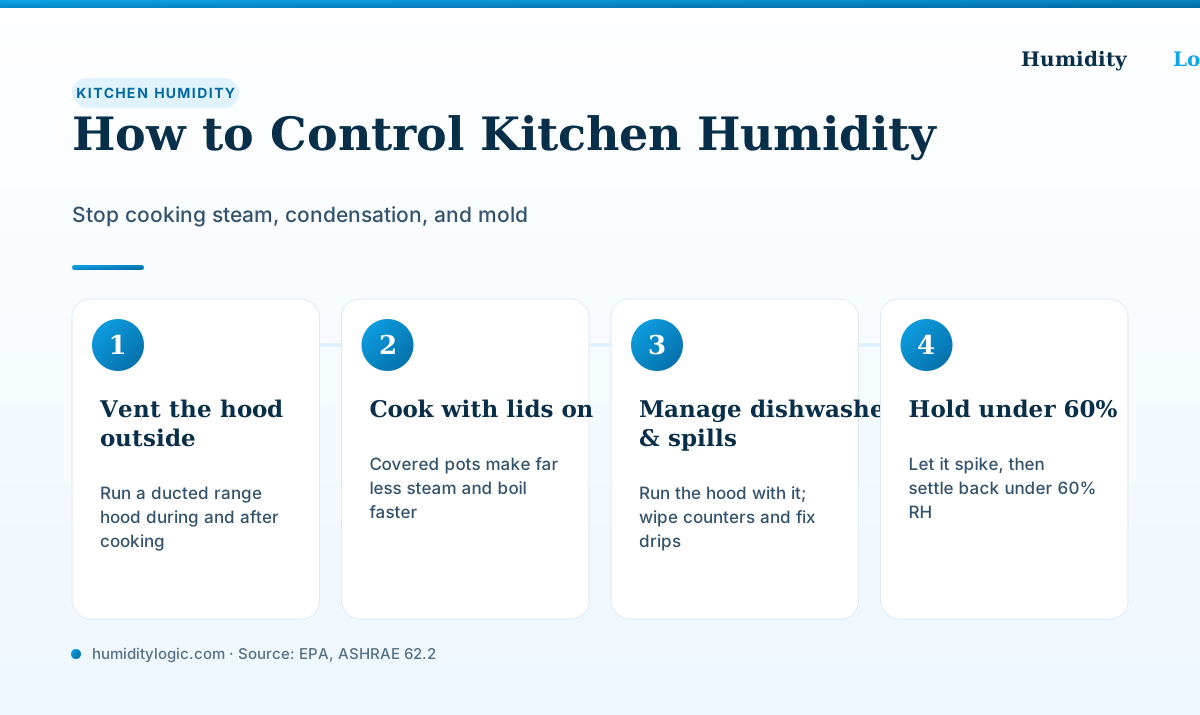
The kitchen quietly produces more water vapor than almost any other room, and the fix is straightforward. Control kitchen humidity by venting the range hood outdoors, cooking with lids on, and running the dishwasher and hot tap no more than you need — with the goal of holding the room under 60% relative humidity. Do that and you keep steam off the cabinets, mold out of the corners, and fog off the windows.
Why is my kitchen so humid?
Because cooking is, in building-science terms, a moisture source — and the kitchen concentrates several of them in one place. A pot of boiling water, a simmering sauce, a steaming kettle, the hot rinse cycle on the dishwasher, and the hot tap at the sink all push water vapor into the air. On a busy evening that adds up fast.
That vapor does not disappear on its own. It drifts to the coldest surfaces in the room and condenses there, exactly the mechanism the EPA describes: “when warm, humid air contacts a cold surface, condensation may form” (EPA Mold Course, Chapter 2). In a kitchen the cold surfaces are the window glass, the wall behind the range, and the backs of cabinets against an exterior wall — which is why those are the first places you see beads of water, peeling paint, or the start of mold.
What humidity should a kitchen be?
The same target as the rest of the house: between 30% and 50% relative humidity, and under 60% at all times. The EPA recommends keeping indoor humidity below 60 percent, and ideally in the 30–50% band, because controlling moisture is the single most effective way to limit mold (EPA — A Brief Guide to Mold, Moisture and Your Home).
A short spike while you cook is normal and nothing to worry about. What matters is that the number falls back under 60% within an hour or so of finishing. A cheap hygrometer on the counter tells you whether it does — and if you are not sure where your readings put you, what is considered high humidity walks through the thresholds. For a quick verdict on a single reading, run it through the humidity comfort checker.
Vent the cooking steam outside
This is the highest-leverage move by far. A range hood that ducts to the exterior removes cooking moisture at the source, before it can spread through the house. That is the whole premise of the residential ventilation standard, ASHRAE 62.2, which calls for a vented kitchen exhaust fan of roughly 100 CFM running on demand (ASHRAE Standards 62.1 & 62.2).
The catch most homes miss: a lot of “range hoods” are recirculating, not vented. They pull air through a charcoal filter to catch grease and smells and then blow it straight back into the kitchen — water vapor and all. If your hood has no duct to the outside, it is doing nothing for humidity. Check whether yours vents outdoors, and if it does, actually use it: switch it on when you start cooking and leave it running for a few minutes after, the same way you would a bathroom fan. The EPA specifically advises venting moisture-producing activities to the outdoors rather than into the living space.
If a full ducted hood is not an option, an over-the-range or wall exhaust fan vented outside does the same job. Want to know whether your fan actually clears the room’s volume fast enough? Our air changes per hour calculator turns a fan’s CFM and your room size into a real ventilation rate.
Cook and clean to make less moisture
Every bit of vapor you never create is vapor you do not have to vent away.
- Keep lids on pots. A covered pot of boiling water releases a fraction of the steam an open one does, and it comes to the boil faster, too.
- Match the burner to the pot and turn simmering food down. A rolling boil that could be a gentle simmer is just extra steam.
- Run the hood with the dishwasher. The hot drying cycle vents moist air into the room; a vented fan catches it. Many dishwashers also have a heat-free “air dry” option that releases far less.
- Wipe up spills and standing water on counters and around the sink, and fix a dripping tap. Small, constant sources keep the baseline humidity up.
These are the kitchen version of the whole-home approach in how to lower humidity in your house: cut the sources first, then deal with what is left.
When does a kitchen need a dehumidifier?
Most kitchens do not, if the hood vents outdoors. But a few situations call for one. An open-plan kitchen that shares air with a damp basement or a humid living area can sit above 60% no matter how well you vent the stove — there the problem is the whole zone, not the cooking. A kitchen with no exterior venting at all (common in older apartments) may also need help clearing moisture.
When you do add one, treat the connected space as the room to size for, not just the kitchen footprint, and follow ENERGY STAR’s moisture bands — “damp” spaces need roughly 20–30 pints a day, “wet” ones more (ENERGY STAR — Dehumidifiers). Set its built-in humidistat to around 50% and let it cycle. Plug your square footage and dampness into the dehumidifier size calculator to get the capacity right, and see what size dehumidifier do I need for the reasoning behind the chart.
Stop the condensation cooking leaves behind
If your kitchen windows fog or the wall behind the stove stays damp, attack it from both sides: remove the steam (vent the hood, cover pots) and warm the cold surface so it stops being the coldest thing in the room. Condensation only forms where humid air meets a surface below its dew point. If foggy glass is your recurring symptom, condensation on the inside of windows covers the targeted fix, and a lingering damp smell points to how to get rid of a musty smell.
Put it together and the kitchen stops being the wettest room in the house. Vent the cooking steam outdoors, make less of it with lids and smarter burners, and keep the room under 60% — and the cabinets, walls, and windows stay dry.
See it in 3D. Explore the kitchen in The Humidity House, our interactive 3D home — click the stove, range hood, or sink to see how cooking moisture builds and how venting clears it. For the room next door, see how to reduce kitchen moisture and the laundry room dehumidifier guide.
Frequently asked questions
What humidity level should a kitchen be?
Keep it in the same healthy band as the rest of the home: 30–50% relative humidity, and under 60% at all times. The EPA recommends staying below 60% because mold and dust mites take hold above that. The kitchen spikes briefly while you cook — that is normal — as long as it falls back under 60% within the hour.
Why is my kitchen so humid?
Cooking is a water generator. Boiling, simmering, steaming, and running the dishwasher or hot tap all release water vapor into the air, and a kitchen packs those sources into one room. Without a range hood vented outdoors, that moisture settles on cabinets, walls, and windows instead of leaving the house.
Does a range hood reduce kitchen humidity?
Only if it vents outdoors. A ducted hood pulls cooking steam and moisture straight outside, which is exactly what the residential ventilation standard ASHRAE 62.2 is built around (it calls for a vented kitchen exhaust of about 100 CFM). A recirculating hood that blows air back into the room through a filter removes grease and odor but leaves the water vapor behind.
Do I need a dehumidifier in the kitchen?
Usually not, if the range hood vents outdoors and you cook with lids on. A dehumidifier helps when the kitchen opens onto a persistently damp space — a basement or an open-plan living area that sits above 60% — or when there is no exterior venting at all. Size it with our calculator rather than guessing.
How do I stop condensation on my kitchen windows while cooking?
Run the vented hood during and for a few minutes after cooking, keep lids on pots, and crack a window if the outdoor air is drier. Condensation forms when humid cooking air meets cold glass, so removing the steam at the source and warming the glass both stop the fog.
Sources & references
Every figure on this page is checked against these published sources. Last reviewed October 2, 2026.