A gun safe dehumidifier keeps the air inside your safe at or below roughly 50% relative humidity — the level where steel corrosion slows to a crawl — at a stable temperature near 70°F. Electric rod units gently warm the air a few degrees so moisture stays vapor instead of condensing on metal. Renewable desiccant packs absorb water vapor directly and recharge in a wall outlet.
Why does a sealed safe rust guns faster than an open closet?
A gun safe is not airtight — it is a cold steel box that breathes slowly. Every time you open the door, room air carries water vapor inside, and the door gasket then traps it. Because the safe’s steel walls track the coldest part of the room (often an exterior wall, basement, or garage slab), the interior surfaces frequently sit below the dew point of the trapped air. Moisture condenses as an invisible film on barrels, actions, and springs, and iron plus oxygen plus water yields iron oxide — rust. Once pitting starts under a bluing layer, no amount of oil reverses it.
Stagnant air makes it worse. In an open closet, air movement evaporates surface moisture; inside a safe there is no circulation at all, so a condensed film lingers for days. That is why a safe in a 55% RH room can rust guns while tools on an open shelf in the same room stay clean. You can estimate how close your storage room runs to condensation conditions with our condensation risk calculator.
What relative humidity should a gun safe hold?
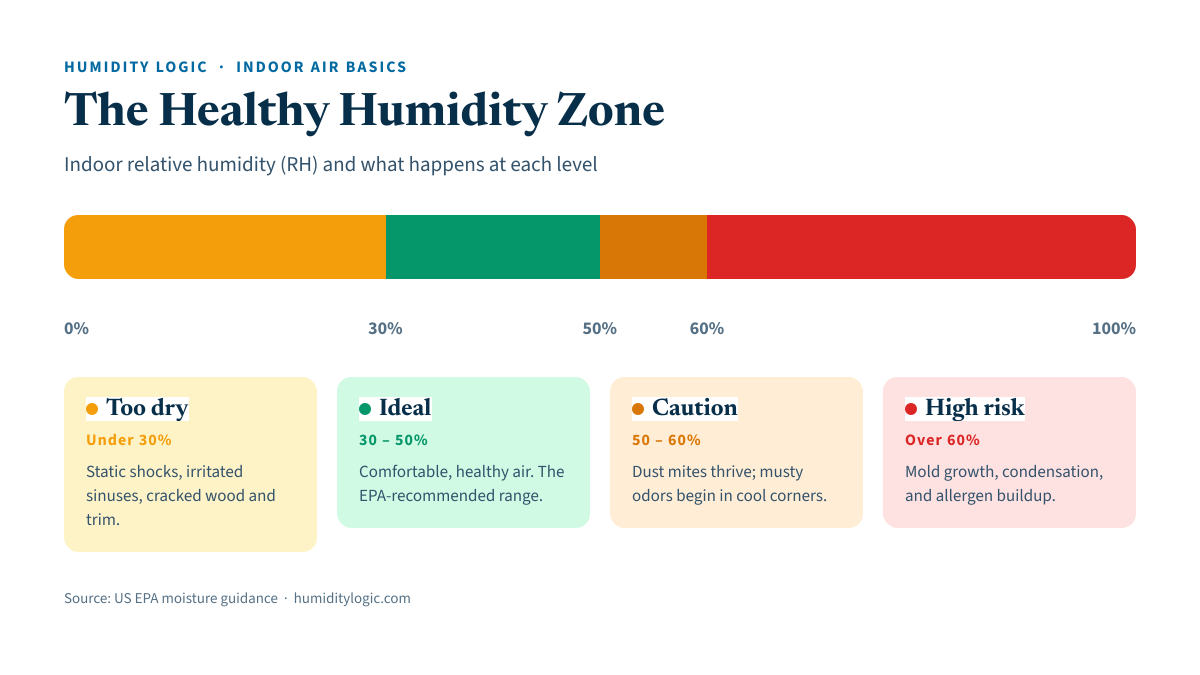
The target band is 30–50% RH at a stable temperature around 70°F. The NRA National Firearms Museum’s widely cited guidance puts ideal firearm storage at 50% relative humidity and 70°F, and safe manufacturers such as Liberty Safe recommend holding the interior between 30% and 50%.
The band has a floor as well as a ceiling. Below about 30% RH, walnut and other stock woods surrender their internal moisture and can shrink, crack, or chip at the wrist and forend, and old grease dries into varnish. Above 50%, corrosion chemistry accelerates: atmospheric-corrosion studies have long identified the range above roughly 50–60% RH as the zone where a continuous moisture film forms on steel and rust rates climb steeply. Your safe’s interior generally mirrors the room it sits in, so it helps to know what indoor humidity your home should run in the first place — and to check the US humidity map for what your region’s outdoor air delivers each season.
How does an electric rod dehumidifier work?
A dehumidifier rod does not remove water from the air — it makes the air hold its water as vapor. The rod is a low-wattage heating element (a Golden Rod–style unit runs on standard 110–120 V household power) that warms the air inside the safe roughly 3°F above ambient. Two things happen:
- Relative humidity drops. Warmer air can hold more moisture, so the same water content reads as a lower RH — enough to keep interior surfaces above the dew point so condensation never forms.
- Convection starts. Warm air rises off the rod, cools at the top of the safe, and sinks along the walls. That continuous gentle circulation prevents the stagnant pockets where moisture films persist.
Rods come in 12- to 36-inch lengths; a 12-inch rod covers roughly 20 cubic feet, while larger rods are rated for enclosures up to about 100 cubic feet. They have no moving parts, no reservoir to empty, and typically carry long or lifetime warranties. The tradeoff: they need an outlet, and they do nothing during a power outage.
How do renewable desiccant packs work?
A desiccant unit removes water from the air by adsorbing it onto silica gel. The crystals hold a large fraction of their weight in water vapor, steadily pulling down the moisture content of the sealed interior. No cord, no outlet, no heat — which makes desiccants the only option for safes without an electrical access hole, for closets and vehicle storage, and the natural backup during power outages.
The catch is saturation. Once the gel is full, the pack stops working and simply sits there. Renewable units include an indicator window — crystals shift color (commonly blue or orange when dry to pink or green when saturated) — and recharge by plugging into a wall outlet for 8–12 hours or warming per the manufacturer’s instructions. In a humid Gulf Coast summer that cycle can come every two to three weeks; in an arid climate the same pack may last a season. If you skip the recharge, protection quietly lapses.
Rod or desiccant: which should you buy?
| Electric rod | Renewable desiccant pack | |
|---|---|---|
| How it works | Warms air ~3°F; lowers RH, drives convection | Silica gel adsorbs water vapor |
| Power | Requires 110–120 V outlet and access hole | None |
| Maintenance | Essentially none | Recharge every 2–8 weeks when indicator changes |
| Coverage | ~20 cu ft (12 in) up to ~100 cu ft (36 in) | One canister per ~1–3 cu ft; use multiples in large safes |
| Works in outage | No | Yes |
| Best fit | Full-size safes near an outlet | Handgun boxes, no-outlet locations, backup duty |
For a full-size safe within reach of an outlet, the rod is the set-and-forget choice. For small pistol boxes, closets, or anywhere a cord cannot go, use desiccant. Many owners in humid climates run both: the rod as the workhorse, a desiccant canister as the buffer for door-opening spikes and outages.
Where should the dehumidifier go — and how do you wire it safely?
Mount a rod low and horizontal. Convection only works if warm air can rise through the whole cabinet, so the floor of the safe (on the included brackets, an inch or two off the carpet) is the right spot. Keep a few inches of clearance around the rod — it runs warm to the touch, and you don’t want a stock or soft case resting against it. Desiccant packs go wherever moisture collects: one low in the main cabinet, one on a shelf near documents.
For wiring, use the safe’s factory electrical access hole — a small pre-drilled opening in the back wall sealed with a plug. Rods with detachable plugs make this painless: feed the bare cord end through from inside, then snap the plug on outside the safe. Plug into a wall outlet directly rather than a daisy-chained power strip, and never drill a new hole in a fire-rated safe without the manufacturer’s blessing, since penetrations can compromise the fire liner. If your safe lives in a garage, remember the room around it is the bigger battle — a garage dehumidifier lowers the moisture load the safe has to fight every time the door opens.
How do you know it’s working?
Put a hygrometer inside the safe — guessing is how rust wins. A small digital unit with a min/max memory costs little and tells you what the interior actually does between openings, not just what it reads the moment you check. Place it mid-height, away from the rod so the sensor reads bulk air rather than the warm plume.
Check weekly at first. If the readout holds 30–50% RH through a full weather cycle — including a stretch of rain — you can drop to monthly checks. Readings creeping above 50% mean the desiccant needs a recharge, the rod is undersized for the cabinet, or the room itself has gotten wetter. Sub-30% readings in winter are a cue to unplug the rod for a while, for the sake of your stocks. Pair the numbers with a quick visual: a light film of oil on steel and no fog on the hygrometer’s own display are the cheap confirmations that the box is doing its job.
Frequently asked questions
What humidity should a gun safe be kept at?
Aim for 30–50% relative humidity at a stable temperature around 70°F. The NRA National Firearms Museum cites 50% RH and 70°F as ideal storage conditions. Below about 30% RH, wood stocks can dry out and crack, so lower is not always better.
Do dehumidifier rods really work in a gun safe?
Yes. A rod warms the air inside the safe by a few degrees, which lowers relative humidity and sets up a gentle convection current that keeps air moving. Because warmer air holds moisture as vapor instead of letting it condense on steel, rust-forming surface moisture never gets a foothold.
How often do desiccant packs need to be recharged?
It depends on your climate and how often the safe is opened — typically every 2 to 8 weeks. Most renewable units have an indicator window that shifts color (commonly blue or orange to pink or green) when the silica gel is saturated. Recharge by plugging the unit into a wall outlet or warming it per the manufacturer instructions.
Can I use both a rod and a desiccant pack together?
Yes, and in damp climates or garage-stored safes the combination works well. The rod handles continuous moisture control while the desiccant buffers spikes after the door is opened or during power outages. A small hygrometer inside the safe confirms the pair is holding the interior in the 30–50% RH band.
How does the power cord get into a sealed gun safe?
Most safes ship with a small pre-drilled electrical access hole in the back wall, sealed with a removable plug. Many rods use a detachable plug so the bare cord end feeds through the hole from inside, then reconnects outside. Never drill a fire-rated safe without checking the manufacturer's guidance, as new holes can void the fire rating.
Sources & references
Every figure on this page is checked against these published sources. Last reviewed July 21, 2026.