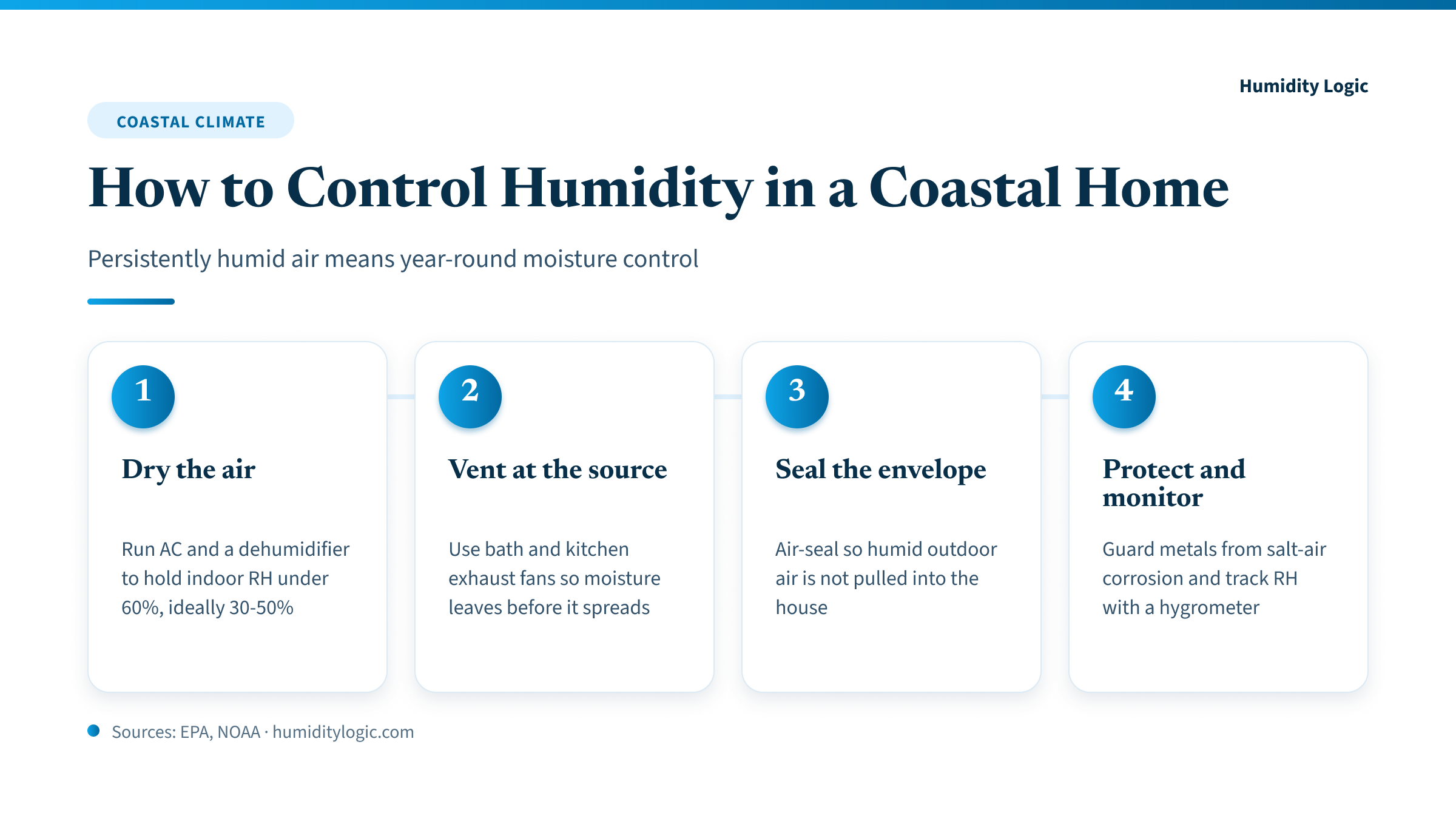
If you live on or near the coast, the fix for humidity problems is straightforward but never one-and-done: coastal climates keep outdoor relative humidity high for most of the year, so your home is constantly fighting incoming moisture. The playbook is to hold indoor RH under 60% (ideally 30-50%) with air conditioning plus dehumidification, ventilate moisture at the source with bath and kitchen fans, and seal the building envelope so humid outdoor air is not pulled inside. Do those three things — then protect metal from salt air and watch a hygrometer — and you shut down the mold, musty smells, sticky air, and condensation that plague coastal homes.
Why is coastal air so humid?
The ocean is an unlimited moisture source, and onshore breezes carry that water vapor over the land day and night. The result is that outdoor relative humidity near the coast rarely drops the way it does inland — it stays elevated through spring, summer, and often into the fall.
Relative humidity alone undersells how sticky that air feels, though. The National Weather Service notes that dew point is a better comfort indicator than relative humidity: a dew point of 55°F or below feels “dry and comfortable,” 55-65°F turns “sticky,” and 65°F or above brings “lots of moisture in the air, becoming oppressive.” Coastal summers spend long stretches above that 65°F line, which is why the air feels heavy even when the thermometer reads mild. If you want to see where your own numbers land, our humidity comfort checker translates temperature and RH into how the air actually feels.
This isn’t only a beachfront issue, either. Marine air pushes well inland — a home several miles from the water still sees elevated humidity and, close enough to the shore, measurable salt in the air. And because the ocean moderates overnight cooling, coastal nights don’t dry out the way inland nights do, so your home rarely gets the natural moisture break that a desert or continental climate provides. That relentlessness is the defining feature of coastal humidity: the load never really lets up, so your moisture-control equipment has to run more of the year than it would almost anywhere else.
What humidity problems does the coast cause?
Persistently damp air is the common thread behind the classic coastal-home complaints:
- Mold and mildew. The EPA is blunt that moisture is the trigger — sustained indoor RH above 60% invites mold on walls, ceilings, closets, and behind furniture. See what’s considered high humidity for where the risk line sits.
- Musty smells. That damp-basement odor is usually mold and bacteria growing in materials that never fully dry out.
- Sticky, clammy air. High moisture slows evaporation from your skin, so rooms feel warmer and stuffier than the temperature suggests.
- Condensation. Humid indoor air meeting cool surfaces — windows, ductwork, toilet tanks, exterior walls — leaves water that feeds mold and rot.
- Salt-air corrosion. Airborne chloride from sea spray settles on outdoor AC coils, railings, fasteners, and appliances, and high humidity accelerates the rust it causes.
How do I control humidity in a coastal home?
Dry the air with AC and a dehumidifier
Your first line of defense is active drying. The EPA’s guide to mold and moisture recommends running “air conditioners and/or de-humidifiers when needed” to keep indoor humidity below 60 percent, ideally 30 to 50 percent.
Here’s the catch that trips up coastal homeowners: an air conditioner is driven by temperature, not humidity. On a mild, muggy day the AC hits its temperature setpoint and cycles off before it has run long enough to remove much water vapor. That’s why so many coastal homes feel clammy despite a running AC. A dehumidifier targets moisture directly and picks up where the AC leaves off — which is why humid rooms, basements, and crawl spaces so often need one. Our guide to lowering humidity in your house walks through sizing and placement, and if mold is already appearing, a dehumidifier for mold is the targeted fix.
Size the dehumidifier to the space and how wet it is — an undersized unit runs nonstop and still misses the 30-50% target, while a right-sized one holds the room steady and cycles less. For whole-house control, some coastal homeowners add a ducted dehumidifier that ties into the HVAC system and manages humidity independently of temperature, so the house stays dry even when the AC isn’t calling for cooling. Whichever route you take, empty or plumb the condensate regularly and keep the unit’s filter clean so it keeps pulling its rated pints per day.
Ventilate moisture at the source
Not all ventilation is helpful on the coast. Opening windows when the outdoor air is more humid than the indoor air — the usual situation near the ocean — just imports moisture. Instead, ventilate where moisture is made. The EPA advises running a bathroom fan when showering and a kitchen exhaust fan whenever you cook or run the dishwasher, and venting the clothes dryer outdoors. Source ventilation removes water vapor before it spreads through the house, without dumping the whole coast’s humidity into your living room. Run bath fans for about 15-20 minutes after a shower, make sure they vent to the outdoors rather than into an attic, and add exhaust or a small dehumidifier to laundry rooms and other damp spots that tend to trap moisture.
Seal the envelope
Every gap in your home’s shell is a path for humid outdoor air to sneak in and overload your AC and dehumidifier. The U.S. Department of Energy stresses that controlling air leakage is critical to moisture control, especially in hot-humid climates where moist air pushed into wall cavities can rot framing and ruin insulation. Air-seal around windows, doors, plumbing and wiring penetrations, attic hatches, and rim joists; weatherstrip doors; and make sure ducts are sealed. A tighter envelope means you’re dehumidifying mostly the air already inside, not the entire outdoors — which cuts both moisture and energy bills.
How do I protect metal from salt air?
Salt-air corrosion is the coastal problem that ordinary humidity control only half-solves. Chloride particles from sea spray land on metal surfaces, and once the surrounding humidity rises, those salts absorb moisture and form a conductive film that dramatically speeds up rust. To slow it down:
- Keep indoor RH low. The same 30-50% target that stops mold also gives corrosion less moisture to work with on indoor metals and electronics.
- Rinse the outdoor AC unit. Periodically hose down the condenser coils and fins with fresh water to wash off accumulated salt; ask about factory corrosion-resistant coil coatings when replacing equipment.
- Choose corrosion-resistant hardware. Stainless steel, hot-dip galvanized, or coated fasteners and fixtures last far longer than bare metal near the shore.
- Don’t let metal stay damp. Wipe down condensation and keep closets and cabinets that hold tools or electronics dehumidified.
How do I monitor the results?
You can’t manage what you don’t measure. Put an inexpensive digital hygrometer in the rooms most prone to dampness — basement, ground-floor bathroom, a closet on the shaded side of the house — and check that they hold under 60% RH, ideally 30-50%. If a room keeps drifting high, that’s your signal to add or upsize a dehumidifier there. The EPA’s mold course makes the underlying rule simple: control the moisture and you control the mold. On the coast, that’s a year-round habit rather than a summer project — but a hygrometer, a dehumidifier, and a sealed, well-ventilated home make it a manageable one.
Frequently asked questions
What is a good indoor humidity level in a coastal home?
The EPA recommends keeping indoor relative humidity below 60%, and ideally between 30% and 50%. On the coast that usually takes active drying — air conditioning plus a dehumidifier — because outdoor RH sits above 60% for much of the year and passive ventilation alone brings that moisture indoors.
Why does my coastal house feel sticky even with the AC running?
Air conditioners are controlled by temperature, not humidity. On mild, muggy coastal days the AC reaches its temperature setpoint and shuts off before it has run long enough to wring out much moisture, so the air stays damp and sticky. A dedicated dehumidifier targets humidity directly and fixes that gap.
Does salt air really corrode metal faster near the coast?
Yes. Airborne chloride from sea spray settles on metal, and once relative humidity climbs high, those salts pull in moisture and form a conductive film that accelerates rust and corrosion. Keeping indoor RH low, rinsing exterior AC coils, and choosing corrosion-resistant hardware all slow the damage.
Do I need a dehumidifier if I live near the ocean?
Almost certainly, at least seasonally. Coastal outdoor air is humid most of the year, and basements, crawl spaces, and closed-up rooms routinely drift past 60% RH — the level where mold risk climbs sharply. A properly sized dehumidifier holds humid rooms in the safe 30-50% range that AC alone often misses.
Will opening windows help with coastal humidity?
Usually not. When outdoor humidity is higher than indoor humidity — the norm on the coast — open windows let moist air in and make the problem worse. Ventilate at the source with bath and kitchen exhaust fans instead, and keep the home sealed so you are dehumidifying dry-ish indoor air rather than the whole outdoors.
Sources & references
Every figure on this page is checked against these published sources. Last reviewed August 1, 2026.