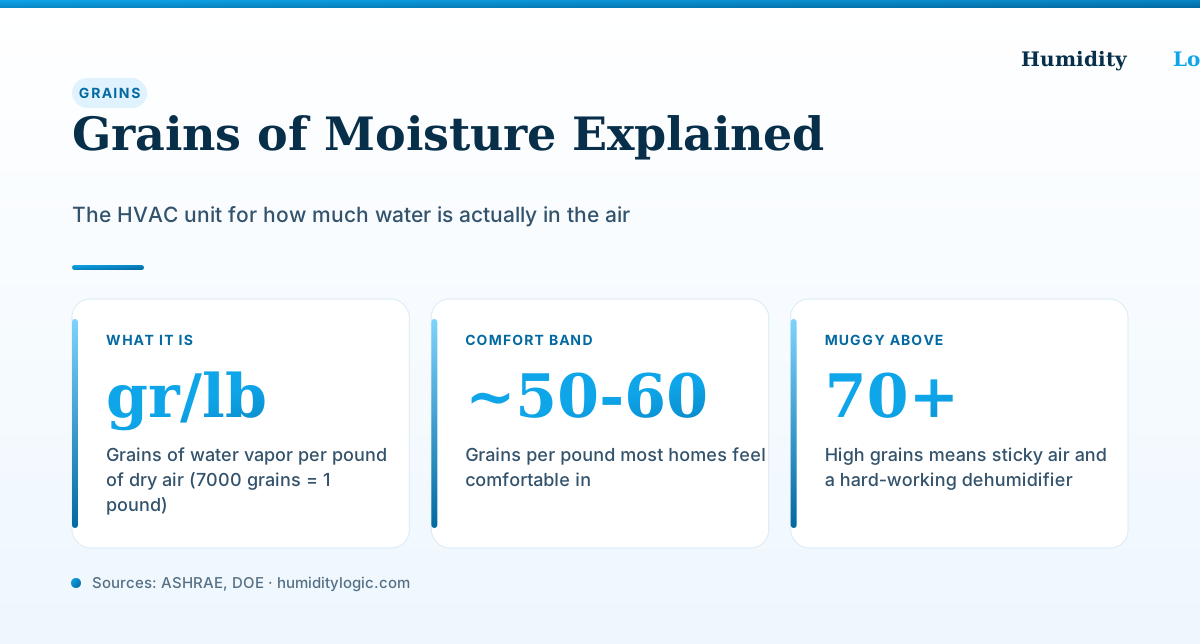
Grains of moisture is a measure of how much water vapor is actually in the air, counted as grains of water vapor per pound of dry air (written gr/lb, or “gpp” for grains per pound). It is the absolute-humidity unit that HVAC technicians reach for because, unlike relative humidity, the number does not shift around when the temperature changes. Heat the air, cool the air — the grain count stays put, because you have not added or removed any water. That is exactly what makes it trustworthy.
If you have ever wondered why a pro with a moisture meter talks in “grains” instead of the percentage on your thermostat, this is the reason. The percentage tells you how full the air is; grains tell you how much water is in it. To convert your own temperature and humidity readings into grains, use our free absolute humidity calculator.
What exactly is a “grain” of moisture?
A grain is a tiny unit of weight, not a droplet you can see. One grain equals 1/7000 of a pound — so it takes 7000 grains to add up to a single pound of water. The unit is an old one, originally based on the weight of a grain of barley and later used to weigh gunpowder and medicine, and it survived into the heating-and-cooling world because it produces convenient whole numbers for the small amounts of water vapor floating in room air.
When you see a figure like “55 grains per pound,” it means every pound of dry air in the room is carrying 55/7000 of a pound of water vapor. That sounds tiny, and it is — but across all the air in a house it adds up to pints of water that a dehumidifier has to pull out.
The technical name for this quantity is the humidity ratio: the ratio of the mass of water vapor to the mass of dry air in the same sample of air. Multiply that ratio by 7000 and you get grains per pound. Same idea, friendlier number.
Why do HVAC pros prefer grains over relative humidity?
Because relative humidity lies to you the moment the temperature moves.
Relative humidity (RH) is a percentage that compares the moisture in the air to the maximum the air could hold at its current temperature. Warm air can hold far more water than cool air, so the same amount of moisture reads as a low percentage when it is warm and a high percentage when it is cool — even though nothing about the actual water content has changed.
Grains per pound has no such problem. It counts the water itself. Consider a real example from HPAC Magazine: air at 70°F carrying 42 grains of moisture reads about 39% RH. Heat that identical air to 125°F and it still holds 42 grains — but the RH plummets to about 7%. Not one drop of water left the air. Only the percentage moved.
That is why a technician trying to figure out whether a space is actually drying out watches the grains, not the percentage. Fifty-five grains is fifty-five grains whether the room is hot or cold, so it is the honest scoreboard for moisture. Watch only the RH and you can fool yourself completely: turn on the heat and the percentage drops, which looks like progress, even though the air is exactly as wet as before. The grain count refuses to be fooled — it moves only when water is genuinely added or removed. It is also why grains are the right number for sizing and troubleshooting equipment. If you want the fuller comparison of the two units side by side, our guide to absolute vs. relative humidity breaks down when each one matters.
What is a comfortable grains-per-pound level?
For most homes, comfortable air lands in the range of roughly 50 to 60 grains per pound. As a benchmark, the standard HVAC design condition of 75°F at 50% RH works out to about 65 grains per pound — near the top of that comfortable zone but still fine for most people.
Here is a rough scale to keep in mind:
- Below ~50 gr/lb — dry side; air feels crisp, and in winter you may want to add moisture.
- ~50 to 60 gr/lb — the comfort sweet spot for most households.
- ~60 to 70 gr/lb — starting to feel humid; noticeable on muggy summer afternoons.
- Above ~70 gr/lb — sticky and oppressive, and microbial (mold) growth risk climbs sharply at typical indoor temperatures.
Those numbers pair naturally with the percentage targets in our ideal indoor humidity levels guide — grains are simply the temperature-proof way of describing the same comfortable band. The reason a single grain range works across seasons, while a single RH range does not, is that grains ignore temperature: 55 grains describes comfortable air on a 68°F winter day and a 78°F summer day alike, whereas the matching RH percentages would be quite different. When grains creep into the 70s and stay there, that is the signal a home is fighting a genuine moisture load rather than just a warm afternoon.
How do grains of moisture relate to dew point?
They are two views of the same thing: the actual amount of water in the air. Because both are absolute measures, they rise and fall together — more grains per pound means a higher dew point.
The difference is what each one tells you. Grains report the mass of water vapor. Dew point reports the temperature the air would have to cool to before that water starts condensing into dew or fog. The National Weather Service puts the principle plainly: the higher the dew point rises, the greater the amount of moisture in the air. Swap “dew point” for “grains” and the sentence stays true.
For everyday comfort, dew point tends to be the more intuitive of the two — most people can feel the difference between a 55°F and a 70°F dew point outdoors. Grains, meanwhile, are the currency of HVAC math, because you can add and subtract them: the drop in grains between the air going into a dehumidifier and the air coming out tells you exactly how much water the machine is removing. Our explainer on dew point vs. humidity covers the comfort side in more depth.
How do you measure grains of moisture at home?
You do not measure grains directly — no household gauge reads them off. Instead you take two ordinary readings and convert.
- Read the temperature and relative humidity. A basic digital hygrometer gives you both. Our guide on how to measure humidity covers placing and reading one accurately.
- Convert to grains. Feed those two numbers into a psychrometric chart or a calculator. Our absolute humidity calculator returns grains per pound instantly, so you skip the chart entirely.
Once you can see the grain count, it becomes a practical diagnostic. Track it across a few days: if grains stay stubbornly above 60 to 70 indoors even when the air conditioner is running, the home is carrying more moisture than the equipment can handle — a classic sign you need dedicated dehumidification. That grain load is also part of what determines what size dehumidifier you need, since a unit is rated by how many pints of water it can pull from the air each day.
The bottom line
Grains of moisture — grains of water vapor per pound of dry air — is simply the honest way to talk about how much water the air is holding. Seven thousand grains make a pound; a comfortable home sits around 50 to 60 grains per pound; and anything much above 70 starts to feel muggy. HVAC pros lean on it instead of relative humidity for one reason: it does not change when the temperature does, so it tells you the truth about moisture whether the room is warm or cool. Get comfortable reading grains and you will understand humidity the way the technicians do.
Frequently asked questions
What are grains of moisture?
Grains of moisture is a way of measuring how much water vapor is actually in the air, counted as grains of water per pound of dry air (written gr/lb or gpp). One grain is 1/7000 of a pound, so 7000 grains equal one full pound of water. It is an absolute measure — the count stays the same whether you heat or cool the air.
How many grains of moisture are comfortable in a house?
Most homes feel comfortable in the range of roughly 50 to 60 grains per pound. For reference, the common HVAC design point of 75°F at 50% relative humidity works out to about 65 grains per pound. Once you climb past about 70 grains the air starts to feel sticky and mold risk rises.
Why do HVAC pros use grains instead of relative humidity?
Because relative humidity changes every time the temperature changes, even when no water has been added or removed. Grains measure the actual amount of moisture, so 55 grains is 55 grains in a hot room or a cold one. That makes grains the reliable number for sizing equipment and checking whether a dehumidifier is actually removing water.
How are grains of moisture related to dew point?
Both are absolute measures of moisture, so they track together: more grains per pound means a higher dew point. Grains tell you the mass of water in the air, while dew point tells you the temperature that same air would have to cool to before it starts condensing. When one goes up, so does the other.
How do I find the grains of moisture in my air?
You need two readings — temperature and relative humidity — from a hygrometer, then convert them. Our absolute humidity calculator does the math and returns grains per pound directly, so you do not have to read a psychrometric chart by hand.
Sources & references
Every figure on this page is checked against these published sources. Last reviewed September 9, 2026.