Relative humidity tells you how full the air is relative to its temperature; dew point tells you how much moisture is actually there. That is why dew point is the better measure of how muggy air feels. Air at 90°F and 50% RH (dew point ~69°F) feels far more oppressive than air at 60°F and 90% RH (dew point ~57°F) — even though the percentage says the opposite.
If you have ever stepped outside on a “50% humidity” day and felt like you were breathing soup, this article explains why — and why the fix is to stop reading the percentage and start reading the dew point. To find your own dew point from any temperature and humidity reading, use our free dew point calculator.
What’s the actual difference between dew point and humidity?
One is a ratio; the other is an amount.
Relative humidity (RH) compares the water vapor in the air to the maximum the air could hold at its current temperature. Because warm air can hold much more moisture than cold air, the same amount of water vapor produces a high RH on a cool morning and a low RH by mid-afternoon — with no change in actual moisture at all.
Dew point is the temperature the air would need to cool to for that moisture to saturate it (100% RH) and begin condensing. It is an absolute measure: more water vapor in the air means a higher dew point, period. Temperature swings don’t move it.
That temperature-dependence is the whole problem with RH. On a typical summer day, RH might read 90% at sunrise and 45% at 3 p.m. while the air contains exactly the same amount of water. The dew point stays put — which is precisely what makes it trustworthy.
Why does dew point describe comfort better than relative humidity?
Because your body doesn’t care about percentages — it cares about evaporation.
You cool off by sweating, and sweat only cools you if it evaporates. Evaporation depends on how much water vapor is already in the air, which is what dew point measures. When the dew point is high, the air is already crowded with moisture, sweat sits on your skin, and you feel hot, sticky, and drained. When the dew point is low, sweat flashes off almost instantly and the same temperature feels dry and manageable.
The National Weather Service makes the point with a stark comparison: air at 30°F and 100% RH (dew point 30°F) feels crisp and dry, while air at 80°F and just 50% RH (dew point 60°F) feels noticeably humid. The percentage ranks them backwards; the dew point ranks them correctly.
Two worked examples: 90°F at 50% RH vs 60°F at 90% RH
Run the numbers on the two days from the opening paragraph, using the same Magnus formula our condensation risk calculator uses:
Day one: 90°F, 50% RH. The dew point works out to about 69°F. That lands solidly in “muggy, bordering on oppressive” territory. Sweat barely evaporates, the heat index climbs several degrees above the actual temperature, and an afternoon outside feels punishing.
Day two: 60°F, 90% RH. The dew point is about 57°F. Despite the alarming-sounding 90%, that is a comfortable dew point — the kind of cool, damp morning where the air feels fresh rather than heavy. The air simply cannot hold much moisture at 60°F, so even near-saturation represents a modest amount of water vapor.
Same lesson from the extreme end: a 100°F desert-style day with a 75°F dew point reads only about 45% RH — a percentage that sounds pleasant and describes air that is anything but. Meanwhile 50°F fog sits at 100% RH and feels merely damp.
What dew point feels comfortable? (The comfort bands)
Here are the generally accepted comfort bands, consistent with National Weather Service guidance (their summer rule of thumb: dew points at or below 55°F are dry and comfortable, 55–65°F is “sticky,” and 65°F or higher is oppressive):
| Dew point | How it feels |
|---|---|
| Below 55°F | Dry to comfortable — sweat evaporates easily |
| 55–60°F | Comfortable — most people notice nothing |
| 60–65°F | Sticky — noticeably humid, muggy evenings |
| 65–70°F | Muggy — uncomfortable for most people |
| 70°F+ | Oppressive — heavy, tropical, draining |
Two caveats worth knowing. First, acclimation is real: a 63°F dew point that feels sticky in Seattle barely registers in New Orleans. Second, these bands describe outdoor comfort in summer; indoors, RH regains some usefulness, as covered next.
Where does each measure matter at home?
Indoors, the two numbers split the job.
RH is the right target for household health. Mold growth, dust mite populations, wood shrinkage, and static all track relative humidity at room temperature, which is why the standard guidance is to hold indoor humidity between 30% and 50%. Since your thermostat keeps indoor temperature nearly constant, RH’s temperature-dependence mostly stops being a liability — at a steady 70°F, RH and dew point move together.
Dew point is the right lens for condensation. Any surface in your home that falls below the air’s dew point will collect water — no exceptions, because that is literally what dew point means.
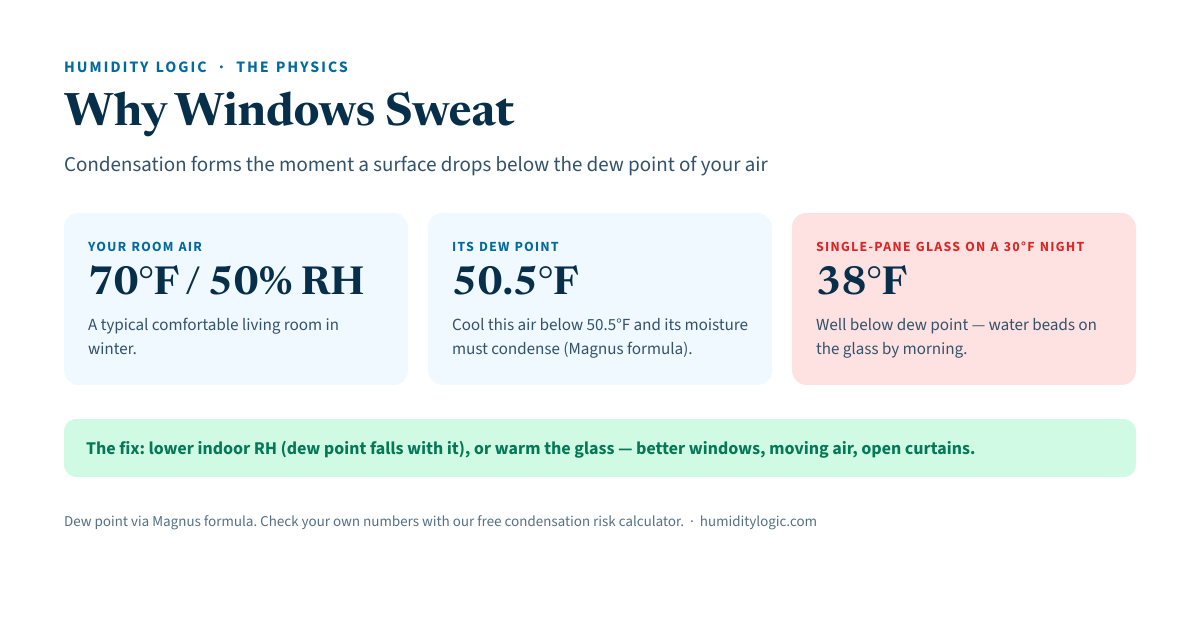
Take a typical living room at 70°F and 50% RH. The dew point is 50.5°F. On a January night, single-pane window glass can easily drop into the 30s or 40s — well below 50.5°F — and water beads up on the inside of the glass. That is the entire mechanism behind condensation on windows, sweating toilet tanks, and damp basement walls. You can check any temperature-and-humidity combination against any surface with our condensation risk calculator, which runs the same dew point math shown here.
Dew point also explains the muggy-house feeling. If your home sits at 75°F and 60% RH in summer, the indoor dew point is about 60°F — the sticky band. That is why a house can feel clammy even when the thermostat says the temperature is fine, and it is one of the clearer signs that your humidity is genuinely high rather than just warm.
How do you actually change the dew point?
This is where the distinction turns practical: only removing or adding water vapor changes the dew point.
- Air conditioning and dehumidifiers lower it. Both pull air across a cold coil, condense water out, and drain it away. Less vapor in the air means a lower dew point — a real change in mugginess, not a cosmetic one.
- Heating does not. Warming a room drops the RH percentage while leaving the dew point exactly where it was. The air feels drier because evaporation speeds up at higher temperatures, but the moisture — and the condensation risk on cold surfaces — is unchanged.
- Fans do not. Moving air accelerates evaporation from your skin, which helps comfort, but the dew point is untouched.
So when summer air in your house crosses roughly a 60°F dew point (for example, 75°F at 60% RH), the fix is moisture removal — mechanical dehumidification or AC runtime — not a lower thermostat setting alone. Cooling humid air without removing water actually raises the RH, which is why an oversized, short-cycling air conditioner can leave a house cold and clammy at once.
The bottom line
Relative humidity answers “how close is this air to saturation right now?” Dew point answers “how much water is actually in this air?” For deciding how a summer afternoon will feel, whether your windows will sweat tonight, or whether your house needs a dehumidifier rather than just more AC, the second question is the one worth asking. Learn your dew point bands — under 55°F comfortable, over 65°F muggy, over 70°F oppressive — and the weather will stop surprising you.
Frequently asked questions
Is 70% humidity the same as a 70°F dew point?
No. Relative humidity is a percentage that depends on air temperature, while dew point is a temperature that measures actual moisture. Air at 60°F and 70% RH has a dew point around 50°F and feels fine; air at 90°F with a 70°F dew point feels oppressive even at roughly 52% RH.
What dew point feels muggy?
Most people notice stickiness once the dew point passes 60°F, and 65–70°F feels distinctly muggy. Above 70°F the air feels oppressive — sweat evaporates so slowly that even mild temperatures feel draining. Below 55°F, almost everyone perceives the air as dry and comfortable.
Why do weather apps show relative humidity instead of dew point?
Mostly habit — RH is the older, more familiar number, and it is what basic hygrometers display. Meteorologists at the National Weather Service consistently point to dew point as the better comfort measure, and most detailed forecasts now list it alongside RH.
Does dew point matter indoors, or only outside?
It matters indoors too, especially for condensation. Room air at 70°F and 50% RH has a dew point of about 50.5°F, so any surface colder than that — winter window glass, an uninsulated corner — will collect water. That is exactly what a condensation-risk calculation checks.
How do I lower the dew point in my house?
You have to remove water vapor, not just change the temperature. A dehumidifier or air conditioner physically condenses moisture out of the air, which lowers the dew point. Fans and heaters change how air feels or its RH percentage, but they leave the dew point untouched.
Sources & references
Every figure on this page is checked against these published sources. Last reviewed July 21, 2026.