Condensation on windows happens when the glass surface drops below the dew point of your indoor air — the temperature at which water vapor has to turn back into liquid. Where the moisture sits tells you the fix: droplets on the inside mean indoor humidity is too high, film on the outside is harmless dew, and fog trapped between panes means a failed window seal.
Why Do Windows Sweat in the First Place?
A foggy window isn’t leaking — it’s measuring. Glass is the coldest indoor surface in your house, which makes it the first place your air’s moisture limit becomes visible.
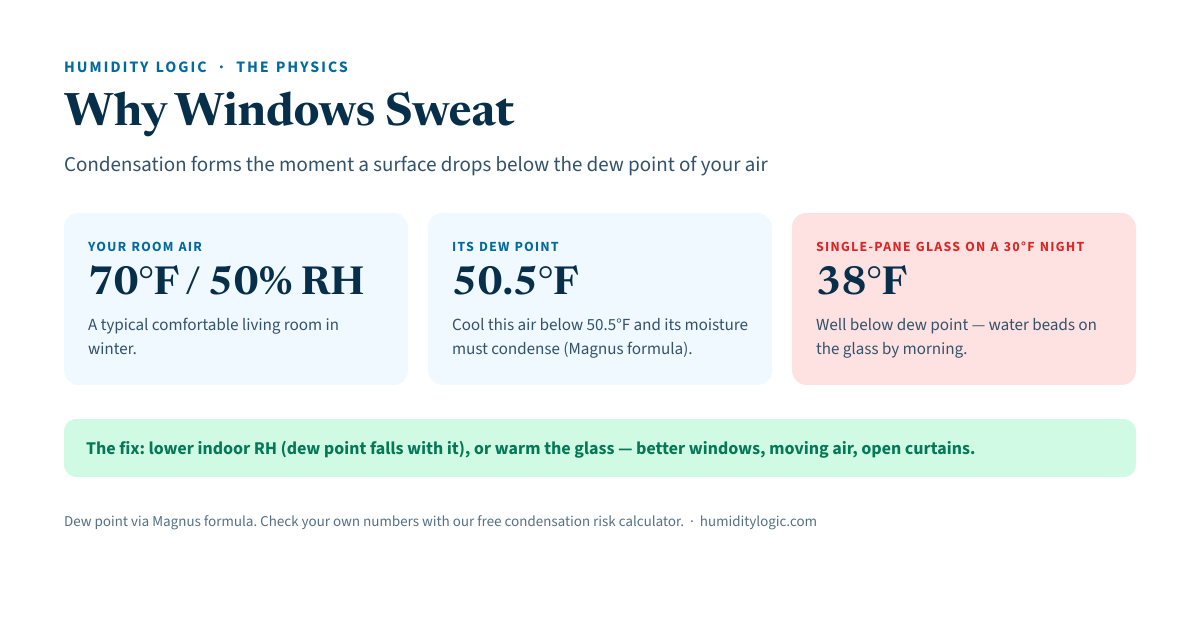
Air can only hold so much water vapor, and that capacity shrinks as air cools. For any combination of temperature and relative humidity, there’s a specific temperature — the dew point — where the air becomes saturated and water must condense out. Room air at 70°F and 50% RH has a dew point of about 50.5°F (calculated with the Magnus formula, the same math behind our condensation risk calculator).
Now put that air against a window on a 30°F night. A single-pane window might hold an interior surface temperature of around 38°F — a full 12 degrees below the 50.5°F dew point. Any air that touches the glass gets chilled past saturation, and the excess moisture has nowhere to go but onto the pane. That’s the entire mechanism. No leak, no defect — just physics finding the coldest surface in the room.
The practical takeaway: you can attack condensation from either side of the equation. Warm up the glass (better windows, storm inserts, air circulation) or lower the dew point of your air (less moisture, more ventilation). If the difference between dew point and glass temperature confuses you, our dew point vs. humidity explainer breaks down why dew point is the number that actually predicts wet windows.
Is the Condensation Inside, Outside, or Between the Panes?
One wipe of a fingertip diagnoses the problem. Run your finger across the fog and see what happens.
It wipes off from the room side: indoor humidity problem. This is the most common case, and the window itself is fine — it’s simply reporting that your indoor air is carrying more moisture than the coldest surface in the room can tolerate. The fixes below, from free habits to a dehumidifier, all target this scenario.
It’s on the exterior and burns off by mid-morning: harmless dew. Exterior condensation forms on cool, humid mornings — usually in spring and fall — exactly the way dew forms on grass. Counterintuitively, it’s a sign of efficient glass: the outer pane stays cold because your indoor heat isn’t escaping through the window. Do nothing. It will evaporate with the sun.
You can’t touch it from either side: failed seal. Fog or a milky haze sealed between the panes of a double- or triple-pane window means the insulated glass unit (IGU) has lost its seal and outside moisture has migrated into the cavity. This is a window repair problem, not a humidity problem — no dehumidifier, fan, or ventilation change will clear it. A glass shop can typically replace the IGU or sash for a fraction of the cost of a full window replacement.
Why Are My Windows Soaked Every Winter Morning?
Overnight condensation is the same physics with the deck stacked against you. Three things converge between midnight and dawn.
First, outdoor temperatures bottom out in the pre-dawn hours, dragging your glass to its coldest surface temperature of the day. Second, indoor moisture keeps accumulating: breathing, houseplants, and the day’s leftover shower and cooking humidity all load the air while ventilation is at its minimum. Third, closed curtains and blinds trap a pocket of still air against the glass, insulating the pane from room heat so it runs even colder — which is why the heaviest fog often hides behind the drapes.
That’s also why winter humidity targets are lower than the year-round comfort range. When it’s below freezing outside, aim for 30–40% RH indoors. At 70°F and 40% RH, the dew point drops to roughly 44°F — a much easier bar for cold glass to stay above than the 50.5°F dew point of 50% air. In severe cold snaps, even 40% can be too much for older windows, so treat the bottom of the range as your cold-weather setting. Our guide to ideal indoor humidity levels maps targets to outdoor temperature in more detail.
How Do You Fix Condensation on Windows, Cheapest First?
Start free, and only spend money when the cheaper tier fails. Most interior condensation surrenders long before you reach the bottom of this table.
| Cost tier | Fix | What it does |
|---|---|---|
| Free | Run bath/kitchen exhaust fans during and 15–20 min after use | Removes moisture at the source before it spreads |
| Free | Open curtains and blinds overnight | Lets room heat warm the glass above the dew point |
| Free | Crack interior doors; brief daily airing-out | Equalizes and flushes humid air |
| Under $50 | Hygrometer ($10–$20) | Tells you your actual RH so you’re not guessing |
| Under $50 | Window insulation film, weatherstripping, moisture absorbers | Warms the inner glass surface; dries closed rooms |
| $50–$300 | Portable dehumidifier | Directly lowers the dew point of your indoor air |
| $200–$600 | Interior storm window inserts | Adds an air gap that keeps room-side glass warm |
| Major | IGU/sash replacement (failed seal) or window upgrade | Repairs between-pane fog; raises glass temperature permanently |
Two notes on the middle tiers. Buy the hygrometer before the dehumidifier — if it reads 55% in January, you’ve found your problem for the price of a pizza, and a dehumidifier sized for the space will fix it. And if your RH is chronically high in winter, find the source before you fight the symptom: an unvented dryer, a crawl space, firewood stored indoors, or a humidifier set too high. Our walkthrough on how to lower humidity in your house covers tracking down hidden moisture sources room by room.
The major tier is for two situations only: between-pane fog (where replacement is the only fix) and homes where even 30% RH still soaks single-pane glass. In that second case, storm inserts or upgraded windows fix the cold-surface half of the equation that no dehumidifier can touch.
When Should You Actually Worry About Window Condensation?
Occasional morning fog that clears by noon is a nuisance. Persistent moisture is a warning.
Water that sits on sashes and sills day after day feeds mold on frames and caulk lines, peels paint, and eventually rots wood trim. If you’re seeing black speckling at the corners of the glass, staining on the drywall below the window, or condensation that never fully dries, your indoor humidity has been above the safe line for a while — and the windows are just the visible symptom. Moisture is likely also condensing inside wall cavities and on other cold surfaces you can’t see.
The fix is the same escalation path: measure your RH, pull it into the 30–40% winter band, and warm up the glass if that’s not enough. Run your numbers through the condensation risk calculator — enter your room temperature, humidity, and outdoor temperature, and it will tell you whether your glass is likely sitting below your air’s dew point tonight.
Frequently asked questions
Is condensation on the outside of my windows bad?
No — exterior condensation is just dew, the same moisture that forms on grass. It actually signals an efficient window: the outer pane stays cold because indoor heat is not leaking through the glass. It evaporates on its own once the sun comes up.
What should indoor humidity be in winter to prevent condensation?
When outdoor temperatures are below freezing, aim for 30–40% relative humidity indoors. Colder climates may need the lower end of that range, because colder glass condenses moisture at lower indoor humidity levels. A basic hygrometer tells you where you stand.
Can I fix fog between the panes of a double-pane window myself?
No. Fog trapped between panes means the insulated glass unit (IGU) seal has failed and moisture has leaked into the sealed cavity. No amount of dehumidifying will clear it — the fix is replacing the glass unit or sash, which a glass shop can often do without replacing the whole window.
Will a dehumidifier stop condensation on windows?
Usually, yes — if the condensation is on the room side of the glass. Lowering indoor relative humidity lowers the dew point of your air, so the glass no longer falls below it overnight. Pair the dehumidifier with a hygrometer and target 30–40% RH in freezing weather.
Why do only my bedroom windows fog up overnight?
Bedrooms combine the coldest hours of the night with a closed door, closed curtains, and hours of moisture from breathing. Curtains trap a pocket of still air against the glass, letting it get even colder. Cracking the door and opening curtains at night often fixes it for free.
Sources & references
Every figure on this page is checked against these published sources. Last reviewed July 21, 2026.