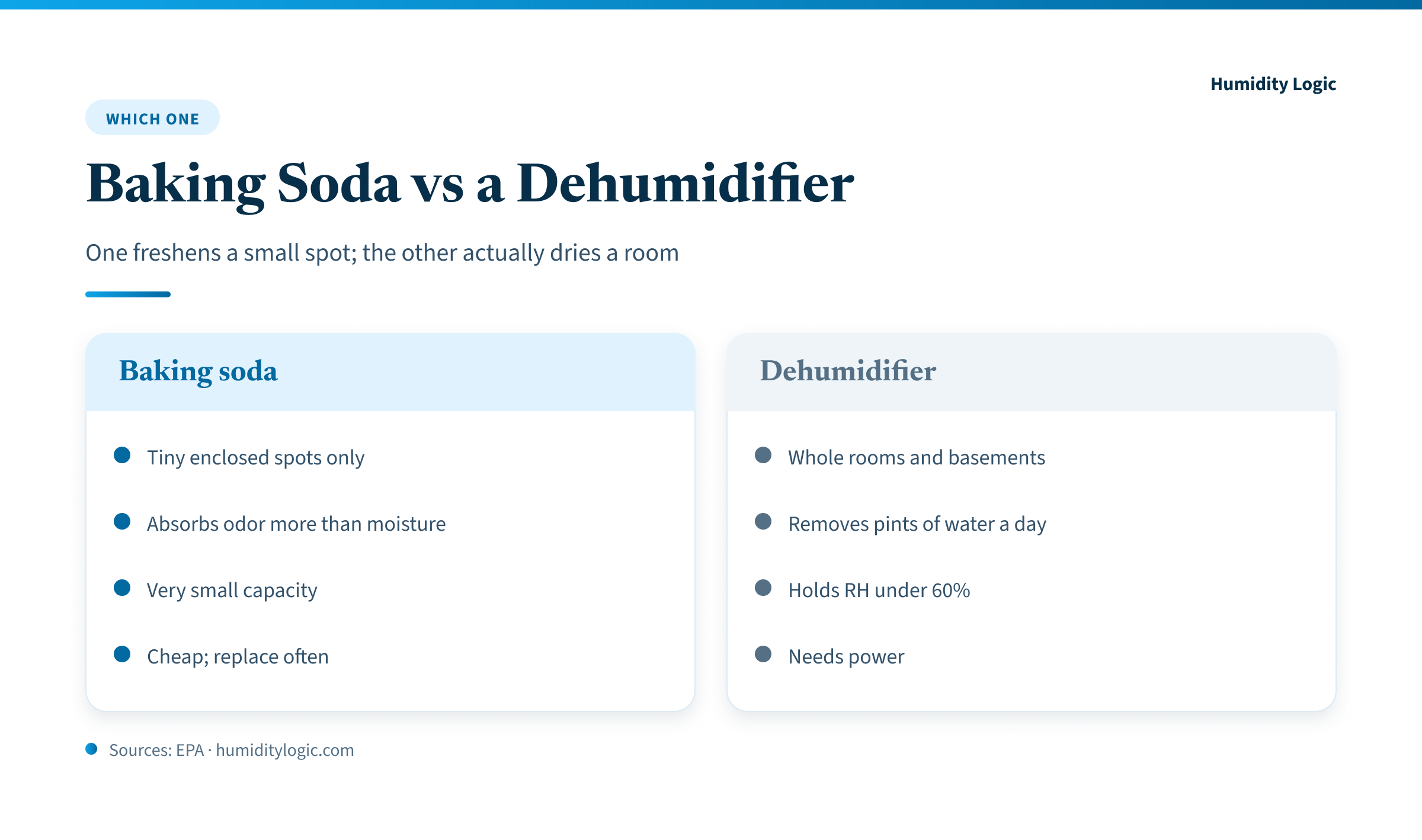
If you are weighing baking soda against a dehumidifier, they are not really competing for the same job. Baking soda freshens the air in a small, enclosed spot, like a drawer, a gym bag, or the fridge, and soaks up only a trace of moisture along the way. It does essentially nothing to lower the humidity of a room. A dehumidifier is an appliance that actively pulls pints of water out of the air and holds a whole room under 60% relative humidity. Baking soda is fine for a musty smell in a small space, but you need a dehumidifier to dry out an actual room.
The reason people compare them is that both get recommended for “damp” problems, and baking soda is cheap and already in the kitchen. But one is a mild odor absorber and the other is a moisture-removal machine. Using baking soda where you needed a dehumidifier just leaves the room damp.
What does baking soda actually do?
Baking soda, or sodium bicarbonate, is best understood as a deodorizer, not a dryer. It is a weak base, and according to the McGill University Office for Science and Society, it reacts with smelly volatile acids to form non-volatile salts that no longer smell. That is why an open box in the fridge slowly cuts food odors. The same article stresses that it only works with a large exposed surface area, which is why you spread it on a plate rather than leave the box mostly closed.
Baking soda is also mildly hygroscopic, so it does attract a small amount of water from the still air right next to it. But “a small amount” is the key phrase. A cup of powder in an open dish can hold only a trace of water before it clumps and stops absorbing, and it does nothing to the moisture in the rest of the room’s air. It has no fan, so it never touches air more than an inch or two away. In a sealed drawer or a shoebox that is enough to keep things fresh; in a room it is a rounding error.
So baking soda is genuinely useful for a narrow set of jobs: a stale closet, a musty gym bag, gym shoes, a cat box, or the fridge. What it cannot do is lower the humidity you feel in a room or stop condensation on a cold wall.
What does a dehumidifier do differently?
A dehumidifier attacks the moisture itself, and it does so on a completely different scale. A fan pulls room air across a refrigerated coil, water vapor condenses onto the cold metal, and the water drips into a tank or out through a drain hose while drier air blows back into the room. Because it moves air continuously, it reaches an entire room instead of just the air touching a container.
That active process is what lets it hit a humidity target. Portable units are rated by how much water they pull in 24 hours, and ENERGY STAR lists dehumidifiers by pint capacity, with common sizes running from around 20 pints for a mildly damp room up to 50-plus pints for a large, wet basement. No dish of powder comes close to that. If you are not sure which capacity fits your space, our guide on what size dehumidifier you need and the dehumidifier size calculator will size it to the room’s square footage and dampness.
The payoff is control. The EPA recommends keeping indoor relative humidity below 60 percent, ideally between 30 and 50 percent, and a properly sized dehumidifier can actually hold a room in that band. Baking soda cannot.
The cost picture works out differently too, and it is worth being clear-eyed about. Baking soda is cheap per box, but it saturates and clumps quickly, so keeping even a closet fresh means replacing it on a regular schedule. A dehumidifier costs more up front and adds to the electric bill while it runs, but that ongoing cost buys real moisture removal that a stack of baking soda boxes could never match. You are paying for capacity, not just convenience.
Baking soda vs dehumidifier: the quick comparison
| Baking soda | Dehumidifier | |
|---|---|---|
| Main job | Neutralizes odor | Removes moisture from air |
| Moisture removed | A trace, then it clumps | About 20-50 pints per 24 hours |
| Area it affects | The air right around the dish | A whole room or basement |
| Holds a humidity target? | No | Yes, typically under 60% RH |
| Power needed | None | Standard outlet |
| Cost | A few dollars, replace often | Higher up front, plus electricity |
| Best for | Drawers, bags, fridge, small closets | Rooms, basements, ongoing damp |
Which one should you use?
Reach for baking soda when the problem is a smell in a small, enclosed space and not the humidity of a room. A stale closet, a gym bag, sneakers, a drawer, or the fridge are all fair game, because the space is tiny and mostly sealed, and odor, not water, is the real complaint. In those spots baking soda is cheap, safe, and needs no outlet. If your issue is a slightly musty but dry closet, it can be enough on its own; see our closet dehumidifier guide for when a small closet crosses over from “smells stale” to “actually damp.”
Reach for a dehumidifier when a whole room, a basement, or a laundry area feels damp, when windows or cold walls sweat, or when you can smell mildew across the space rather than inside one box. Those are moisture problems, and only active moisture removal fixes them. A dehumidifier is also the right tool if you are trying to protect a finished basement or hold a steady humidity through a humid summer. For a broader plan, our article on how to lower humidity in the house walks through ventilation, source control, and dehumidification together.
If you are choosing between passive moisture products, a tub of moisture-absorbing crystals is a middle option worth understanding too. Our DampRid vs dehumidifier comparison covers that trade-off, and the short version applies here as well: passive absorbers suit small enclosed spaces, appliances suit rooms.
Does either one stop mold?
No, and this is the most important thing to be honest about. Neither baking soda nor a dehumidifier kills mold. What controls mold is controlling moisture. The EPA states plainly that the key to mold control is moisture control, and its mold course notes that mold can grow on virtually any organic material as long as moisture and oxygen are present. Take the moisture away and mold has nothing to grow on.
That is exactly why the two tools land so differently. Baking soda barely changes the moisture in a room, so it does little to prevent mold there, though it can scrub and deodorize a small patch of surface mildew. A dehumidifier keeps the whole room’s humidity low, which removes the condition mold needs. It still will not clean up mold that is already growing; you have to remove that separately. For the full picture on using humidity control to fight mold, see our guide on dehumidifiers for mold.
The bottom line
Baking soda and a dehumidifier are not rivals; they are tools for different sizes of problem. Baking soda is a mild, cheap odor absorber for a small enclosed spot, and it barely touches the humidity of a room. A dehumidifier is a moisture-removal appliance that dries whole rooms and holds them under 60% RH. Use baking soda for a musty drawer or gym bag. Use a dehumidifier for a damp room or basement. And remember that neither one kills mold: both only manage the moisture and odor that come with it.
Frequently asked questions
Does baking soda lower humidity in a room?
Not in any meaningful way. Baking soda is mildly hygroscopic, so an open dish will pull a little moisture out of the still air right next to it, but a cup of it holds almost nothing compared with the water in a whole room of air. It cannot keep an open room below a target humidity. For that you need a dehumidifier, which actively moves room air across a cold coil and removes pints of water a day.
Is baking soda or a dehumidifier better for a closet?
For a small, closed closet that mainly smells musty, an open box of baking soda is a cheap way to freshen the air. But if the closet actually feels damp or grows mildew, baking soda will not fix the moisture. A small dehumidifier, or a rechargeable desiccant unit, is the better tool because it removes water from the air rather than just neutralizing odor.
Does baking soda kill mold?
No. Neither baking soda nor a dehumidifier kills mold. The EPA is clear that the key to mold control is moisture control and that mold cannot grow without moisture. Baking soda can scrub some surface mildew and cut the smell, and a dehumidifier keeps humidity low so new mold has less chance to grow, but visible mold still has to be cleaned off the surface separately.
How much moisture can baking soda absorb compared with a dehumidifier?
A very small fraction. A dish of baking soda absorbs a limited amount of water before it clumps and stops working, usually over days. A portable dehumidifier is rated to pull anywhere from about 20 to 50 pints of water out of the air every 24 hours. The two are not on the same scale, which is why baking soda suits a drawer and a dehumidifier suits a room.
Can I use baking soda and a dehumidifier together?
Yes. A dehumidifier handles the overall humidity of a room or basement, while an open box of baking soda tucked inside a closet, gym bag, or fridge deals with odor in a small enclosed spot the airflow never really reaches. Each does what it is best at, so there is no conflict in using both.
Sources & references
Every figure on this page is checked against these published sources. Last reviewed August 1, 2026.