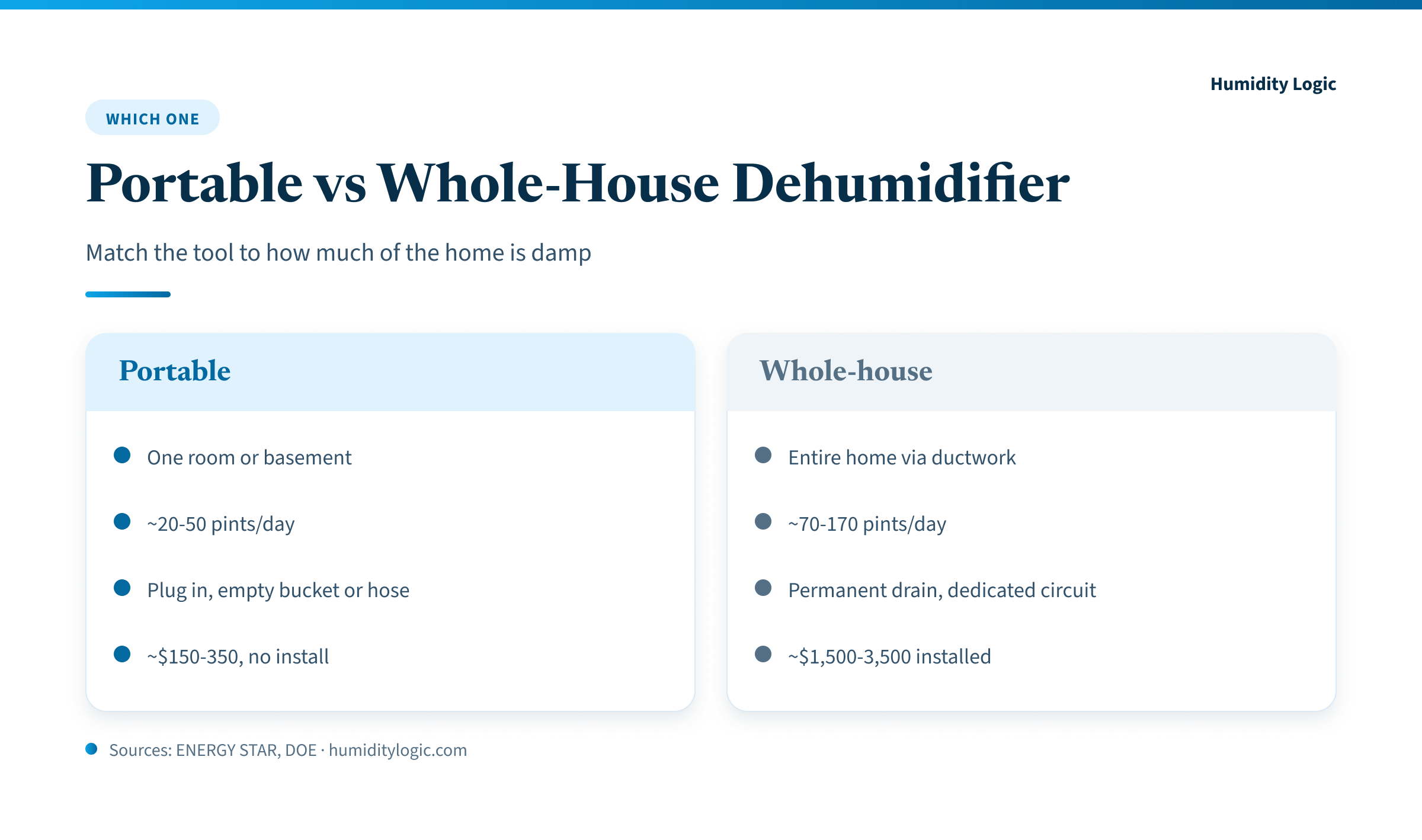
A portable dehumidifier fixes one damp room or basement cheaply — expect about $150–350 with no installation, and you plug it in and empty a bucket or run a short hose. A whole-house dehumidifier ties into your HVAC ductwork to dry the entire home and costs roughly $1,500–3,500 installed. The portable is the right first move for a single problem space; the whole-house unit earns its price when several rooms stay humid at once, when one portable can’t keep up, or when you want hands-off control across the whole home.
What Is the Real Difference Between Them?
The split is about how much of the home each one treats. ENERGY STAR describes a portable as a unit “typically used to dehumidify a single room or space” that “can be easily moved,” while a whole-home model is “installed to use your home’s air ducts to dehumidify one or more rooms” and is “often permanent” (ENERGY STAR).
A portable is a self-contained appliance sitting on the floor of the room it dries. A whole-house unit is a larger machine — usually tucked in a basement, crawl space, or mechanical closet — that pulls air from your return ducts, wrings the moisture out, and sends dry air back through the same registers that carry your heating and cooling. That single design choice cascades into every other difference: capacity, drainage, install, cost, and upkeep.
How Do Coverage and Capacity Compare?
Coverage is the first thing to match to your problem. A portable realistically handles one space — commonly 300–700 square feet of open area, or a basement up to roughly 2,500 square feet if the layout is open and the dampness is moderate. A whole-house unit is built to treat 2,000–4,500 square feet across multiple rooms and floors through the ductwork.
Capacity follows coverage. Portables are rated around 20–50 pints of water removed per day, which lines up with ENERGY STAR’s sizing guidance for rooms under 2,000 square feet. Whole-house units pull far more — commonly 70–170 pints per day (many popular models land in the 90–165 range) — because they are drying the volume of an entire home, not one room (AlorAir).
If you’re not sure which capacity class your space calls for, our guide to what size dehumidifier you need walks through square footage and dampness level and turns those inputs into a target pint rating. Getting the number right matters in both directions: ENERGY STAR advises that when you’re between sizes “it’s better to oversize than undersize,” because an undersized unit runs constantly and still loses ground on a truly damp space.
Portable vs Whole-House: The Numbers Side by Side
| Factor | Portable | Whole-house |
|---|---|---|
| Coverage | One room or basement (~300–2,500 sq ft) | Whole home (~2,000–4,500 sq ft) |
| Capacity | ~20–50 pints/day | ~70–170 pints/day |
| Installation | Plug into an outlet, no install | Ducted into HVAC, pro install |
| Drainage | Bucket or gravity hose | Permanent drain or condensate pump |
| Electrical | Standard 120V outlet | Often a dedicated circuit |
| Efficiency | ~1.5 L/kWh typical | ~2.6 L/kWh typical |
| Filter | Simple mesh, clean weekly | MERV-grade media |
| Typical lifespan | ~3–5 years | ~8–15 years |
| Typical price | ~$150–350, no install | ~$1,500–3,500 installed |
Two notes keep this table honest. The efficiency figures are per pint of moisture removed, not per hour — a small portable can draw fewer watts at any given moment yet still cost more per pint of water it extracts. And the price gap narrows over a full lifespan: because portables last only a few years and may need replacing two or three times, the ten-year total for running enough portables to cover a large home can approach or exceed a single ducted system.
What Does Installation and Drainage Look Like?
A portable needs nothing but a standard 120V outlet. You set it down, switch it on, and either empty the collection bucket by hand or run the included gravity hose to a nearby drain. That simplicity is the portable’s biggest advantage — and its biggest chore, since a full bucket shuts the unit off, and in a humid stretch you may empty it several times a day.
A whole-house unit is a professional installation. An HVAC tech ties it into your ductwork, sets up continuous drainage to a floor drain, sewer line, or condensate pump, and usually runs a dedicated electrical connection. Bryant notes that installation ties the unit into “ductwork integration with central HVAC,” “dedicated electrical connections,” and a “drainage system,” and that a complex install can take 6–10 hours (Bryant). The payoff is that it drains automatically and runs unattended — even while you’re away — with no bucket to empty. Our whole-house dehumidifier installation guide covers where the unit goes and how it connects.
How Much Does Each One Cost?
Upfront, the two aren’t close. A quality portable runs about $150–350, occasionally less for a small unit. A whole-house system costs roughly $1,500–2,800 for the unit, plus $500–1,000 for professional installation — landing most projects between $2,000 and $3,800, or about $1,500–3,500 for a typical install (Carrier).
Running cost tilts back toward the ducted unit for big jobs. Whole-house models are more efficient per pint (around 2.6 L/kWh versus roughly 1.5 for many portables), and drier air lets you nudge the thermostat up and cut AC runtime. For a full breakdown of what drives the installed number, see our dehumidifier installation cost guide and the whole-house dehumidifier overview.
What About Maintenance and Lifespan?
Portables ask for frequent, small attention: empty the bucket, rinse the mesh filter about weekly, and expect a service life of roughly 3–5 years of hard use. A portable that runs flat-out through every humid season wears its compressor and fan hard, and a meaningful share of units fail early. Whole-house units ask for less-frequent, larger attention: change a MERV-grade filter periodically and have the system checked with your annual HVAC service, with a typical lifespan of 8–15 years. The trade is hands-on-often versus hands-off-mostly — and it’s a big reason the two systems end up closer in lifetime cost than the sticker prices suggest, since replacing a portable every few years quietly adds up.
When Should You Step Up to Whole-House?
Start with a portable when the problem is contained — a single damp basement, a musty spare room, or a seasonal humidity spike. Our basement dehumidifier guide covers the most common single-space case in detail.
Step up to whole-house when the damp isn’t contained anymore. The clearest signals:
- Multiple rooms or floors stay humid at once. Closed doors and separate levels defeat a portable, which only dries the air near it.
- One portable can’t keep up. If you’re emptying the bucket several times a day or the room never reaches your target humidity, the unit is undersized for the load.
- You’d need two or more portables to cover the space. At that point the combined price, noise, and upkeep of several machines often exceeds one ducted system.
- You live in a consistently humid climate. Across much of the Southeast, whole-home control tied to the HVAC is simpler and more effective than chasing rooms with portables.
- You want it hands-off. A whole-house unit drains itself and runs while you’re away; a portable stops when its bucket fills.
The Bottom Line
Match the tool to how much of the home is damp. One problem room, a tight budget, and a willingness to empty a bucket point to a portable at $150–350. Several humid rooms, a large or persistently damp home, and a preference for set-and-forget point to a whole-house unit at $1,500–3,500 installed. If you’re on the fence, size the space first with the dehumidifier size calculator — the pint number it returns usually makes the choice obvious.
Frequently asked questions
Can a portable dehumidifier dry a whole house?
Sometimes, if the house is under about 2,000 square feet, fairly open, and the moisture is mild. But a single portable unit only treats the air near it — closed doors, separate floors, and distant rooms stay humid. Once you find yourself buying a second or third portable to cover more rooms, a whole-house unit ducted into your HVAC usually costs less over its life and dries every room evenly.
How much does a whole-house dehumidifier cost installed?
Plan on roughly $1,500 to $3,500 installed. The unit itself runs about $1,500 to $2,800, and professional installation adds another $500 to $1,000 depending on ductwork access, drain routing, and whether a dedicated electrical circuit is needed. A portable, by contrast, is $150 to $350 with no install cost.
Do portable dehumidifiers use less electricity than whole-house units?
Per hour, a portable often draws less because it is a smaller machine. But whole-house units are more efficient per pint of water removed — around 2.6 liters per kWh versus roughly 1.5 for many portables — so if you are drying a large or persistently damp home, the ducted unit can remove far more moisture for each dollar of electricity.
Does a whole-house dehumidifier need its own drain and circuit?
Yes. Whole-house units drain continuously to a floor drain, condensate pump, or sewer line rather than a bucket, and most need a dedicated electrical connection installed by a pro. That permanent drain and wiring is a big part of what separates a $2,000-plus installed system from a plug-in portable you empty by hand.
When should I upgrade from a portable to a whole-house dehumidifier?
Step up when multiple rooms or floors stay humid at once, when you are emptying a portable's bucket several times a day, when you would need two or more portables to cover the space, or when you live in a consistently humid climate and want hands-off, whole-home control tied to your HVAC.
Sources & references
Every figure on this page is checked against these published sources. Last reviewed July 27, 2026.