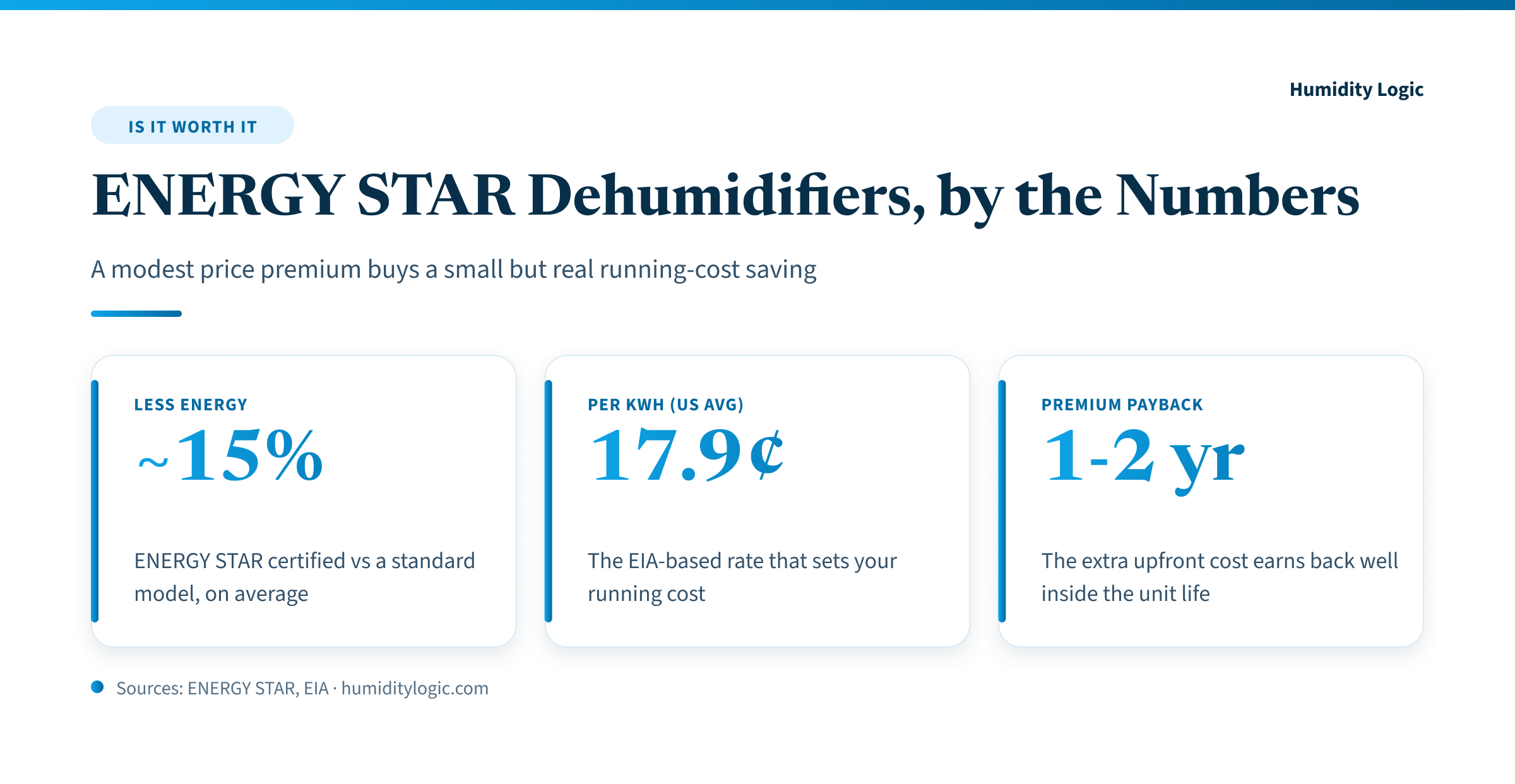
An ENERGY STAR dehumidifier uses about 15% less energy than a standard model of the same size while pulling out the same amount of water, and the certified version usually costs only about $30–$50 more upfront. Because a typical 50-pint unit costs roughly $24 a month to run at the US average rate of 17.9¢/kWh, that modest premium normally pays for itself in one to two years — comfortably inside the unit’s five-to-ten-year life. So it is worth it for most buyers, as long as you are not paying a big premium chasing what are, in absolute dollars, fairly small savings.
The rest of this article shows exactly what certification requires, does the running-cost math for a standard versus a certified unit, and explains when the premium is — and isn’t — worth paying.
What does ENERGY STAR certification actually mean?
ENERGY STAR rates dehumidifiers on their Integrated Energy Factor (IEF), which ENERGY STAR defines as “liters of water removed per kilowatt-hour (kWh) of energy consumed, or L/kWh.” A higher IEF means the unit wrings more water out of the air for every unit of electricity it draws. Unlike the older Energy Factor metric it replaced, IEF also counts the electricity used when the unit has cycled off, so it reflects real-world running cost more honestly.
To earn the label under the Version 6.0 requirements that took effect October 1, 2025, a portable dehumidifier has to clear a minimum IEF for its capacity class:
- 25 pints/day or less: at least 1.70 L/kWh
- About 25 to 50 pints/day: at least 2.01 L/kWh
- 50 pints/day or more: at least 3.30 L/kWh
Larger units have to hit a higher bar because bigger compressors move more air and water, so the standard scales with capacity. The practical takeaway: certification is a floor on efficiency, not a measure of how much moisture the unit removes. A certified 50-pint unit and a standard 50-pint unit both remove 50 pints a day — the certified one just uses less power to do it.
How much less energy does it really use?
ENERGY STAR states that a certified dehumidifier uses about 15% less energy than a standard model of the same capacity, thanks to more efficient refrigeration coils, compressors, and fans. The very best models, flagged as ENERGY STAR Most Efficient, beat the baseline by a wider margin, but 15% is the honest number to plan around for a typical certified unit.
Fifteen percent sounds small, and in a single month it is. The reason it can still be worth chasing is that a dehumidifier is one of the longer-running appliances in a damp home — in a wet basement it may cycle for the better part of the year. Efficiency compounds with hours, so the value of the certification depends heavily on how much you actually run the machine. That is why the payback math below matters more than the headline percentage.
What does a dehumidifier cost to run?
Start with the baseline. A right-sized 50-pint unit draws about 550 watts. If it cycles for 8 hours a day, that is 0.55 kW × 8 h = 4.4 kWh a day. At the US average price of 17.9¢/kWh, that works out to about $0.79 a day, or roughly $24 a month — the same figure our guide to how long to run a dehumidifier lands on. You can run your own numbers with our electricity cost calculator, which estimates monthly cost from wattage, hours, and your local rate.
Now compare a certified unit doing the identical job with about 15% less power:
- Standard 50-pint: 4.4 kWh/day × 17.9¢ ≈ $0.79/day → ~$23.6/month
- ENERGY STAR (~15% less): 3.74 kWh/day × 17.9¢ ≈ $0.67/day → ~$20.1/month
The certified unit saves you roughly $3.50 a month while it is running — call it about $0.12 a day. Nobody notices that on a single bill, which is exactly why the sticker-shock reaction (“it’s not worth a few dollars a month”) misreads the math. The saving is real; it just has to be added up over a season and a lifetime.
How fast does the premium pay back?
Here is the honest payback, built entirely from the numbers above. Certified models typically cost about $30 to $50 more than an otherwise-comparable non-certified unit.
- Light seasonal use — 8 hours a day for a four-month humid season: about $16 saved a year. A $40 premium pays back in roughly 2 to 3 years.
- Typical damp-basement use — 8 hours a day for six months: about $24 saved a year. A $40 premium pays back in under 2 years.
- Heavy near-year-round use — a basement that stays humid most of the year: $30 to $40+ saved a year, so the premium is gone in about a year.
Against a 5-to-10-year service life, every one of those scenarios comes out ahead. The unit spends most of its life saving you money after the premium is repaid. The one case where certification isn’t worth stretching for is a machine you’ll barely use — a spare-room unit that runs a few weeks a year saves so little that a large premium would take many years to recover. Match the decision to your run hours, not to the badge.
How do you spot the efficiency at the store?
Two labels tell you almost everything. The blue ENERGY STAR mark confirms the unit clears the IEF floor for its capacity class. The yellow EnergyGuide label, required on the box, then lets you compare specific models: it estimates the unit’s annual energy use and cost, so two certified 50-pint units aren’t necessarily equal — one may still edge out the other. If you want the top tier, look for the ENERGY STAR Most Efficient designation, which flags the models that beat the baseline by the widest margin.
Because the certified premium is small and the payback is measured in months of running, the more valuable comparison at the shelf is usually between two certified models rather than certified versus not. A slightly higher IEF on the exact capacity you need will save more over the unit’s life than agonizing over whether to buy certified at all. Note the wattage on the spec sheet too — it’s the number that drives the daily-cost math above, and a lower draw for the same pint rating is the efficiency you’re paying for.
When is it not worth it?
Certification is an efficiency label, not a capability upgrade, so it should never be your first filter. Get the size right for your space and moisture load first — an oversized or undersized unit wastes far more money than the 15% efficiency gap ever recovers. It also helps to understand how a dehumidifier actually works, because the efficiency gains live in the compressor and coil design that the IEF rating measures.
Two situations make the premium hard to justify. First, very light use, as noted above. Second, the wrong technology for cold conditions: standard compressor dehumidifiers — certified or not — lose efficiency in chilly spaces, so if you’re drying an unheated basement or crawlspace below about 65°F, the compressor-versus-desiccant tradeoff matters more than the ENERGY STAR label. In a normal basement or living space run through humid months, though, a certified compressor unit is the straightforward pick.
The bottom line
For a unit you’ll run through the humid season year after year, an ENERGY STAR dehumidifier is worth it: about 15% less energy, a premium of only $30–$50, and a payback measured in one to two years at 17.9¢/kWh. Treat certification as the tiebreaker after you’ve chosen the right size and type — not as the headline feature — and you’ll capture the savings without overpaying for the badge.
Frequently asked questions
What does ENERGY STAR certification actually require for a dehumidifier?
Certification is based on the Integrated Energy Factor (IEF), measured in liters of water removed per kilowatt-hour (L/kWh) — a higher number means a more efficient unit. Under the Version 6.0 requirements effective October 1, 2025, a portable model must hit at least 1.70 L/kWh at 25 pints/day or less, 2.01 L/kWh from about 25 to 50 pints/day, and 3.30 L/kWh at 50 pints/day or more.
How much less energy does an ENERGY STAR dehumidifier use?
ENERGY STAR says a certified dehumidifier uses about 15% less energy than a standard model of the same capacity while removing the same amount of moisture. The gain comes from more efficient compressors, coils, and fans. ENERGY STAR Most Efficient models can do considerably better than the baseline.
Is the higher price of an ENERGY STAR dehumidifier worth it?
For most buyers, yes. The certified premium is usually only about $30–$50 on a comparable model, and the running-cost saving typically earns that back within one to two years of normal seasonal use — well inside the five-to-ten-year life of the unit. The savings are modest in dollar terms, so it is not worth paying a large premium chasing them.
How much does an ENERGY STAR dehumidifier save per year?
It depends entirely on how many hours it runs. A 50-pint unit run about 8 hours a day through a roughly four-month humid season saves in the ballpark of $15–$20 versus a standard model at 17.9¢/kWh. A unit that runs most of the year in a damp basement can save $30–$40 or more annually.
Does ENERGY STAR certification make the dehumidifier work better?
It certifies efficiency, not moisture removal — a certified 50-pint unit pulls the same water from the air as a standard 50-pint unit, just using less electricity to do it. So size the unit to your space and moisture load first, then treat ENERGY STAR as a tiebreaker between similarly capable models.
Sources & references
Every figure on this page is checked against these published sources. Last reviewed July 27, 2026.