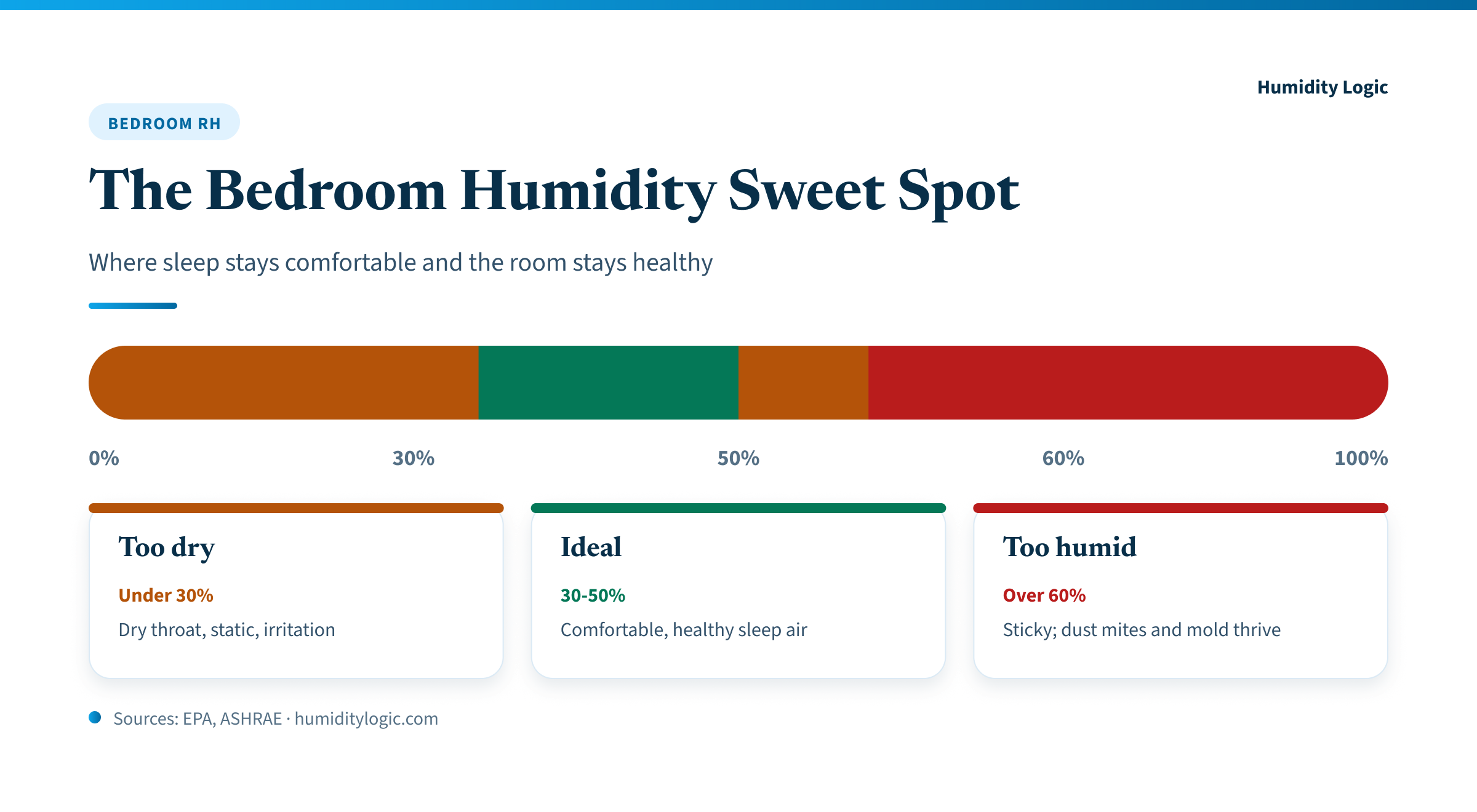
The best bedroom humidity for sleep is 30-50% relative humidity, and you should keep it under 60% at all times. That is the same healthy band the EPA recommends for the whole house, and the Sleep Foundation points to the same 30-50% range for comfortable rest. Too humid and the room feels sticky while dust mites and mold gain a foothold; too dry and you wake with a scratchy throat and static-charged sheets. Landing in the middle keeps the air comfortable to breathe and the room healthy to sleep in.
What is the best humidity level for sleep?
Aim for 30-50% relative humidity in the bedroom, the same range that works for the rest of your home. There is no separate “sleep number” for humidity — a comfortable, healthy bedroom sits in the identical band that keeps a living room or hallway comfortable. The EPA advises keeping indoor humidity “below 60 percent (ideally between 30 and 50 percent),” and that guidance carries straight into where you sleep.
Some sleep and HVAC sources cite a slightly narrower 40-60% window, but the numbers overlap on the parts that matter: stay above roughly 30% so the air is not parching, and stay clear of 60%, which nearly everyone treats as the ceiling. If you want the full reasoning behind the range for every room, our guide to ideal indoor humidity levels breaks it down season by season. For the bedroom specifically, 40-45% is a comfortable middle target most of the year.
How does humidity affect sleep quality?
Humidity shapes how easily your body manages its own temperature overnight, and body temperature is central to sleep. As you fall asleep your core temperature naturally drifts down, and your skin sheds heat partly by evaporating sweat. When the surrounding air is already saturated with moisture, that evaporation slows, so your body has a harder time cooling to the level deep sleep prefers.
The Sleep Foundation notes that excessive humidity “can increase wakefulness and reduce the amount of time you spend in both slow-wave NREM and REM sleep” — the restorative stages. In other words, a muggy room does not just feel unpleasant; it can fragment the night into lighter, more broken sleep. The effect is strongest when heat and humidity stack together, because a warm, damp room removes the two easiest paths your body has for cooling down.
Dry air works from the other direction. It does not disturb your thermoregulation, but it pulls moisture from the surfaces it touches, which is why very dry winter bedrooms are associated with a dry throat, irritated sinuses, and worse snoring for some people. None of this is a diagnosis — it is comfort and environment, and individual responses vary — but the pattern is consistent enough that keeping humidity in range removes a common, avoidable sleep disruptor.
What happens when the bedroom is too humid at night?
Above 60%, three separate problems build at once. First, comfort: sweat evaporates poorly, so you feel sticky and may wake up warm even when the thermostat reads a reasonable number. Second, dust mites. These microscopic bedding-dwellers absorb water vapor directly from the air rather than drinking it, and the American Lung Association calls humidity “the most important factor” in whether a home has high dust-mite levels, advising you keep the house below 50% to discourage them. A mattress and pillows in a chronically damp room are exactly the warm, moist habitat they favor.
Third, mold. The EPA’s core principle is that “the key to mold control is moisture control,” and sustained humidity past 60% keeps porous surfaces — drywall, closet contents, the wall behind a bed pushed against a cold exterior wall — damp enough to grow it. If your bedroom regularly reads in the high 50s or 60s, our explainer on what is considered high humidity covers the thresholds, and a right-sized bedroom dehumidifier is usually the most direct fix for a room that will not dry out on its own.
Is low humidity bad for sleep?
Very dry air is more of a comfort nuisance than a hazard, but it can still cost you rest. Below about 30% — common in winter when heating systems run for months — the air draws moisture out of everything, including the mucous membranes in your nose and throat. People often describe waking with a dry or scratchy throat, a stuffy nose that will not clear, chapped lips, and static that crackles across the sheets. Dry air can also aggravate snoring for some sleepers.
The fix is gentle. You rarely need to flood a room with moisture; nudging a bedroom from the low 20s up into the 30s is usually enough. A small humidifier running overnight is the common tool, and our guide to how to increase humidity covers both appliance and no-appliance methods. Keep it modest, though — overshooting into the 50s and 60s in a cold bedroom can send that moisture straight to the windows as condensation, trading one problem for another.
What is the ideal bedroom temperature and humidity together?
Temperature and humidity work as a pair, and the most comfortable sleep comes from managing both. The Sleep Foundation recommends a bedroom temperature around 65°F, which aligns with the body’s natural overnight temperature dip. Pair that with 30-50% humidity and you have a room that lets your body cool efficiently without feeling either clammy or parched.
The pairing matters because relative humidity depends on temperature. The same amount of moisture in the air reads as a higher relative humidity when the room is cool and a lower one when it is warm — which is why a bedroom that feels fine at bedtime can read damper by the coolest hour before dawn. Our humidity comfort checker lets you plug in your bedroom’s temperature and humidity to see whether the combination lands in the comfortable zone or drifts toward sticky or dry. If you want the underlying physics, the National Weather Service explains how dew point tracks the actual moisture in the air regardless of temperature.
How do you keep bedroom humidity in the ideal range?
Match the tool to the direction you need to move. In a damp bedroom, start by removing moisture at the source: run the bathroom exhaust fan after showers, avoid drying laundry in the room, and in humid months lean on air conditioning, which dries the air as it cools. When those are not enough — a basement bedroom, a humid climate, a room that reads 60% night after night — a dehumidifier sized to the space is the reliable answer. Our guide to lowering humidity in the house ranks every method by cost and impact.
In a dry bedroom, add moisture in moderation with a humidifier and, if you can, run the heat a touch cooler so the air is not baked dry. The EPA’s indoor air quality guidance stresses that both extremes are worth avoiding, and that clean, well-ventilated air supports a healthier bedroom overall. Whichever direction you are correcting, make one change at a time and recheck after a night or two.
How do you measure bedroom humidity?
Buy a small digital hygrometer — they cost about $10-15 — and set it on the nightstand, away from the door, window, and any vent so it reads the air you actually sleep in. Check it over several nights rather than trusting a single number, because humidity swings with the weather, the season, and whether the door is open. Reading it last thing at night and first thing in the morning gives you the range your body experiences during sleep, and morning is often the dampest reading because the room has cooled.
Once you know your baseline, the numbers to remember are short: 30-50% is the target, 40-45% is a comfortable middle, and 60% is the ceiling you do not want to sit above overnight. If your bedroom already lives in that band, there is nothing to fix — the room is doing its job so you can rest.
Frequently asked questions
What is the best humidity level for sleeping?
Aim for 30 to 50 percent relative humidity in the bedroom and keep it under 60 percent. That is the same healthy band the EPA recommends for the whole house, and the Sleep Foundation points to the same range for comfortable sleep.
Is 60% humidity too high for a bedroom?
Sixty percent is the ceiling, not a target. At and above 60% the air feels sticky, sweat evaporates poorly, and dust mites and mold have the moisture they need. If your bedroom sits at 60% or higher overnight, treat it as a signal to remove moisture.
Can dry air affect my sleep?
Yes. Below about 30% relative humidity the air can leave your throat and sinuses feeling dry and scratchy and worsen static and cracked skin. It is a comfort issue rather than a medical one, and adding a little moisture usually settles it.
Does a humid bedroom make you hot at night?
It can. When the air is very humid, sweat evaporates off your skin more slowly, so your body sheds heat less efficiently and you may wake up feeling warm and clammy. Lowering both temperature and humidity helps you stay comfortable.
What humidity keeps dust mites out of the mattress?
The American Lung Association advises keeping your home below 50 percent humidity, because dust mites pull moisture straight from the air and struggle in drier conditions. Staying in the 30-50% band makes bedding a far less hospitable place for them.
Sources & references
Every figure on this page is checked against these published sources. Last reviewed July 27, 2026.