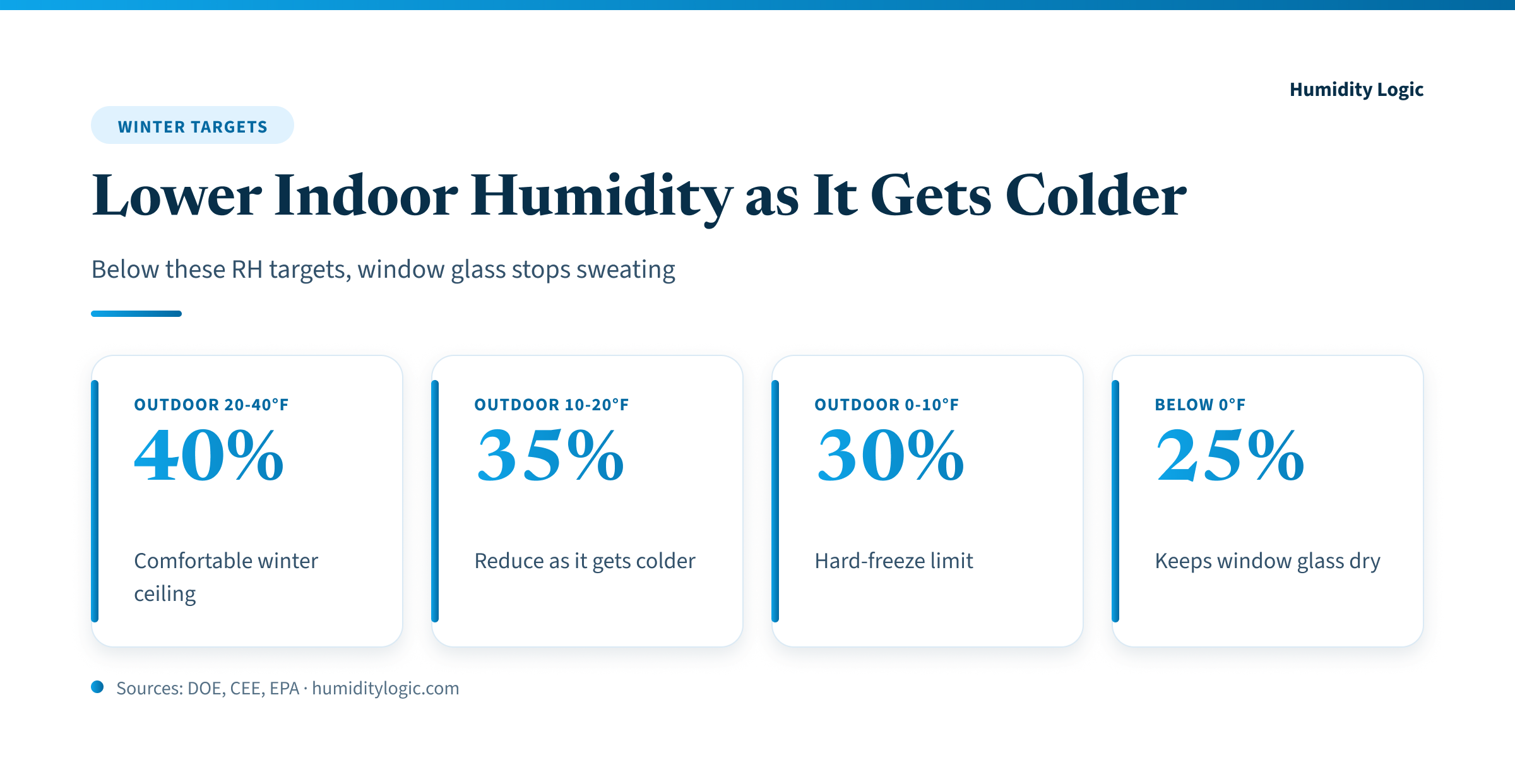
In winter, indoor humidity should slide down as the outdoor temperature falls. Keep relative humidity around 40% when it is in the 20s and 30s (°F) outside, drop toward 30-35% in the teens and single digits, and pull down to 25% or lower in a hard freeze below 0°F. The one rule that never changes: the EPA says keep indoor humidity under 60% year-round. The reason for the sliding scale is condensation on cold glass, not comfort.
Why Does Winter Indoor Humidity Have to Drop as It Gets Colder?
The colder it is outside, the colder your window glass gets, and cold glass is where indoor moisture goes to condense. Your furnace keeps the room air warm, but it cannot keep the inside surface of the glass warm. On a single- or older double-pane window, that interior surface roughly tracks the outdoor temperature — so when it is 10°F outside, the glass can sit in the 30s or 40s (°F) even while the room reads a cozy 70°F.
Warm air holds more water vapor than cold air, and every parcel of air has a temperature at which it can hold no more. Cross that line and the water comes out as liquid. As the DOE Building America Solution Center puts it, “visible condensation or frost on windows or cold wall surfaces is an obvious sign of high humidity levels in the home.” The fix is to keep the air dry enough that it does not reach that limit on the coldest surface in the room — the glass. That is why the winter target is not a single number but a scale that moves with the weather.
What Is the Winter Indoor Humidity Sliding Scale?
There is a well-established table for this, built from building-science studies at a 70°F indoor temperature. The Center for Energy and Environment publishes the version most often cited in cold-climate states:
| Outdoor temperature | Maximum indoor RH |
|---|---|
| +20 to +40°F | 40% |
| +10 to +20°F | 35% |
| 0 to +10°F | 30% |
| -10 to 0°F | 25% |
| -20 to -10°F | 20% |
| Below -20°F | 15% |
Read it as ceilings, not goals. You do not have to run your house at 20% just because a cold snap arrived — but if condensation shows up, this table tells you how far down you may have to go. CEE is blunt about the top of the range: “When it is extremely cold out, 40% RH may still lead to problematic condensation on windows and wall surfaces.” Window makers land in the same place. Andersen Windows advises, “In the winter months, you should aim for 30 to 35 percent humidity in your home.”
None of this contradicts the EPA’s familiar 30-50% ideal range. Winter simply lives in the bottom half of it. Think of 30-50% as the year-round envelope and the sliding scale as where inside that envelope you should sit on any given cold day. For the full-year picture, see our guide to ideal indoor humidity levels.
How Does the Dew Point Actually Cause Window Sweat?
The dew point is the single number that ties humidity and temperature together, and it is what really governs whether your windows drip. The National Weather Service defines it as “the temperature the air needs to be cooled to (at constant pressure) in order to achieve a relative humidity (RH) of 100%.” In plain terms: it is the temperature at which the air is full and starts letting go of water. Any surface colder than the dew point of the surrounding air will collect condensation.
That reframes the whole problem. Room air at 70°F and 40% RH has a dew point near 44°F. So the moment any window, wall, or pipe drops below 44°F, that surface sweats. Lower the indoor humidity to 30% and the dew point falls to about 37°F — the glass can now get several degrees colder before condensation starts. You are not warming the glass; you are lowering the temperature at which the air surrenders its moisture. That is the entire mechanism behind the sliding scale, and it is why relative humidity alone can mislead you. Our explainer on dew point vs. humidity works through more examples, and the condensation risk calculator does the math for your exact indoor temperature and humidity, showing the surface temperature at which your windows will begin to fog.
What Are the Signs My Winter Humidity Is Too High?
Your windows are the most honest hygrometer in the house. Because the glass is the coldest surface in most rooms, it fogs first — long before you would notice damp air any other way. Persistent condensation on the interior of the glass, water pooling on the sill, or frost patterns in a hard freeze all mean the same thing: the indoor air is carrying more moisture than the current outdoor temperature allows.
Watch for these, roughly in the order they appear as humidity climbs:
- Fog at the corners and bottom edge of windows in the morning — the first and mildest sign.
- Steady beads or running water on the glass that do not clear by midday.
- Frost or ice on the interior glass when it is well below freezing outside.
- Damp, staining, or peeling paint on the sill and window frame, and eventually mold at the joints.
- Musty smells or spots on closet walls and exterior-facing corners, where surfaces are coldest.
A little edge fog on a bitter morning is common and not an emergency. Sustained condensation is the signal to act. If your glass is already wet, our step-by-step guide to condensation on windows covers the fixes in order of cost and impact.
How Do I Lower Indoor Humidity in Winter?
Start by measuring, then subtract moisture at its sources. You cannot manage a number you are not watching, so put an inexpensive humidity meter in a main living area — away from the kitchen, bathroom, and exterior doors, which read artificially high. Check it against the sliding scale for the current outdoor temperature. If you are above the ceiling for today’s cold, work down this list:
- Run exhaust fans. Cooking, showering, and even boiling water for tea dump moisture into the air. Run the bath fan during and 20 minutes after a shower, and the range hood while you cook.
- Turn down or turn off a whole-house humidifier. Many furnaces have one, and a humidistat set for mild weather will overshoot badly in a cold snap. Dial it back as the forecast drops.
- Vent moisture sources. Make sure the clothes dryer vents outside, cover sump pits and crawl-space dirt floors, and avoid drying laundry indoors during cold spells.
- Move air across the glass. Open blinds and drapes so warm room air reaches the window; closed coverings trap a cold pocket against the glass and invite condensation, which is why CEE notes covered windows may need even lower humidity.
- Add ventilation or a dehumidifier for stubborn spots. In tight, modern homes the DOE points to balanced mechanical ventilation; in a damp basement, a dehumidifier sized to the space does the work.
The opposite problem — air so dry it cracks woodwork and chaps skin below 30% — is real too, but it is a comfort issue, not a building-damage one. If your windows are bone dry and the house feels harsh, our guide to how to increase humidity shows how to add moisture back safely without tipping into condensation.
What Winter Humidity Numbers Should I Memorize?
Keep three anchors in mind and you will rarely go wrong. First, 40% is your mild-winter ceiling — fine when it is in the 20s or 30s outside. Second, drop to 30-35% once it is in the teens or colder, and toward 25% or below in a hard freeze. Third, 60% is the line you never cross, in any season, per the EPA.
Everything else follows from watching the glass. If the windows are clear, your humidity is in the right place for today’s weather. If they are fogging, the air is too wet for how cold it is outside — lower it by about 5% and check again the next morning. The sliding scale is just a starting point; your own windows are the final word.
Frequently asked questions
What should indoor humidity be in winter?
It depends on how cold it is outside. Aim for about 40% when outdoor temperatures sit in the 20s and 30s (°F), drop to 30-35% once it falls into the teens and single digits, and pull down to 25% or lower in a hard freeze below 0°F. Never exceed 60%.
Why do I have to lower humidity when it gets colder?
Because your window glass gets colder too. Interior glass tracks the outdoor temperature, and when it drops below the dew point of your indoor air, water condenses on it. Lowering indoor humidity lowers the dew point, so the glass can get colder before it sweats.
Is 50% humidity too high in winter?
For most heated homes in freezing weather, yes. Fifty percent air condenses on any window colder than about 50°F, which describes most glass when it is below freezing outside. Fifty percent is fine in summer, but winter calls for 30-40% to keep windows and walls dry.
Is 30% humidity too low for a house in winter?
No. Thirty percent sits at the bottom of the EPA's 30-50% range and is a normal, healthy winter target, especially during cold snaps. It can feel dry on skin and sinuses, but it protects windows and walls from condensation. Below 30% is where dryness becomes a comfort issue.
How do I know if my winter humidity is too high?
Your windows tell you. Persistent condensation, fog, or frost on the interior glass, or damp sills and mold at the frame, means the indoor air is too humid for the current outdoor temperature. Lower it by 5% and watch whether the glass clears over the next day.
Sources & references
Every figure on this page is checked against these published sources. Last reviewed July 27, 2026.
- US EPA — A Brief Guide to Mold, Moisture and Your Home
- DOE Building America Solution Center — Managing Indoor Humidity and Ventilation in Cold Weather
- Center for Energy and Environment — Managing Indoor Humidity Levels All Year Round
- Andersen Windows — Window Condensation 101
- National Weather Service — Dew Point vs. Relative Humidity