You need a crawl space dehumidifier only when relative humidity stays above 60% after sealing the space — the threshold at which EPA says mold growth becomes likely. Fix moisture sources first: a 6-mil ground vapor barrier, sealed vents, and working drainage. Then size the unit at roughly 35–50 pints/day (post-2019 rating) for a typical 1,000–1,500 sq ft crawl space, targeting about 55% RH.
Do You Actually Need a Crawl Space Dehumidifier?
Not automatically — a dehumidifier is the last step in crawl space moisture control, not the first, and plenty of crawl spaces never need one once they’re sealed. The honest test is a $15 hygrometer: if RH holds above 60% for a week after the space is encapsulated, you need mechanical drying.
Sellers of crawl space equipment have an incentive to skip that nuance, so here’s the sequence that building-science guidance actually supports. The Building America Solution Center (a program of the U.S. Department of Energy, maintained by Pacific Northwest National Laboratory) recommends sealing the crawl space — vapor barrier down, vents closed, drainage corrected — and then providing a drying mechanism, which can be a small amount of conditioned air, an exhaust fan, or a dehumidifier.
EPA’s numbers frame the decision. Indoor relative humidity should stay below 60% at all times, ideally 30–50% in living spaces. Crawl spaces run cooler than the rooms above, so the practical setpoint most pros use is about 55% RH — low enough to stop mold and wood-decay fungi, high enough that you’re not over-drying framing lumber or burning electricity chasing a number the space doesn’t need.
Skip the dehumidifier when:
- RH stays at or below 60% year-round after sealing (common in dry-summer Western climates)
- The crawl space is open to conditioned basement air that already runs 45–55% RH
- The real problem is bulk water — puddles, seepage, a leaking pipe — which no dehumidifier can keep up with
Get one when RH exceeds 60% in a sealed space, when floor joists read above roughly 15–16% wood moisture content, or when musty odors return every summer despite a vapor barrier.
What Conditions Require a Dehumidifier in a Crawl Space?
Persistent humidity above 60% RH, condensation on ducts or joists, recurring musty odors upstairs, and visible mold or rusting fasteners are the conditions that call for a crawlspace dehumidifier. One damp week after a storm doesn’t; a moisture pattern that repeats does.
Watch for these specific signals:
- Hygrometer readings above 60% RH for more than a few days at a time, especially May through September in the Southeast, Mid-Atlantic, and Midwest
- Condensation beading on AC ductwork, water pipes, or the underside of the subfloor
- Cupped hardwood floors upstairs — moisture entering the bottom of the boards from the crawl space
- Musty smell in the living space — up to half the air in your first floor can rise from the crawl space through gaps and penetrations (the stack effect)
- Mold on joists or insulation — note that EPA advises professional remediation for any moldy area larger than about 10 square feet; a dehumidifier prevents regrowth but is not a cleanup tool
Vented crawl spaces in humid climates fail in a predictable way: summer air enters through foundation vents, hits framing that’s been cooled by the air-conditioned rooms above, and condenses. Venting — required by older codes as a moisture solution — is the moisture source. That’s why modern practice seals the vents, and why a dehumidifier for crawl space use only makes sense inside a sealed space. Our basement humidity guide covers the same physics one level down.
Why Does Encapsulation Come First?
Because a dehumidifier in an unsealed crawl space is dehumidifying the planet — moisture pours in from exposed soil and open vents faster than any residential unit can remove it. Encapsulation cuts the load first, so the dehumidifier only has to handle what’s left.
Exposed earth releases moisture continuously through evaporation; a bare dirt crawl space adds roughly 10 pints/day of extra load to your sizing math. Open vents add whatever the outdoor dew point delivers. Seal both and the remaining load is small enough that a modest unit — sometimes none — can hold 55%.
The encapsulation checklist, per DOE Building America guidance:
- Fix bulk water first. Grade soil away from the foundation, extend downspouts, and add a sump or perimeter drain if water ever stands. Standing water and existing mold must be dealt with before sealing.
- Lay a ground vapor barrier. Minimum 6-mil polyethylene (12–20 mil for durability if the space is accessed), seams overlapped about 12 inches and taped, run up foundation walls and sealed to them.
- Seal the vents and the access door. Rigid foam in vent openings, weatherstripping on the hatch.
- Insulate the walls, not the floor above — this brings the crawl space inside the thermal envelope so it stays closer to indoor temperature.
- Then measure. Give it two to four weeks and let the hygrometer tell you whether step six — the dehumidifier — is necessary.
Doing this backward is the most expensive mistake in crawl space work: an oversized unit running constantly against an open moisture source, wearing itself out to hold 65%.
What Size Dehumidifier Does a Crawl Space Need?
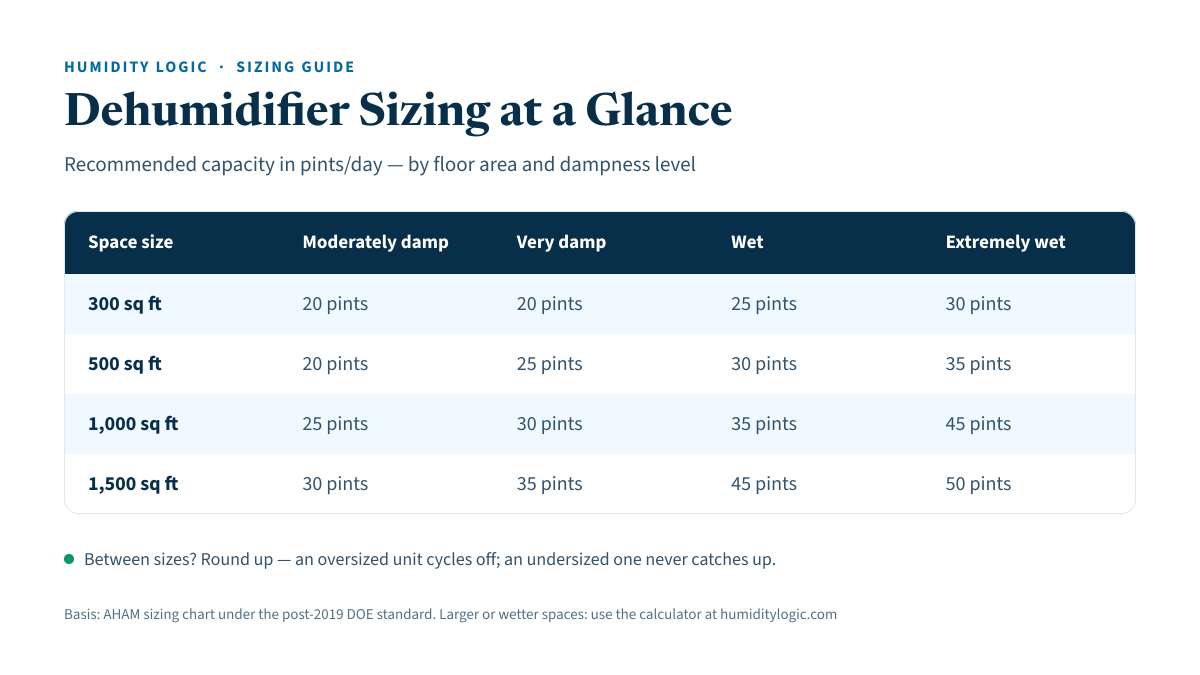
Size by floor area and dampness using the post-2019 AHAM chart, then add capacity for crawl-space-specific loads: a wet 1,000 sq ft crawl space needs a 35-pint unit as a baseline, 45 pints if extremely wet. These are today’s ratings, not the inflated pre-2019 numbers.
| Floor area | Wet (musty, damp walls) | Extremely wet (visible water, sweating walls) |
|---|---|---|
| 300 sq ft | 25 pints/day | 30 pints/day |
| 500 sq ft | 30 pints/day | 35 pints/day |
| 1,000 sq ft | 35 pints/day | 45 pints/day |
| 1,500 sq ft | 45 pints/day | 50 pints/day |
Then adjust for the crawl space itself:
- Exposed dirt floor (no vapor barrier yet): add ~10 pints/day. Better answer: install the barrier and skip the surcharge.
- Below-grade or partially below-grade: add ~5 pints/day for soil moisture migrating through foundation walls.
- Round up, not down. A slightly larger unit cycles less, dries faster after rain, and lasts longer than a small unit running nonstop.
So a wet, 1,200 sq ft crawl space with the dirt covered and vents sealed lands around 40–45 pints/day; the same space unsealed would demand 55+. Run your exact numbers through our dehumidifier sizing calculator — it applies this same chart and the crawl space adjustments automatically. Sizing logic for basements is nearly identical; see the basement dehumidifier guide for that variant.
Why Do Old Pint Ratings Overstate Capacity?
Because the DOE test changed in 2019: dehumidifiers are now rated at 65°F instead of 80°F, and cooler air holds less water, so the same machine earns a number roughly 30% lower than it did under the old label. A “70-pint” unit from 2018 and a modern “50-pint” unit are approximately the same machine.
This matters for crawl spaces twice over. First, old articles and old Amazon listings still quote pre-2019 numbers — if a guide tells you a 1,000 sq ft crawl space needs “70 pints,” it’s using the old scale. Second, the new 65°F test condition is actually closer to real crawl space temperatures than the old 80°F test, so post-2019 ratings predict crawl space performance more honestly. ENERGY STAR’s current capacity tiers reflect the new procedure. All figures in the table above are post-2019 ratings.
Can a Regular Dehumidifier Work in a Cold Crawl Space?
Below about 65°F — where most crawl spaces sit for much of the year — a standard portable unit loses capacity and its coils begin to frost, so crawl spaces need a unit with automatic frost control (hot-gas defrost) or a desiccant dehumidifier. This is the main reason bargain portables die young under houses.
What a crawl space unit needs that a bedroom unit doesn’t:
- Low-temperature operation rated to at least 40–50°F with a real defrost cycle, not just an “auto-off when iced” feature
- Continuous drainage — a gravity drain line or condensate pump, because nobody is crawling under the house to empty a bucket
- A remote humidistat or app readout so you can verify 55% without a site visit
- Low clearance — many purpose-built crawlspace dehumidifier models are under 15 inches tall for 18–24 inch spaces
Desiccant units are the alternative for genuinely cold spaces: their capacity barely drops with temperature, though they use more electricity per pint and add a little heat. For placement, ducting, condensate routing, and leveling details, see our crawl space dehumidifier installation guide.
What Should You Do Before Buying Anything?
Spend a week measuring, because data beats guesswork: log RH in the crawl space with a cheap hygrometer, check readings against the 60% threshold, and walk the space looking for the moisture sources a dehumidifier can’t fix. Half the time, the fix is a tarp-and-tape weekend, not a machine.
The pre-purchase sequence:
- Log RH for 5–7 days, morning and evening, at the dampest-feeling end of the space.
- Find the water. Puddles, white mineral staining (efflorescence) on block walls, damp soil in one corner — trace it to grading, gutters, or plumbing.
- Encapsulate per the checklist above.
- Re-measure. If the space now holds at or under 60%, monitor through one full summer before spending more.
- If it doesn’t, size from the chart, add the dirt-floor or below-grade surcharge if either still applies, and buy a low-temperature unit with a drain.
Crawl space humidity is one front in a whole-house problem — if the upstairs is muggy too, start with our guide to lowering humidity in your house and treat the crawl space as the foundation of the fix, literally.
See it in 3D. The crawl space is one of eight areas you can explore in The Humidity House, our interactive 3D home — click it to see how a sealed vapor barrier turns a wet, vented crawl space into a dry one.
Frequently asked questions
Do I really need a dehumidifier in my crawl space?
Only if humidity stays above 60% RH after you fix moisture sources — a ground vapor barrier, sealed vents, and corrected drainage. Many crawl spaces dry out from encapsulation alone. Measure with a hygrometer for a week before buying anything.
What size dehumidifier do I need for a 1,000 sq ft crawl space?
Start at 35 pints/day (post-2019 rating) for a wet 1,000 sq ft space, or 45 pints if it is extremely wet. Add about 10 pints if any dirt floor is exposed and 5 pints if the space sits below grade, so a typical unsealed crawl space lands at 50–60 pints.
Can I use a regular household dehumidifier in a crawl space?
Usually not for long. Most portable units lose capacity and ice up below about 65°F, and their small tanks need daily emptying. Crawl spaces need a low-temperature unit with frost control (or a desiccant model) plumbed to a condensate drain or pump.
What humidity level should a crawl space be kept at?
Aim for about 55% relative humidity — comfortably under the 60% ceiling EPA sets for mold prevention, without over-drying wood framing. Living spaces target 30–50%, but 55% is the common crawl space setpoint because conditions there run cooler.
Should I encapsulate my crawl space or buy a dehumidifier first?
Encapsulate first. A vapor barrier over the dirt floor and sealed vents can cut the moisture load dramatically, which means a smaller, cheaper dehumidifier — or none at all. A dehumidifier running in an unsealed crawl space fights the ground and outdoor air around the clock.
Sources & references
Every figure on this page is checked against these published sources. Last reviewed July 21, 2026.