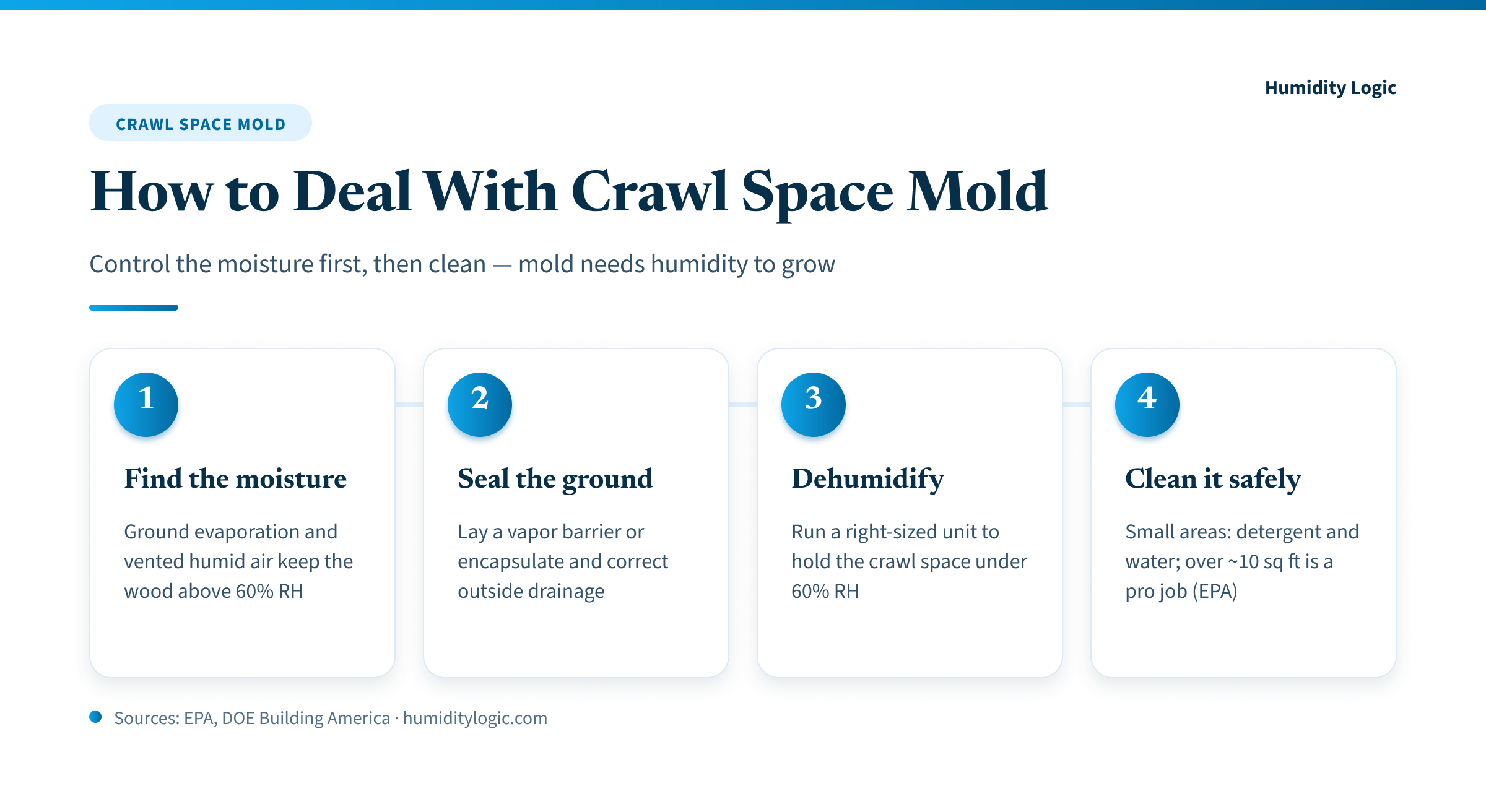
Crawl space mold comes down to one thing: humidity above 60%. When water vapor from the bare ground and warm, vented outdoor air keep the joists and subfloor damp, mold has everything it needs to grow on that wood. The durable fix is moisture control, not just scrubbing — lay a vapor barrier over the dirt (full encapsulation is better), correct outside drainage, seal the vents in humid climates, and add a dehumidifier to hold the space under 60% RH. Then clean the mold: small patches come off with detergent and water, but per EPA, an area larger than about 10 square feet is a job for a professional.
What causes mold in a crawl space?
Mold needs a food source, oxygen, and moisture. The wood framing under your house supplies the food, the air supplies the oxygen — so moisture is the only variable you can actually control. EPA’s mold guidance states the principle bluntly: “controlling indoor moisture will control the growth of indoor mold.” Keep the wood dry and mold cannot establish, no matter how many spores drift through.
In a crawl space, that moisture comes from two main places. The first is the ground. A bare dirt floor sits on soil that is almost always damp, and the relative warmth of the space evaporates that water up into the air — a single 1,000 sq ft dirt floor can release many gallons of water vapor a day. The second is the air you invite in through the foundation vents. Both keep the relative humidity around the joists parked above 60%, which is the level at which mold and wood-decay fungi thrive. Our crawl space humidity guide breaks down each moisture source and the order to tackle them.
Bulk water is the factor people overlook. If gutters dump against the foundation, the grade slopes toward the house, or groundwater seeps in after rain, the soil stays saturated and no amount of drying will keep up. A leaking pipe, a sweating cold-water line, or an HVAC condensate drain backing up under the house can feed mold the same way on a smaller scale.
Why do crawl space vents make the mold worse?
Because in a humid climate, outdoor air is usually wetter than the air already under your house. The U.S. Department of Energy’s Building America research on conditioned crawlspaces puts it plainly: vents were designed on the idea that fresh air would push moist air out, but “in humid climates, the air from outside is often more moist than the air in the crawlspace, leading to structural, mold, and pest problems.”
The physics is the same as a glass of iced tea sweating on a July afternoon. Your crawl space runs cool year-round because it is shaded and partly underground. When hot, humid outdoor air pours through a vent and hits the cool joists, ducts, and the underside of the subfloor, the air chills to its dew point and water condenses right onto the wood. That film of condensation is exactly the wet surface mold colonizes. So open vents in a muggy climate do not dry the space — they deliver a fresh load of moisture every humid day and lay it down on the framing.
That is why closing and sealing the crawl space is now mainstream building science across the humid South, Mid-Atlantic, and Midwest. Vents still make sense in dry Western climates where outdoor air is genuinely drier, but where summers are sticky, they are usually part of the mold problem rather than the cure.
How do I get rid of crawl space mold for good?
Work the moisture sources in order, biggest first, and clean the mold last. Cleaning before you fix the moisture just resets the clock — the colonies grow back on the same wet wood.
- Seal the ground. Cover the entire dirt floor with polyethylene sheeting. The Building America Solution Center specifies at least 6-mil poly, seams overlapped about 12 inches and sealed, run up the foundation walls. Full encapsulation uses a thicker 12–20 mil liner sealed to the walls and piers, but even a well-lapped 6-mil barrier cuts off the bulk of ground evaporation.
- Fix bulk water and drainage. Extend downspouts away from the house, regrade so soil slopes away from the foundation, and add a sump pump or interior drain if groundwater still enters. A vapor barrier controls soil vapor, not standing water — puddles have to be handled separately. The same drainage principles apply to below-grade spaces in our basement humidity guide.
- Seal the vents. In humid climates, close the foundation vents and air-seal them with rigid foam and caulk so summer air stops condensing inside, converting the crawl space to an unvented, sealed assembly.
- Add a dehumidifier. Once the ground and vents are sealed, the moisture that remains is small enough for a right-sized unit to hold under 60% RH. A dehumidifier is your insurance that mold never returns — details on choosing one are in our dehumidifier for mold guide and our crawl space dehumidifier guide.
- Clean the mold. With the space drying out, remove the existing growth — covered next.
How do I clean crawl space mold safely?
For a small area, cleanup is straightforward. EPA advises scrubbing mold off hard surfaces like framing lumber “with detergent and water, and dry completely.” You do not need bleach on solid wood; the point is to physically remove the growth and then keep the surface dry so it cannot regrow. Wear an N-95 respirator, gloves, and eye protection, because disturbing mold releases spores. Porous materials that stay moldy — old cardboard, insulation batts, anything crumbling — should be bagged and thrown out rather than cleaned.
Know when to stop and call a pro. EPA’s threshold is clear: “If the moldy area is less than about 10 square feet (less than roughly a 3 ft. by 3 ft. patch), in most cases, you can handle the job yourself.” Larger infestations, or mold that followed major water damage or sewage, should be handled by an experienced remediation contractor. A crawl space that has mold spread across multiple joist bays is past the DIY line — get a professional assessment rather than trying to scrub it all yourself.
One rule holds no matter the size: clean only after the moisture is under control. If you scrub the wood while the dirt floor is still open and the vents are still letting in humid air, the relative humidity climbs right back over 60% and the mold returns within weeks.
What humidity keeps crawl space mold from coming back?
Keep the crawl space under 60% relative humidity at all times. EPA sets indoor RH below 60% — ideally 30–50% — because that is the threshold where mold and wood-decay fungi stop finding the conditions they need. Crawl spaces run cooler than living space, so a practical setpoint of about 55% RH is common: low enough to stop mold, high enough that you are not over-drying framing lumber or running the dehumidifier nonstop.
Buy a cheap hygrometer and actually measure. Many crawl spaces drop below 60% from the vapor barrier and vent-sealing alone and never need a dehumidifier at all, so measure first and add mechanical drying only if RH stays high after the space is sealed. If you do need a unit, size it to the sealed space, not the leaky one — plug your square footage and dampness level into our dehumidifier sizing calculator for a pint-per-day target, and choose a crawl-space-rated model with low-temperature operation and a condensate pump or gravity drain.
The bottom line
Crawl space mold is a moisture problem wearing a mold costume. The soil and, in summer, the vented outdoor air keep the wood above 60% RH, and that dampness is what the mold actually feeds on. So fix the moisture in order — seal the ground with a vapor barrier, correct drainage and bulk water, close the vents in humid climates, and finish with a right-sized dehumidifier — then clean the growth off the wood. Handle small patches yourself with detergent and water, leave anything over about 10 square feet to a professional, and the crawl space stays dry enough that mold has nothing left to grow on.
Frequently asked questions
What causes mold in a crawl space?
Moisture. Water vapor evaporating from a bare dirt floor and warm, humid air coming through the foundation vents keep the wood joists and subfloor above 60% relative humidity, and that is all mold needs to grow. Fix the moisture and you remove the cause.
Can I clean crawl space mold myself?
For small patches, yes. EPA says if the moldy area is less than about 10 square feet — roughly a 3 ft by 3 ft patch — most people can handle it with detergent and water. Larger areas, or mold after major water damage, should be handled by an experienced professional.
Will a dehumidifier get rid of crawl space mold?
A dehumidifier stops mold from coming back by holding the space under 60% RH, but it does not remove mold that is already growing. You still have to clean the existing colonies off the wood. Control the moisture first, clean second, or the mold simply returns.
What humidity level stops crawl space mold?
Keep the crawl space under 60% relative humidity at all times — EPA recommends indoor RH below 60%, ideally 30–50%. Most sealed crawl spaces are held near 55% RH, low enough to stop mold and wood decay without over-drying the framing lumber.
Is crawl space mold dangerous?
It damages the wood it grows on and can send musty odors and spores up into the rooms above, since crawl space air leaks into the house. EPA advises cleaning up mold promptly and fixing the moisture problem behind it. Large infestations are a job for a professional.
Sources & references
Every figure on this page is checked against these published sources. Last reviewed August 1, 2026.
- EPA — Mold Cleanup in Your Home (10 sq ft threshold, detergent-and-water cleaning)
- EPA — Mold Course Chapter 2 (Moisture and Humidity Control)
- Building America Solution Center (DOE/PNNL) — Unvented, Insulated Crawlspaces
- U.S. Department of Energy — Unvented, Conditioned Crawlspaces (Building America Top Innovation)