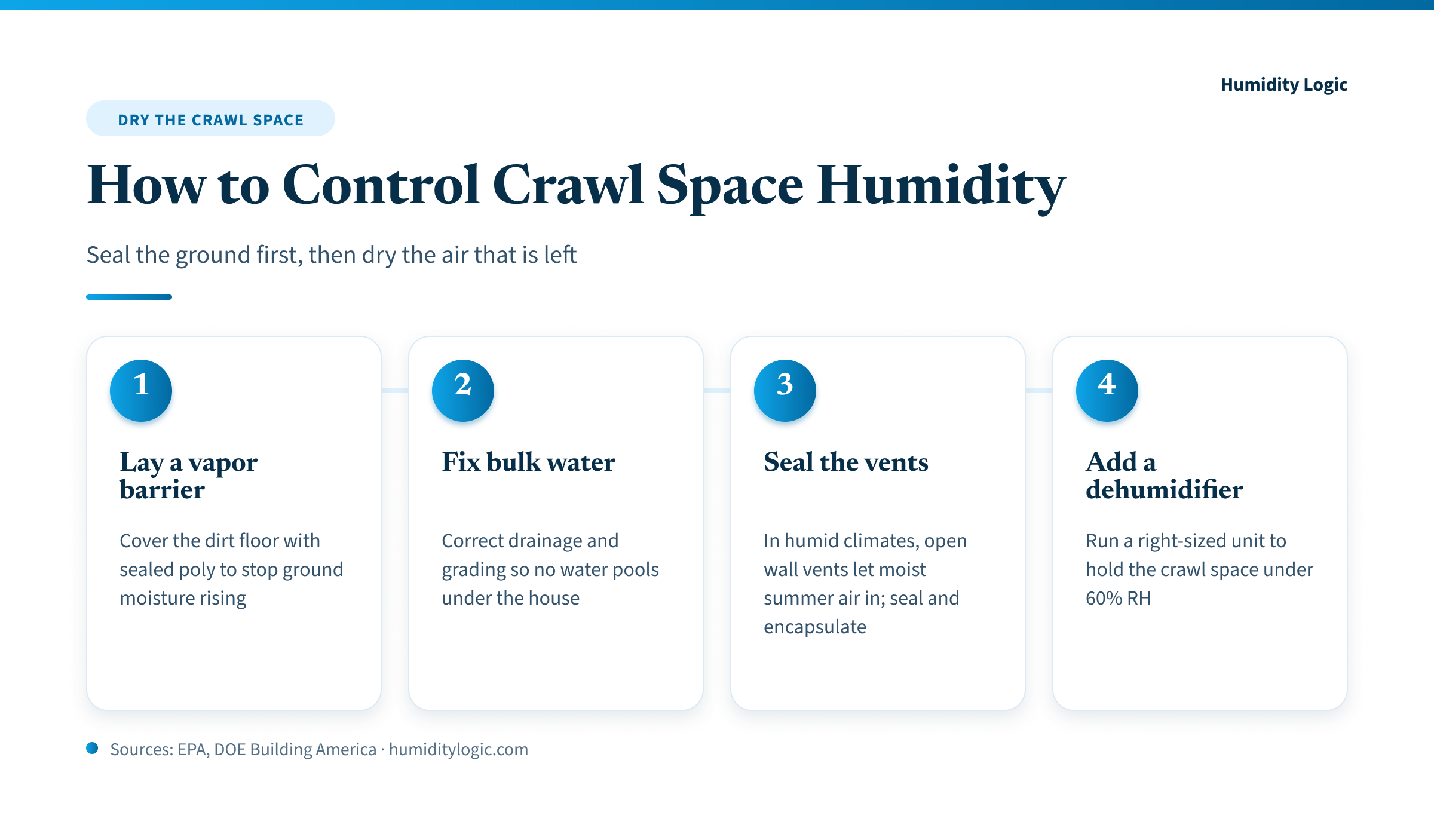
Crawl space humidity climbs for two reasons: moisture in the bare soil evaporates up into the air, and in summer the foundation vents let warm, humid outdoor air in, where it condenses on cooler framing. The fix is an order of operations, not a single gadget. Lay a vapor barrier over the dirt floor (full encapsulation is better), correct any drainage that lets water pool, seal the vents, and only then add a dehumidifier to hold the space under 60% RH — the ceiling EPA sets for preventing mold.
Why is my crawl space so humid?
Most of the water comes straight out of the ground. A crawl space with an open dirt floor sits on soil that is almost always damp, and the relative warmth of the space dries that soil by evaporation — adding the moisture to the crawl space air, where EPA’s moisture guidance warns it can feed mold. A single 1,000 sq ft dirt floor can release many gallons of water vapor a day. That vapor doesn’t stay put, either: it migrates up through cracks and floor penetrations into the rooms above, which is why a damp crawl space often shows up as musty odors, cupping floors, or high humidity on the main level.
The second source is the air you invite in. Older crawl spaces have wall vents that were meant to flush out moisture, on the assumption that outdoor air would carry it away. In a humid climate that assumption backfires — more on why below.
Bulk water is the third factor and the one people overlook. If gutters dump against the foundation, the grade slopes toward the house, or groundwater seeps in after rain, no amount of ventilation or dehumidification will keep up. Standing water and saturated soil have to be corrected first. A plumbing leak, a sweating cold-water line, or an HVAC condensate drain backing up under the house can do the same thing on a smaller scale, so check those before assuming the ground is the only culprit.
Why do crawl space vents make summer humidity worse?
Because outdoor air in summer is usually wetter than the air already under your house. The U.S. Department of Energy’s Building America research on conditioned crawlspaces puts it plainly: vents were designed on the idea that fresh air entering one side would push moist air out the other, but “in humid climates, the air from outside is often more moist than the air in the crawlspace, leading to structural, mold, and pest problems.”
Here is the physics. Your crawl space runs cool year-round because it’s shaded and partly underground. When hot, humid outdoor air pours through a vent and hits those cool joists, ducts, and the underside of the subfloor, the air chills to its dew point and water condenses right onto the wood — the same way a glass of iced tea sweats on a July afternoon. So the vents don’t dry the space; they deliver a fresh load of moisture every humid day and let it condense on the framing.
That finding is now mainstream building science. DOE reports that closing and conditioning the crawl space instead cut humidity by more than 20% and trimmed heating and cooling energy by 15–18% in test homes, and it reshaped the 2009 and 2012 International Residential Code. Wall vents still make sense in dry Western climates where outdoor air is genuinely drier, but across the humid South, Mid-Atlantic, and Midwest, open vents are usually part of the problem.
The seasonal pattern is a giveaway. If your crawl space reads fine in winter but soars above 60% RH every summer, and you can feel condensation on the ductwork after a run of muggy days, vented outdoor air is almost certainly the driver — not a sudden new leak in the ground.
How do I lower crawl space humidity? (the fix order)
Work the sources in order, biggest first. Skipping ahead to a dehumidifier while the dirt floor is open just wastes electricity.
- Lay a ground vapor barrier. This is the single highest-impact step. Cover the entire dirt floor with polyethylene sheeting — the Building America Solution Center specifies at least 6-mil poly, with seams overlapped about 12 inches and sealed, extended up the foundation walls. Full encapsulation uses a thicker (12–20 mil) liner sealed to the walls and piers, but even a well-lapped 6-mil barrier stops the bulk of ground evaporation.
- Fix bulk water and drainage. Extend downspouts away from the house, regrade so soil slopes away from the foundation, and add a sump pump or interior drain if groundwater still enters. A vapor barrier controls soil vapor, not liquid water — puddles must be handled separately. Our wet basement guide covers the same drainage principles for below-grade spaces.
- Seal the vents. In humid climates, close the foundation vents and air-seal them with rigid foam and caulk so summer air stops condensing inside. This converts the crawl space to an unvented, sealed assembly — the approach DOE and EPA both favor for humid regions.
- Add a dehumidifier. Once the ground and vents are sealed, whatever moisture remains is small enough for a right-sized dehumidifier to hold under 60% RH. Details on choosing and mounting a unit are in our crawl space dehumidifier guide and installation walkthrough.
What humidity level should a crawl space be?
Keep it under 60% relative humidity at all times. EPA’s mold guidance sets indoor RH below 60% — ideally 30–50% — because that’s the threshold where mold and wood-decay fungi stop finding the conditions they need. Crawl spaces run cooler than living space, so a practical setpoint of about 55% RH is common: low enough to stop mold, high enough that you’re not over-drying framing lumber or running the dehumidifier nonstop.
Buy a cheap hygrometer and actually measure before and after each step. Many crawl spaces drop below 60% from the vapor barrier and vent-sealing alone and never need a dehumidifier at all — so measure first, and only add mechanical drying if RH stays high after the space is sealed. The same measure-then-act logic applies throughout the house, as our guide to lowering indoor humidity explains.
What size dehumidifier does a crawl space need?
If you get to step four, size the unit to the sealed space, not the leaky one — sealing dramatically lowers the moisture load, so an encapsulated crawl space usually needs a smaller unit than the raw square footage suggests. As a rough starting point, a sealed 1,000–1,500 sq ft crawl space is typically served by a 30–50 pint/day unit (post-2019 AHAM rating), sized up if the space is deep, below grade, or in a very humid region.
Rather than guess, plug your square footage and dampness level into our dehumidifier sizing calculator for a pint-per-day target, and cross-check it against our overview of what size dehumidifier you actually need. Choose a crawl-space-rated unit with low-temperature operation and a condensate pump or gravity drain, because a portable model with a bucket won’t survive an unattended crawl space.
The bottom line
Crawl space humidity is a moisture-source problem, not a ventilation problem. The soil and, in summer, the vented outdoor air are what drive it up, so the durable fix follows the source order: seal the ground with a vapor barrier, correct drainage and bulk water, close the vents in humid climates, and finish with a right-sized dehumidifier only if the space still reads above 60% RH. Do it in that sequence and the crawl space — and the rooms above it — stay dry, with far less equipment running than a bare dirt floor would ever require.
Frequently asked questions
What causes high humidity in a crawl space?
Two things. Moisture in the soil evaporates up into the air of an open dirt crawl space, and in summer the foundation vents let warm, humid outdoor air in, which condenses on cooler joists and ducts. Bulk water from poor drainage makes both worse.
What humidity level should a crawl space be?
Keep it under 60% relative humidity at all times, the ceiling EPA sets for mold prevention. Most sealed crawl spaces are held around 55% RH, which stops mold and wood decay without over-drying the framing lumber.
Do crawl space vents reduce humidity?
Not in humid climates. Vents were meant to flush out moisture, but DOE research found outdoor air is often wetter than crawl space air, so venting adds moisture instead of removing it. Sealing the vents and encapsulating is the modern fix.
Should I put down a vapor barrier or a dehumidifier first?
Vapor barrier first. Sealing the dirt floor with poly cuts off the largest moisture source, so a dehumidifier then has far less to remove. Running a dehumidifier over exposed soil just fights the ground around the clock.
Will a dehumidifier alone fix a wet crawl space?
No. A dehumidifier only dries air, so it cannot keep up with an exposed dirt floor, open vents, or standing water. Seal the ground, fix drainage, and close the vents first; then a right-sized dehumidifier holds the space under 60% RH.
Sources & references
Every figure on this page is checked against these published sources. Last reviewed July 29, 2026.
- EPA — Mold Course Chapter 2 (Moisture and Humidity Control)
- Building America Solution Center (DOE/PNNL) — Unvented, Insulated Crawlspaces
- U.S. Department of Energy — Unvented, Conditioned Crawlspaces (Building America Top Innovation)
- EPA — Moisture Control Guidance for Building Design, Construction and Maintenance