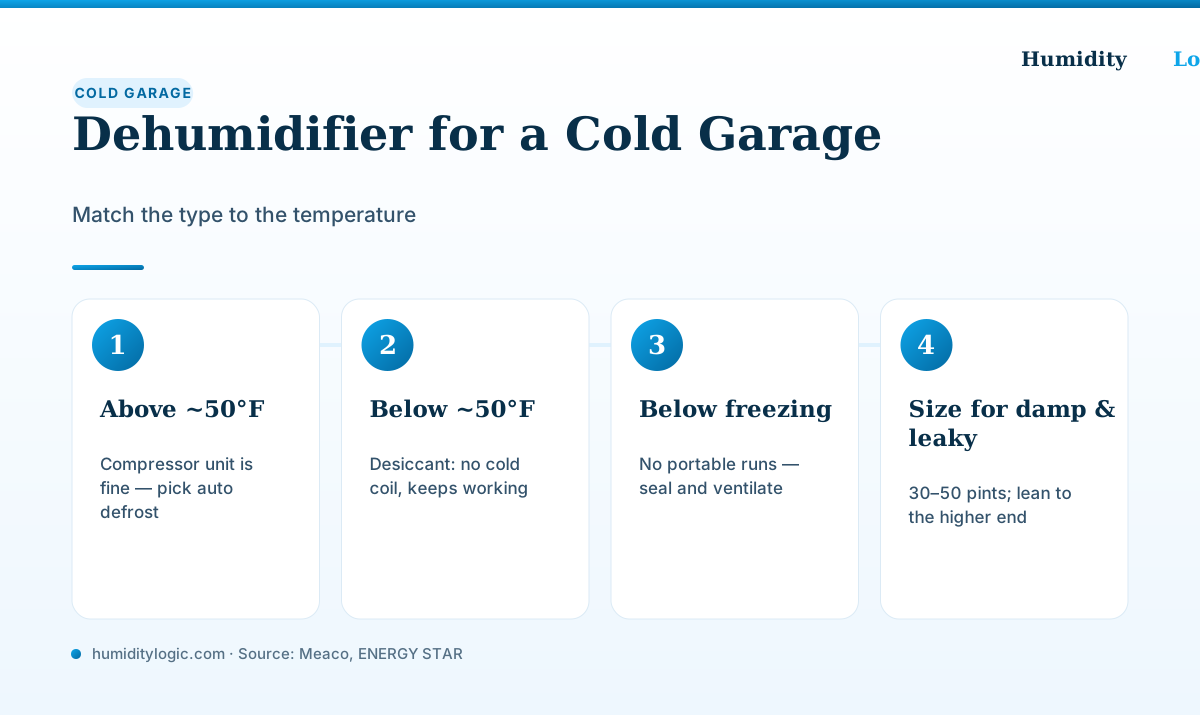
The single most common dehumidifier mistake in a garage is buying the wrong type for the temperature. A standard compressor dehumidifier ices up and stalls in a cold garage, so below about 50°F you want a desiccant model, which uses a moisture-absorbing wheel instead of a cold coil and keeps working in the cold. Match the type to the temperature first; size and placement come second.
Why a normal dehumidifier fails in the cold
A standard compressor (refrigerant) dehumidifier works like a mini air conditioner: it pulls air across a cold coil, water condenses on the coil, and drips into the tank. That only works while the coil stays above freezing. In a cold garage the coil drops below 32°F, frost builds up on it, and the unit has to pause and defrost — so it “spend[s] more and more of [its] time defrosting [itself] rather than dehumidifying,” as Meaco puts it (Meaco). Below about 50°F a compressor unit loses most of its useful capacity, and in the low 40s it can ice up solid without an auto-defrost cycle.
Why a desiccant unit works where a compressor can’t
A desiccant dehumidifier has no cold coil to freeze. It passes air over a rotating wheel coated with a moisture-absorbing material, then gently heats the wheel to drive the captured water into the tank. Because nothing relies on a surface being below the dew point, it keeps removing water in a cold garage — down well below where a compressor gives up. Two bonuses in a garage: it works in near-freezing conditions, and it gives off a little warmth as it runs, which nudges the cold slab and door up away from their dew point so they sweat less.
The trade-off is energy: a desiccant unit generally draws more power per pint in warm conditions. But in a cold garage, it is the one that actually removes water, so it is the efficient choice there. The full head-to-head is in our desiccant dehumidifier guide.
Which should you buy?
- Garage stays above ~50°F year-round (attached, insulated, or a mild climate): a compressor unit is fine, and cheaper to run. Choose one with automatic defrost for the cold snaps.
- Garage drops below 50°F in winter (detached, uninsulated, cold climate): choose a desiccant unit. It is the reliable option and the one that will still be drying in January.
- Garage drops below freezing: no portable dehumidifier runs in a hard freeze. Control moisture then with sealing and ventilation, and run the desiccant unit whenever the space is above freezing. (The good news: very cold air holds little moisture, so the worst condensation seasons are the shoulder months, not deep winter.)
Size it for a damp, leaky space
Once the type is right, size for a damp-to-wet garage — ENERGY STAR’s moisture bands put a typical garage at roughly 30–50 pints a day (ENERGY STAR — Dehumidifiers) — and lean to the higher end, because a cold, unsealed garage leaks air and runs any unit inefficiently. Put your square footage and dampness into the dehumidifier size calculator; for the reasoning, see what size dehumidifier do I need, and for the full garage buying guide, garage dehumidifier.
Set it up to hold under 60%
Place the unit centrally with clear airflow, set the humidistat to about 55%, and run a hose to a floor drain so you are not emptying a bucket — see continuous drainage. The target is the EPA’s ceiling of 60%, ideally lower if you store bare-steel tools (EPA — A Brief Guide to Mold, Moisture and Your Home). Pair it with sealing the door gaps and insulating cold surfaces, since drying the air and warming the surfaces together are what stop the condensation the EPA describes — warm, humid air meeting a cold slab or door (EPA Mold Course, Chapter 2).
Get the type right for the cold, size it generously, and set it to cycle — and a garage that iced up your last dehumidifier will finally stay dry. For the complete process, see how to dehumidify a garage.
See it in 3D. Explore the garage in The Humidity House, our interactive 3D home.
Frequently asked questions
Why does my dehumidifier not work in a cold garage?
A standard compressor dehumidifier pulls water onto a cold coil. In a cold garage that coil drops below freezing and ices over, so the unit spends more and more of its time defrosting instead of drying. Below about 50°F a compressor model loses most of its capacity, and without auto defrost it can ice up solid.
What kind of dehumidifier works in a cold garage?
A desiccant dehumidifier. Instead of a cold coil, it uses a moisture-absorbing wheel that works regardless of temperature, so it keeps drying in a cold or even near-freezing garage. If you prefer a compressor unit, choose one with an automatic defrost feature and expect reduced output as the temperature drops.
What temperature is too cold for a dehumidifier?
For a standard compressor unit, performance falls off below about 50°F and icing becomes likely in the low 40s. A desiccant unit keeps working well below that. No portable dehumidifier runs in a hard freeze, so for a garage that drops below freezing, you control moisture by sealing and ventilation and run the desiccant unit when the space is above freezing.
Does a desiccant dehumidifier use more electricity?
A desiccant unit generally draws more power per pint in warm conditions than a compressor, but in a cold garage it is the one that actually removes water, so it is the efficient choice there. It also gives off a little warmth as it runs, which nudges cold surfaces up away from their dew point.
What size dehumidifier do I need for a cold garage?
Size for a damp-to-wet space — roughly 30–50 pints a day for a typical two-car garage — and buy the higher end because a cold, unsealed garage leaks air and runs any unit inefficiently. Match the type to the temperature first, then size by area and dampness with our calculator.
Sources & references
Every figure on this page is checked against these published sources. Last reviewed October 21, 2026.