Drying out a garage is a sequence, not a single purchase. Dehumidify a garage by cutting the moisture coming in, deciding between ventilation and a dehumidifier, sizing the unit for a cold and leaky space, and draining it so it can hold the garage under 60% relative humidity. Do the steps in order and a modest dehumidifier will keep up — skip the first step and even a big one will run forever.
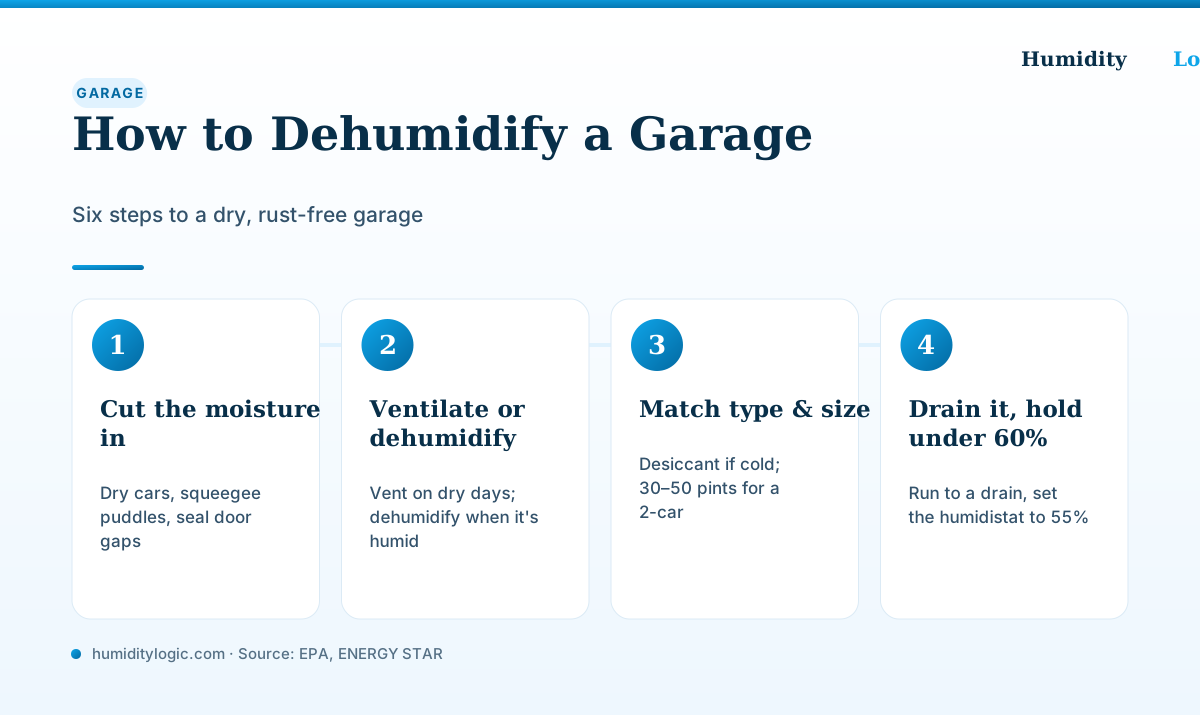
This is the step-by-step “how.” For the wider picture of why a garage runs damp and what level to target, start with garage humidity control.
Step 1: Measure where you actually stand
Put a cheap hygrometer in the garage for a few days before you buy anything. You want to know whether you are fighting a seasonal spike or a year-round damp problem, and roughly how far over the line you are. The target is the same as the rest of the home — under 60% relative humidity, ideally 30–50% (EPA — A Brief Guide to Mold, Moisture and Your Home). If you store bare-steel tools or a car you care about, aim tighter, under about 55%, since rust speeds up past 60%. See what is considered high humidity for the thresholds.
Step 2: Cut the moisture coming in
This is the cheapest step and the one most people skip. Every gallon you keep out is a gallon you never have to remove.
- Dry wet vehicles or park them outside until the worst of the rain or snow melt runs off. A drip tray under the car keeps meltwater off the slab.
- Squeegee standing water toward the door, and fix grading or add a channel drain if water runs in from the driveway.
- Seal the gaps. Replace a cracked bottom door seal and worn weatherstripping so humid outdoor air stops pouring in.
- Vent any dryer outside. If a clothes dryer lives in the garage, make sure it exhausts outdoors — the EPA specifically advises venting moisture-producing appliances outside, not into the space.
Step 3: Decide — ventilate or dehumidify?
Both work; the climate decides which. Ventilation is free and effective when outdoor air is drier than the garage — crack the door or run an exhaust fan on a breezy, low-humidity day. But it backfires in humid weather, when opening up just imports moisture. A dehumidifier is the reliable, set-and-forget option when outdoor air is often humid. Most people use both: vent on dry days, dehumidify the rest of the time with the door shut.
Step 4: Size the dehumidifier for a garage
Size for a damp-to-wet space, not a spare bedroom. ENERGY STAR’s moisture bands run from “damp” (20–30 pints a day) to “wet” (30–50 pints a day) (ENERGY STAR — Dehumidifiers). A typical two-car garage with a bare slab and wet cars lands in the very-damp-to-wet range, so plan on 30–50 pints — and favor the higher end because a leaky, cold garage runs a unit inefficiently. Put your square footage and dampness into the dehumidifier size calculator, and see what size dehumidifier do I need for the reasoning. The full garage-specific buying guide is here.
Step 5: Pick the right type for the temperature
Garage temperature is the catch that trips up most buyers. A standard compressor dehumidifier frosts its cold coil in a cool garage — below about 50°F these units “spend more and more of their time defrosting themselves rather than dehumidifying” (Meaco). A desiccant unit uses a moisture-absorbing wheel instead and holds capacity in the cold, so it is the right tool for an unheated garage. If your garage stays warm year-round, a compressor with auto defrost is fine. The full comparison is in our desiccant dehumidifier guide. If your garage gets genuinely cold, read the dedicated dehumidifier for a cold garage guide before buying.
Step 6: Set it, drain it, and let it cycle
Place the unit centrally with clear airflow around the intake and outlet, set the humidistat to 55%, and run a hose to a floor drain so you are not emptying a bucket — our continuous drainage guide covers the setup. A cheap oscillating fan helps either type by keeping a still, damp layer from settling on the floor and tools, where condensation starts — exactly the mechanism the EPA describes, warm humid air meeting a cold surface (EPA Mold Course, Chapter 2).
Work the steps in order — measure, cut the sources, choose your tool, size it, match it to the temperature, and drain it — and the garage holds under 60% without a fight. If beads of water on the door or floor are your specific symptom, see condensation on a garage door and garage floor condensation.
See it in 3D. Explore the garage in The Humidity House, our interactive 3D home — click the car to see why a wet vehicle makes the whole space damp.
Frequently asked questions
What is the fastest way to dehumidify a garage?
Cut the moisture coming in first — dry wet cars, squeegee puddles, and seal the door gaps — then run a right-sized dehumidifier set to around 55%. Source control makes the dehumidifier's job small enough that it can actually hold the target instead of running flat out against an open door.
Will a regular dehumidifier work in a cold garage?
Only down to about 50°F. A standard compressor dehumidifier pulls water onto a cold coil, and below roughly 50°F that coil frosts over and the unit spends more time defrosting than drying. For a garage that gets genuinely cold, use a desiccant dehumidifier, which works regardless of temperature, or a compressor model with auto defrost.
What size dehumidifier do I need for a garage?
Treat a garage as damp-to-wet, not a spare room. A typical two-car garage with a bare slab and wet cars needs roughly 30–50 pints a day, and buying the higher end is wise because an unsealed garage leaks air. Size it by square footage and dampness with our calculator rather than guessing.
Do I need to run the dehumidifier all the time?
No. Set its built-in humidistat to about 55% and let it cycle on and off to hold that target. ENERGY STAR-certified units all include a humidistat for exactly this, so the unit only runs when the air climbs above your setting instead of around the clock.
Should I ventilate or dehumidify the garage?
Ventilate when the outdoor air is drier than the garage air — a breezy, low-humidity day. Dehumidify when outdoor air is often humid or you want a set-and-forget target. On muggy days, keep the door shut and let the dehumidifier work; opening up just pulls more moisture in.
Sources & references
Every figure on this page is checked against these published sources. Last reviewed October 15, 2026.