A wet garage floor on a dry day is one of the most misdiagnosed moisture problems there is. Garage floor condensation happens when warm, humid air touches a cold concrete slab and the water vapor condenses on top of it — it is usually not a leak, and you stop it by drying the air and keeping it off the cold slab. Here is why it happens, how to prove what you are dealing with, and how to fix it for good.
Why a concrete slab sweats
Concrete is a big, cool thermal mass sitting in contact with the ground, so it changes temperature slowly. In spring and early summer, warm, moist air arrives long before the slab has caught up — and when that humid air touches the cold concrete, it hits its dew point and condenses on the surface. It is the exact mechanism the EPA describes: “when warm, humid air contacts a cold surface, condensation may form” (EPA Mold Course, Chapter 2). The colder the slab relative to the air, and the more humid the air, the more water you get.
There is a second, separate source: a slab can also wick ground moisture up from below, which the DOE describes as moisture moving through the foundation by capillary action and vapor diffusion (DOE Building America — Moisture Flow). That shows up as dampness coming through the concrete rather than forming on top of it — and it needs a different fix, which is why the test below matters.
Test it: condensation or seepage?
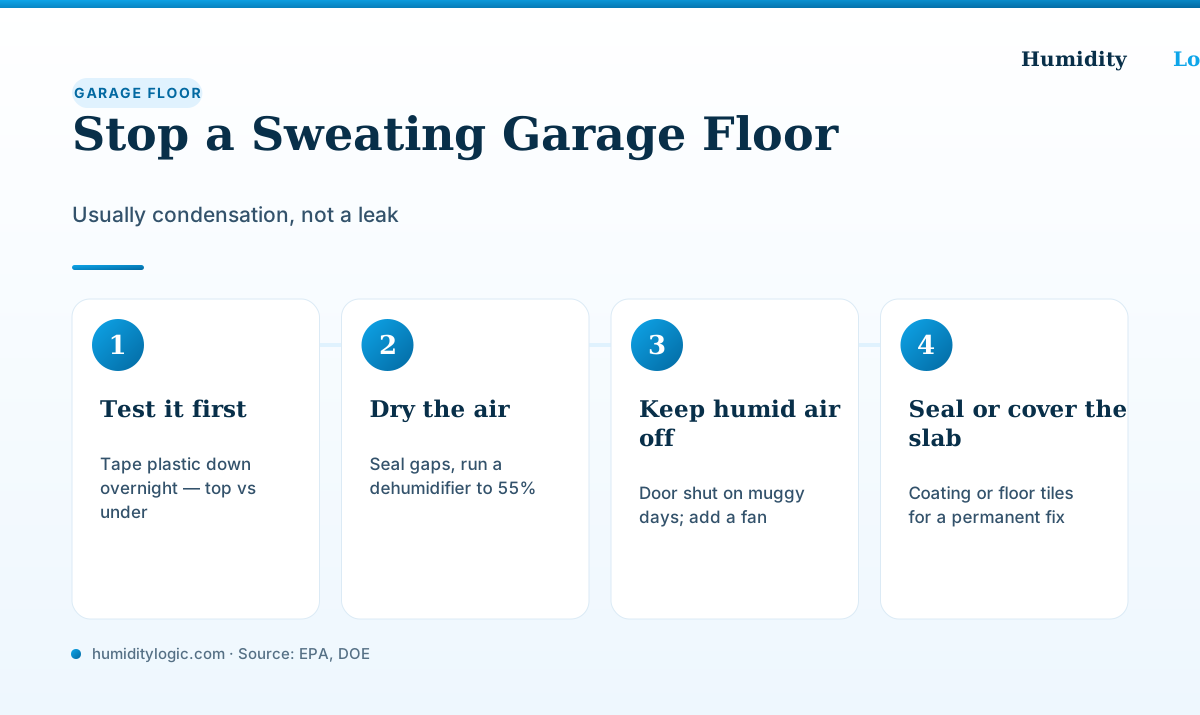
Before you spend anything, find out which problem you have. Tape a 2-foot square of plastic sheet (a garbage bag works) tightly to the floor on all four edges and leave it overnight:
- Water on top of the plastic → condensation from the air. The slab is colder than the air’s dew point, and the fix is to dry the air and keep humid air off the slab.
- Water trapped underneath the plastic → seepage. Ground moisture is coming up through the slab, and the fix is a vapor barrier or sealing the concrete from below.
- Both → you have the common double problem, and the steps below handle it.
This is the same diagnostic used for condensation on a concrete floor and basement floor condensation elsewhere in the house.
Fix 1: Dry the air
Lowering the humidity lowers the air’s dew point, which makes the slab less likely to be the coldest thing in the room. Seal the door’s bottom seal and perimeter gaps so humid outdoor air stops pouring in, and run a dehumidifier set to around 55%. In a cold garage, this is where dehumidifier type matters: a standard compressor unit frosts up below about 50°F and “spend[s] more and more of [its] time defrosting… rather than dehumidifying,” so use a desiccant model in the cold (Meaco). Size it for a damp-to-wet space with the dehumidifier size calculator.
Fix 2: Keep humid air off the slab
Ventilation cuts both ways here. On a dry, breezy day, airing the garage out helps. But on a warm, muggy day, opening the door just pours more humid air onto the cold slab and makes the sweating worse — so keep the door shut when it is humid out and let the dehumidifier work. A fan moving air across the floor also helps prevent a still, saturated layer from settling and condensing.
Fix 3: Warm or seal the slab (the permanent fix)
The two fixes above manage the problem; this one ends it. If the slab surface is kept above the dew point, it cannot condense:
- A sealed concrete coating (a quality epoxy or polyurea floor system over a properly prepped slab) gives a surface that warms faster and resists the water film. Note that coatings fail if applied over a slab with active seepage from below, so pass the plastic-sheet test first.
- An insulating floor covering — interlocking tiles or a thick mat — separates your tools and feet from the cold concrete so condensation on the slab no longer matters as much.
- For ground-moisture seepage, the fix is below the slab: a vapor barrier or a penetrating sealer, not just drying the air.
Put it together and the floor stays dry: test first, dry the air (with the right dehumidifier for the temperature), keep humid air off the slab, and seal or cover the concrete for good. A dry floor also protects everything sitting on it — which is the whole point. For the broader catalog of garage damp issues, see garage moisture problems, and keep the space under the EPA’s 60% ceiling overall (EPA — A Brief Guide to Mold, Moisture and Your Home).
See it in 3D. Explore the garage in The Humidity House, our interactive 3D home, and for the full plan see how to dehumidify a garage.
Frequently asked questions
Why is my garage floor wet when it has not rained?
It is almost certainly condensation. The concrete slab stays cool, and when warm, humid air touches it, water forms on top — the same way a cold drink sweats on a summer day. It is most common in spring and early summer, when warm, moist air arrives before the slab has warmed up.
How do I know if it is condensation or a leak?
Tape a 2-foot square of plastic sheet tightly to the floor and leave it overnight. Water on top of the plastic means condensation from the air. Water trapped underneath means moisture is coming up through the slab from the ground. The two problems have different fixes, so this test is worth doing first.
How do I stop my garage floor from sweating?
Attack it from both sides: dry the air (seal door gaps, run a dehumidifier) and keep warm, humid air off the cold slab (ventilate on dry days, keep the door shut on muggy ones). For a permanent fix, a sealed concrete coating or an insulating floor covering keeps the slab surface above the dew point.
Is a sweating garage floor a problem?
Yes. A constantly damp slab rusts anything metal sitting on it, grows mold and mildew, makes the floor slippery, and can lift paint or epoxy coatings. It also signals the garage air is humid enough to damage tools and stored items, so it is worth fixing.
Will a dehumidifier stop garage floor condensation?
It helps a lot by lowering the air's dew point so the slab is less likely to be colder than it. In a cold garage, use a desiccant dehumidifier, since a standard compressor unit ices up below about 50°F. Pair it with sealing the door gaps, and for a complete fix, warm or seal the slab itself.
Sources & references
Every figure on this page is checked against these published sources. Last reviewed October 19, 2026.