A concrete floor that “sweats” is almost always condensation: warm, humid summer air touching a cool slab whose surface sits below the air’s dew point, so water vapor beads out onto the concrete. The slab stays cool because the ground beneath it does, and when moisture-laden air drifts across it, the air chills, hits its dew point, and drops its water onto the floor. Before you fix anything, separate that from the other cause — ground moisture wicking up through the slab — with a simple foil or plastic test. Once you confirm it is condensation, the fix is to hold the room’s relative humidity under 55% so the slab no longer reaches the dew point.
Why Is My Concrete Floor Sweating?
Soil a few feet down stays cool all year, so a basement or garage slab holds a temperature well below summer air. When warm outdoor air — carrying a lot of moisture — reaches that cool concrete, the air right at the surface cools rapidly. Air holds less water vapor as it cools, and at the dew point it becomes saturated and the extra moisture has to condense out onto whatever cold surface it is touching. The EPA states the mechanism plainly: when warm, humid air contacts a cold surface, condensation may form.
The DOE’s Building America program describes the same thing happening below grade: during warm seasons in humid climates, humid air can leak into a basement and condense on cooler surfaces such as floor joists or below-grade wall surfaces. A slab floor is one of the coolest surfaces in the building, so it is often the first place you notice the problem. If the link between temperature and moisture is new to you, our dew point vs. humidity explainer walks through why the dew point — not the humidity reading alone — is the number that predicts a wet surface.
This is why the sweating is seasonal. In winter, outdoor air is cold and dry, its dew point is low, and even a cool slab stays above it. In summer, outdoor dew points climb into the 60s and 70s °F while your slab sits in the low-to-mid 60s, and the gap flips. The slab suddenly runs below the dew point of the air above it, and it starts to bead up.
Is It Condensation or Moisture Coming Up Through the Slab?
This is the single most important question, because the two causes have completely different fixes. Condensation pulls moisture out of the room air onto the cold top of the slab. The other problem is ground moisture wicking up through the concrete from wet soil — porous concrete draws water through its pores by capillary action — and surfacing on top. Treating one as the other wastes money and leaves the floor wet.
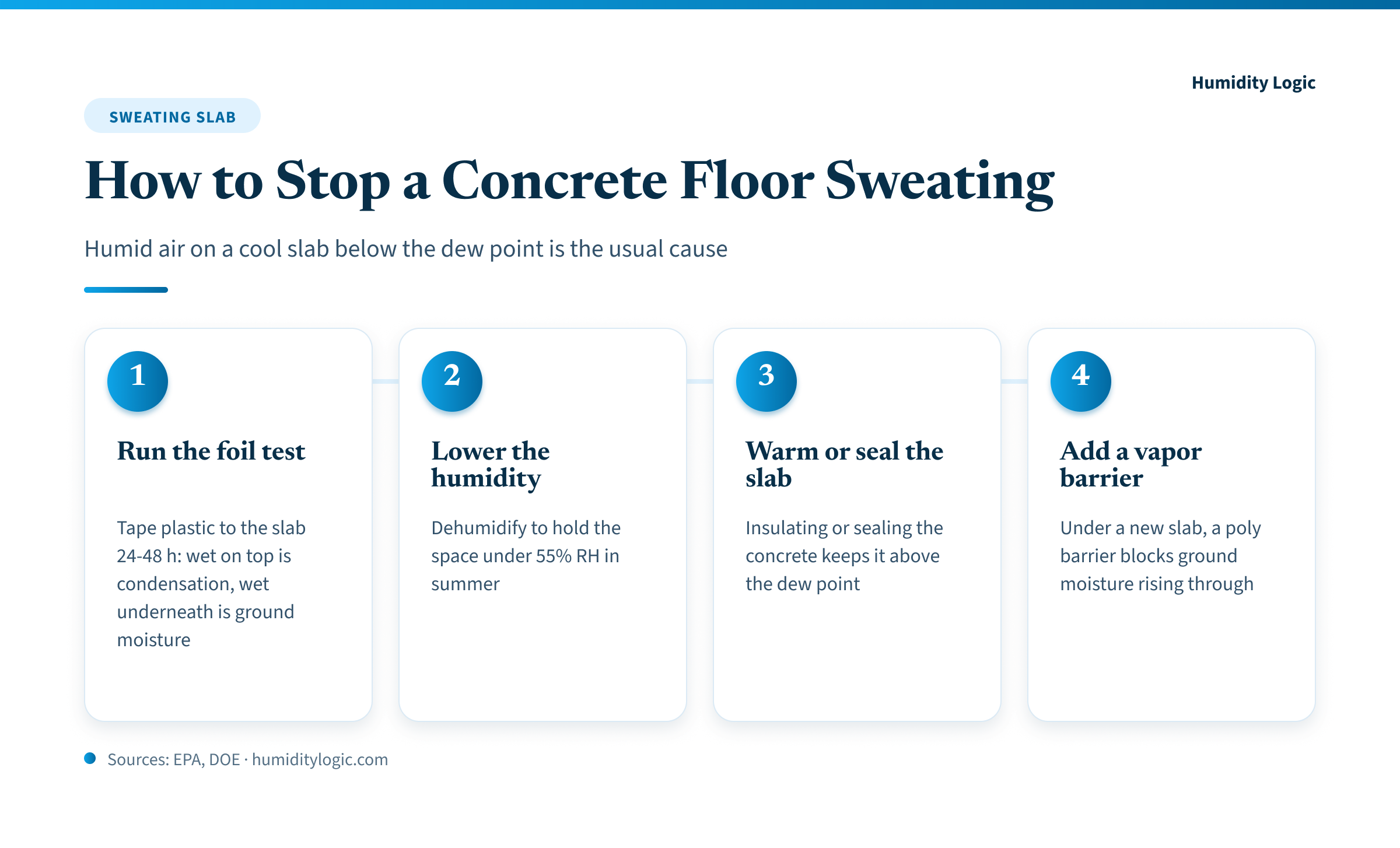
The foil or plastic test settles it cheaply. Tape a one-foot square of aluminum foil or clear plastic sheeting tightly to the slab, sealing all four edges, and leave it 24 to 48 hours. Then peel it back:
- Moisture on top of the plastic (the room-facing side) means humid indoor air is condensing on the cool concrete. This is a humidity problem, and the fixes below solve it.
- The top stays dry but the underside against the concrete is damp means water is migrating up through the slab from the ground. That is a capillary and drainage issue, closer to the situation covered in our wet basement guide.
Both can happen at once in a humid basement, but the foil test tells you which one dominates so you spend your effort in the right place. For the broader picture of what drives moisture in below-grade rooms, see our basement humidity guide.
How Do I Stop a Concrete Floor From Sweating?
Once you have confirmed condensation, you have two levers: lower the dew point of the air, or raise the temperature of the slab surface. Doing either — ideally both — keeps the concrete above the dew point so vapor stops condensing.
Lower the humidity first. This is the fastest and most reliable fix. Run a dehumidifier sized to the space and hold the room under 55% relative humidity; the EPA recommends indoor RH stay below 60 percent – ideally between 30 percent and 50 percent. As the air dries, its dew point drops below the slab temperature and the sweating stops. Keep a hygrometer on the floor to confirm the number, and keep doors and windows closed while the dehumidifier works — letting humid outdoor air back in defeats it. You can check how much margin you have between your air and your slab with our condensation-risk calculator, which compares the surface temperature to the dew point.
Warm or seal the slab. Anything that keeps the concrete surface above the dew point helps. A penetrating concrete sealer reduces how readily the surface takes on moisture, and insulating the slab — rigid foam under a subfloor, or an insulated floor assembly — keeps the walking surface warmer so it never reaches the dew point. Insulation also cuts the temperature swing that ENERGY STAR targets when it advises homeowners to seal and insulate below-grade and unconditioned spaces.
Ventilate or move air across the floor. Gently circulating room air over the slab reduces the thin, still layer of humid air that condensation needs and evens out the temperature difference between the cool floor and warmer air above. In a conditioned space, a fan plus a dehumidifier is a practical pairing.
Add a vapor barrier under new concrete. If you are pouring a new slab or garage floor, block ground moisture before it can ever reach the surface. The DOE recommends a capillary break of gravel plus polyethylene sheeting directly beneath the slab: a 4-inch layer of gravel topped with 6-mil poly, seams overlapped and taped, sealed around any penetrations. That barrier stops water vapor from wicking up through the finished floor. On an existing slab you cannot retrofit an under-slab barrier, so manage the air and the top surface instead.
Does a Sweating Slab Cause Mold?
It can, if it stays wet. Persistent moisture on and around a slab feeds mold and mildew, warps anything stored on the floor, and can lift flooring adhesives. The EPA’s core guidance is to control moisture to control mold, and holding the space under 55% RH does exactly that. Get the humidity down and the slab dry, and the conditions that let mold grow go away with it.
What About a Garage Floor?
A garage slab sweats for the same reason a basement slab does — cool concrete plus humid air — but garages add their own moisture: a wet or snow-covered car dripping onto the floor, and doors that open straight to humid outdoor air. The same rules apply. Keep the door closed on muggy days, wipe up standing water, and run a unit rated for the space; our garage dehumidifier guide covers sizing and cold-weather limits, since many dehumidifiers struggle in an unheated garage once temperatures drop.
The Bottom Line
A sweating concrete floor is usually condensation, not a leak from below — humid summer air dropping its moisture onto a slab that sits below the dew point. Prove it with the foil test: wet on top is condensation, wet underneath is ground moisture. For condensation, hold the room under 55% relative humidity with a dehumidifier, warm or seal the slab so it stays above the dew point, and add a poly vapor barrier under any new pour. Get those in place and the floor stays dry through the muggiest part of summer.
Frequently asked questions
Why is my concrete floor sweating?
In most homes a sweating slab is condensation: warm, humid summer air touches the cool concrete, drops below its dew point, and water beads out onto the surface. The slab stays cool because the soil beneath it is cool year-round. The same air that fogs a glass of iced tea is fogging your floor, which is why it happens in summer and clears up in winter.
How do I tell condensation from moisture coming up through the slab?
Run the foil or plastic test. Tape a square of plastic sheeting or aluminum foil flat to the slab, sealing all four edges, and leave it 24 to 48 hours. If moisture collects on top of the plastic, humid room air is condensing on the cold concrete. If it is dry on top but wet underneath against the concrete, ground moisture is wicking up through the slab and you have a capillary or drainage problem instead.
What humidity stops a concrete floor from sweating?
Hold the space under 55% relative humidity, and never above 60%. The EPA advises keeping indoor RH below 60 percent, ideally 30 to 50 percent. Lower humidity lowers the air's dew point, so the cool slab no longer reaches it and condensation stops forming.
Will a dehumidifier stop a sweating garage or basement floor?
Usually yes, when the problem is condensation rather than ground moisture. A dehumidifier lowers the air's dew point so the cool slab stays above it. Confirm with the foil test first, size the unit to the space, keep the doors closed while it runs, and use a hygrometer to verify the room holds under 55%.
Do I need a vapor barrier under a concrete floor?
Under a new slab, yes. The DOE recommends a capillary break of gravel plus 6-mil polyethylene sheeting, seams overlapped and taped, directly beneath the concrete to block ground moisture from wicking up. On an existing slab you cannot add an under-slab barrier, so control the air with dehumidification and seal or insulate the top surface instead.
Sources & references
Every figure on this page is checked against these published sources. Last reviewed August 1, 2026.