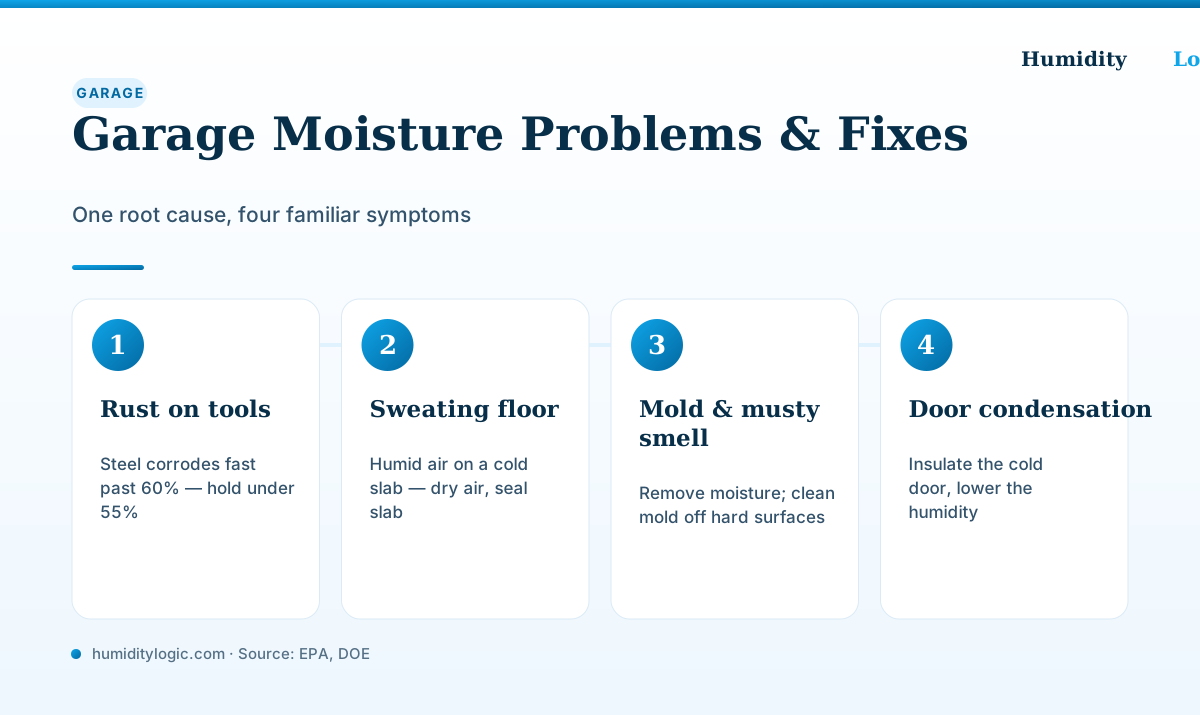
Most garage complaints — rust, mold, a wet floor, that basement-like smell — are the same root cause wearing different clothes: too much moisture meeting cold surfaces. Garage moisture problems come from an unconditioned, leaky space where ground water, humid air, and wet cars condense on the cold slab and metal; the fix for every one of them is to cut the moisture and hold the garage under 60% relative humidity. Here is how each problem shows up and what to do about it.
For the overall plan behind these fixes, see garage humidity control; this page is the symptom-by-symptom diagnosis.
Why garages have moisture problems in the first place
A garage is essentially unconditioned space with three built-in moisture sources. The uninsulated concrete slab sits in direct contact with the ground and wicks water up out of the soil — the DOE describes this capillary and vapor movement through foundations as a primary moisture path (DOE Building America — Moisture Flow). The large door and its gaps let humid outdoor air pour in. And vehicles are the biggest single event: a car covered in rain or melting snow can shed a gallon or more onto the floor. All that moisture then meets the coldest surfaces in the room and condenses, exactly as the EPA puts it — “when warm, humid air contacts a cold surface, condensation may form” (EPA Mold Course, Chapter 2).
Rust on tools, hardware, and the car
Bare steel corrodes faster as humidity rises, and it picks up speed noticeably once the air passes about 60% RH. In a garage the cold metal — tool surfaces, cast-iron tops, the door, the car body — is often where damp air condenses first, putting a film of water right where rust starts. The fix is to hold the garage under 60%, and under about 55% if it is a workshop full of bare steel. A light coat of oil on exposed tool surfaces buys time, but drying the air is the real cure.
A sweating or wet garage floor
A wet slab is usually condensation, not a leak. The concrete stays cool, and when warm, humid air (especially in spring and early summer) touches it, water forms on top — the same reason a cold drink sweats. A slab can also wick ground moisture up from below. To tell which you have, tape a 2-foot square of plastic sheet tightly to the floor overnight: water on top of the plastic is condensation from the air; water underneath is moisture coming up through the slab. Either way, drying the air and warming or sealing the slab fixes it. The full walkthrough is in garage floor condensation and the related condensation on a concrete floor.
Mold and a musty smell
That damp-basement smell in a garage is mold and mildew at work. Mold needs only moisture and a surface, and the EPA is blunt that the way to control it is to control moisture — there is no mold without water (EPA — A Brief Guide to Mold, Moisture and Your Home). It shows up on drywall, on stored cardboard, and along the cold base of exterior walls. Clean visible mold off hard surfaces, throw out moldy cardboard, improve airflow, and run a dehumidifier to hold under 60%. The smell fades once the space stays dry — the same approach as getting rid of a musty smell elsewhere in the house.
Condensation on the door, walls, and windows
Beads of water or frost on the inside of the garage door each morning are the clearest sign the surface is colder than the air’s dew point. An uninsulated steel door is a giant condensing plate. Attack it from both sides: lower the air moisture and warm the cold surface by insulating the door and walls. The targeted fix is in condensation on a garage door.
Rotting wood and damaged stored items
Left unchecked, garage moisture rots the bottom of wood framing, door jambs, and shelving, and ruins anything stored in cardboard. Keep stored items up off the slab and away from exterior walls so air can circulate, and deal with the humidity at its source rather than replacing warped boxes every year.
The one fix behind all of them
Every problem on this list traces back to moisture, so the cure is the same: cut the water coming in (dry cars, seal gaps, fix drainage), add airflow, and run a right-sized dehumidifier to hold the garage under 60%. Size it for a damp-to-wet space — ENERGY STAR’s bands put that at 30–50 pints a day for a typical garage (ENERGY STAR — Dehumidifiers) — with the dehumidifier size calculator. Do that and the rust, mold, smell, and sweating floor all go away together.
See it in 3D. Explore the garage in The Humidity House, our interactive 3D home — click the car and shelving to see where garage moisture collects. For the step-by-step, see how to dehumidify a garage.
Frequently asked questions
Why is my garage so damp and wet?
A garage is barely conditioned: an uninsulated slab wicks ground moisture, a big door leaks humid outdoor air, and wet vehicles carry water in. That moisture meets the cold slab, steel door, and bare metal and condenses, leaving the floor, walls, and tools damp.
Why is there rust on my tools in the garage?
Humidity. Unprotected steel corrodes faster as relative humidity climbs past about 60%, and in a garage the cold metal is often the first surface where damp air condenses. Holding the garage under 60% — ideally under 55% for a workshop — is what stops the rust.
Why does my garage floor get wet?
Usually condensation, not a leak. A cold concrete slab sits below the dew point of warm, humid air, so water forms on top of it — most common in spring and early summer. A slab also wicks ground moisture up from below. A simple plastic-sheet test tells condensation from seepage.
How do I get rid of the musty smell in my garage?
The smell is mold and mildew feeding on moisture, so remove the moisture. Dry the sources, improve airflow, and run a dehumidifier to hold the garage under 60%. Clean any visible mold off hard surfaces, and the odor fades once the space stays dry.
Can garage moisture damage the house?
Yes. Persistent damp rusts tools and hardware, grows mold on drywall and stored items, rots the bottom of wood framing and doors, and can migrate into living space above or beside the garage. Controlling it protects both your belongings and the structure.
Sources & references
Every figure on this page is checked against these published sources. Last reviewed October 17, 2026.