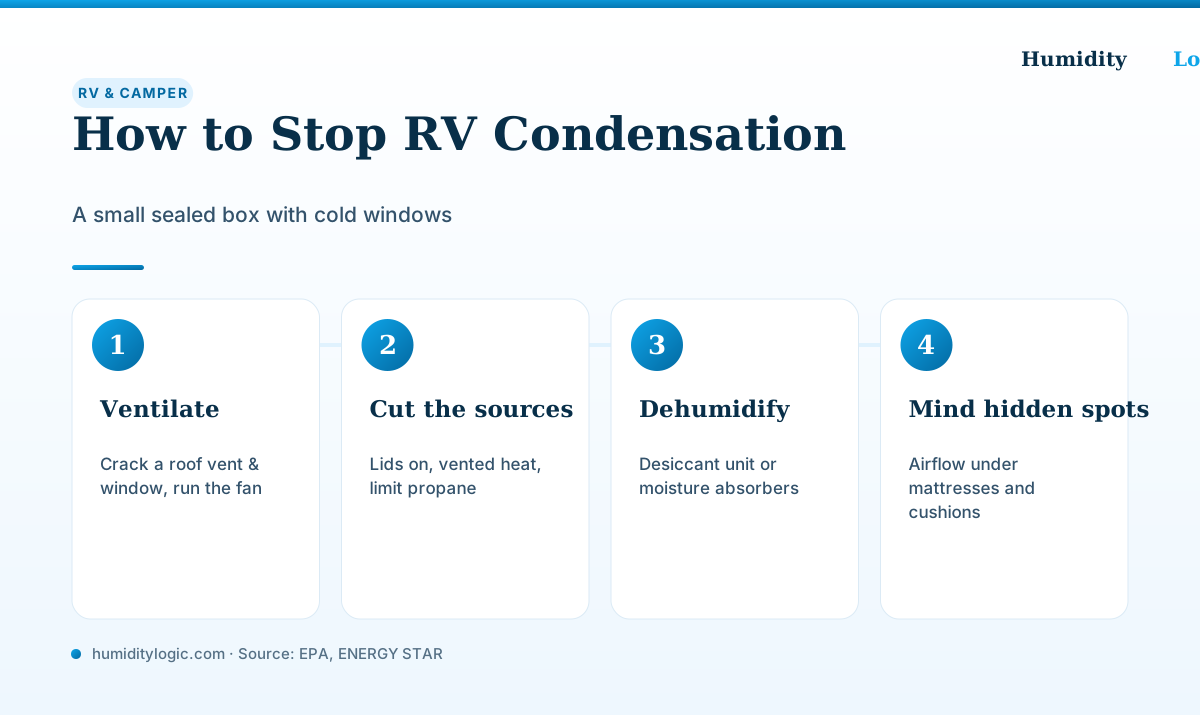
Anyone who has woken up to dripping windows in a camper knows RVs collect condensation far faster than a house. RV condensation happens because a small, well-sealed cabin with thin walls and cold single-pane windows fills with moisture from breathing, cooking, showering, and propane — and the fix is to ventilate, cut the moisture sources, and dehumidify. Here is why it is so much worse in an RV, and exactly what to do about it.
Why RVs get so much condensation
Three things stack up against an RV. First, it is a small, well-sealed box, so the moisture a few people produce raises the humidity quickly — there is very little air volume to dilute it. Second, the walls and windows are thin and poorly insulated; single-pane glass and aluminum framing get cold, giving water vapor plenty of cold surfaces to condense on. Third, you generate a lot of moisture in that small space: breathing overnight, cooking, showering, and burning propane all add water vapor.
The mechanism is the same one the EPA describes for any building — “when warm, humid air contacts a cold surface, condensation may form” (EPA Mold Course, Chapter 2) — just concentrated into a far smaller, colder box. That is why you see it first and worst on the windows.
The moisture sources, and how to cut each one
- Breathing and bodies. Two people sleeping overnight release a surprising amount of water vapor. Crack a window or roof vent while you sleep so it can escape instead of condensing on the walls.
- Cooking. Boiling and simmering pour steam into the cabin. Cook with lids on, run the range vent if it exhausts outside, and crack a window.
- Propane. Burning propane produces water vapor as a combustion byproduct — the EPA flags unvented combustion as a source of both moisture and pollutants indoors (EPA — Combustion Pollutants and Indoor Air Quality). Use vented appliances, and never use the stovetop as a heater: it dumps water and carbon monoxide into a sealed cabin.
- Showering. An RV shower spikes humidity fast. Run the bathroom roof vent during and after, and squeegee the walls.
Fix 1: Ventilate
Air exchange is the single most effective move. Crack a window or a roof vent — ideally two, to cross-ventilate — especially while cooking, showering, and sleeping. A powered roof fan (the kind many RVs have) pulls moist air straight out and makes a big difference. It feels counterintuitive to open up when you are trying to stay warm, but a little steady airflow is what keeps the cabin from turning into a terrarium.
Fix 2: Dehumidify
When ventilation alone is not enough — humid climates, cold-weather camping, or full-time living — add moisture removal:
- A small dehumidifier sized to the cabin holds the humidity down automatically. In cold weather, choose a desiccant model: a standard compressor dehumidifier ices up below about 50°F, while a desiccant unit keeps working in the cold (and gives off a little warmth). Size it for the small space with the dehumidifier size calculator; the full picture is in our RV dehumidifier guide and dehumidifier for a camper.
- Moisture absorbers (rechargeable desiccant tubs or disposable calcium-chloride pots) are a cheap, power-free option for short trips and small campers. Place them near the worst windows and empty or recharge them on schedule.
Keep the cabin under the EPA’s 60% ceiling, ideally 30–50% (ENERGY STAR — Dehumidifiers; EPA — A Brief Guide to Mold, Moisture and Your Home).
Fix 3: Handle the hidden spots
The condensation you do not see causes the mildew. Warm, humid air meets the cool underside of a mattress or cushions against a cold wall, and water collects in that trapped space. Improve airflow underneath with a slatted base or a ventilating mattress underlay, pull cushions a finger’s width off the wall, and lift mattresses occasionally to let them dry. Check slide-out seals, cabinet backs, and window frames, too — the cold corners where damp hides.
Put it together — ventilate, cut the cooking and propane moisture, dehumidify, and keep air moving behind soft furnishings — and the dripping windows and musty smell go away. For cold-season camping specifically, which is when this gets hardest, see RV moisture control in winter, and for the full routine, how to dehumidify an RV.
See it in 3D. For the same moisture ideas in a full home, explore The Humidity House, our interactive 3D home.
Frequently asked questions
Why is there so much condensation in my RV?
An RV is a small, well-sealed box with thin walls and single-pane windows, so moisture builds fast and the cold surfaces are close by. Breathing, cooking, showering, and burning propane all add water vapor, and with little air exchange it condenses on the windows, walls, and ceiling — far more than it would in a house.
How do I stop condensation in my RV or camper?
Ventilate and dehumidify. Crack a window or roof vent (especially while cooking, showering, and sleeping), run a roof fan, and add a dehumidifier or moisture absorbers. Cook with lids on, limit unvented propane, and wipe down windows in the morning. The goal is to keep humidity down and air moving.
Does propane cause condensation in an RV?
Yes. Burning propane produces water vapor as a combustion byproduct, so an unvented propane heater or cooktop adds significant moisture — and carbon monoxide — to the small cabin. Use vented appliances, run the range fan or crack a window while cooking, and never use the stovetop as a heater.
Why is there moisture under my RV mattress and cushions?
Warm, humid air from your body meets the cool underside of a mattress or cushion sitting against a cold wall or platform, and water condenses in that trapped space — the perfect spot for mildew. Improve airflow underneath with slatted bases or mattress underlay, pull cushions off the wall, and lower the cabin humidity.
Will a dehumidifier help with RV condensation?
Yes, a small one sized to the space will. In cold-weather camping, choose a desiccant model, since a compressor dehumidifier ices up below about 50°F. For short trips or small campers, rechargeable or disposable moisture absorbers plus good ventilation often do enough.
Sources & references
Every figure on this page is checked against these published sources. Last reviewed October 23, 2026.