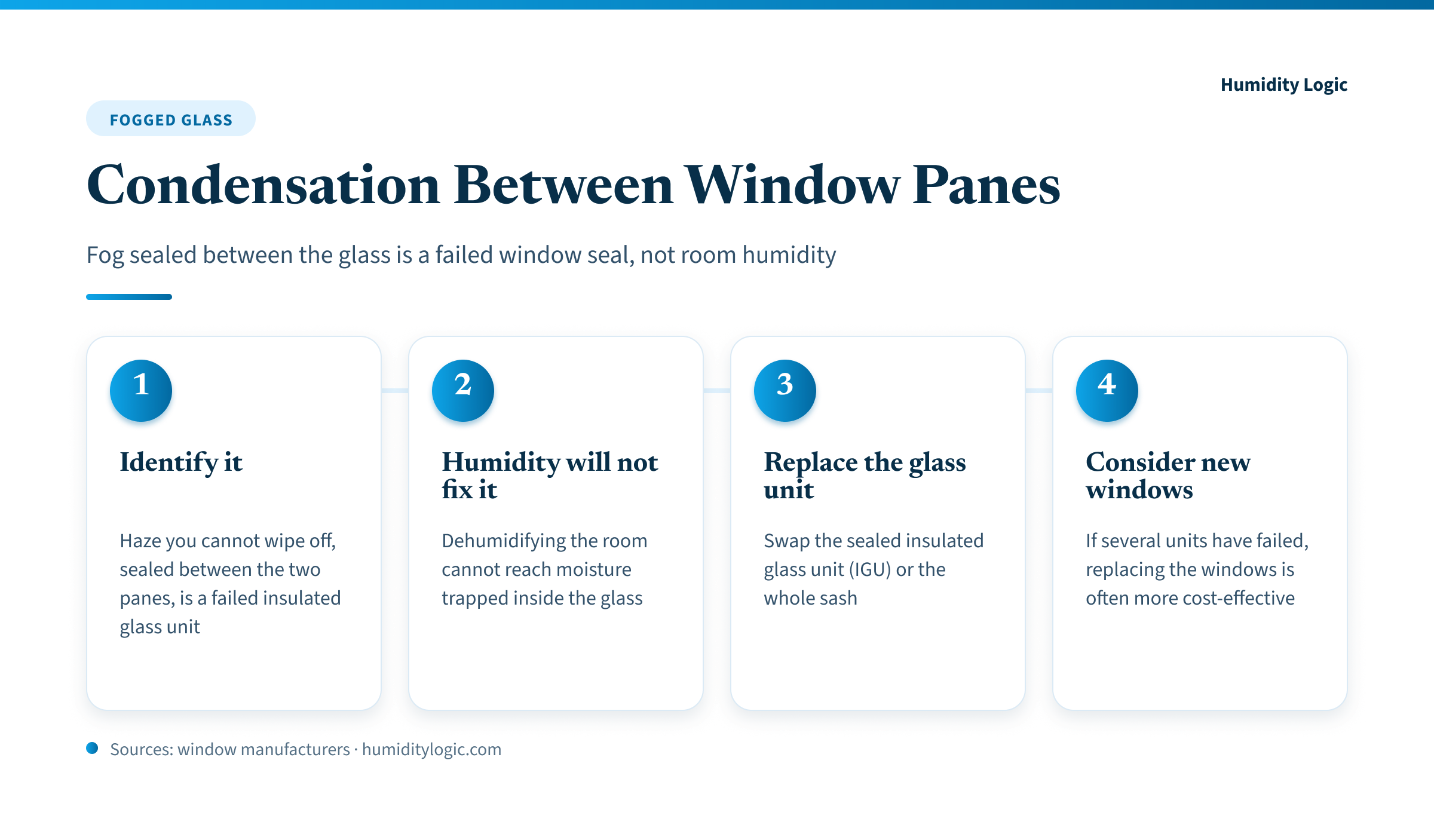
Fog trapped between the two panes of a double- or triple-glazed window is not a humidity problem you can wipe away or dehumidify out. It means the insulated glass unit (IGU) seal has failed and the moisture-absorbing desiccant inside the spacer has become saturated, letting water vapor condense inside the sealed cavity. Because that space is sealed behind glass you cannot open, no dehumidifier, fan, or cloth will ever reach it. The only real fixes are replacing the sealed glass unit, replacing the sash, or replacing the window — this is glass repair, not room-air management.
How Do I Know the Fog Is Between the Panes?
Run a fingertip across the haze: if you cannot touch it from inside or outside, it is sealed between the panes. This one test separates a failed seal from the two far more common — and much cheaper — kinds of window condensation. Moisture on the room-side surface wipes off and points to humid indoor air. A film on the exterior glass burns off by mid-morning and is harmless dew on an efficient window. Only the between-the-panes case leaves a haze, streaks, or a cloudy mineral film that stays put no matter which side you wipe. As Andersen puts it, “If you ever notice condensation in between the two panes of glass, it’s a sign that the seal on your window has failed.” Our full guide to condensation on windows walks through all three locations if you are not yet sure which one you have.
What Actually Fails Inside the Glass?
A double-pane window is a sealed sandwich, and when its edge seal breaks, the whole insulating system unravels. Between the two panes sits a spacer bar filled with a desiccant — a moisture-absorbing material — and the cavity is usually filled with an inert gas like argon or krypton and sealed at the edges. That sealed gas layer is what slows heat transfer and keeps the inner glass warm enough to resist condensation. Over years of daily heating and cooling, the glass expands and contracts, and sunlight breaks down the sealant, especially on south- and west-facing windows that take the most UV. Once the seal cracks, the inert gas leaks out and humid outside air seeps in. The desiccant absorbs that moisture until it is fully saturated, and after that, every warm, humid day drives water vapor into the cavity, where it condenses on the cold inner face of the glass. That is the haze you see — and why it often looks worse on hot, humid afternoons and clears slightly on cool, dry days, even though the seal is permanently broken.
Why Won’t Lowering Room Humidity Clear It?
Because the moisture is sealed in a space your room air cannot reach, drying the room does nothing. This is the single most important point to understand, and it is where people waste the most time and money — running a dehumidifier for weeks, caulking around trim, even replacing weatherstripping, all while the haze between the panes never budges. Dehumidifiers, cracked windows, exhaust fans, and moisture absorbers all work on the air in your room — and they are the right tools when condensation sits on the room-side surface of the glass. But a failed IGU has its own tiny, sealed atmosphere trapped between the panes. Your 40% indoor humidity and the outdoor weather both feed moisture into that cavity through the broken seal; the dry air from your dehumidifier never gets in to pull it back out. If you want to understand why the glass surface condenses in the first place, our explainer on dew point versus humidity covers the physics. But for between-the-panes fog specifically, no humidity target on the EPA’s recommended 30–50% range will ever fix it.
What Are My Repair Options?
You have three real paths, and they trade cost against how long the fix lasts. Ranked cheapest to most durable, they are defogging, glass-unit replacement, and whole-window replacement. Before you pay for any of them, dig out your original purchase paperwork: many insulated-glass units carry a manufacturer warranty against seal failure for roughly 10 to 20 years, and a covered unit can shift the decision entirely.
Replace the insulated glass unit (IGU). This is the sweet spot for most homeowners. A glass shop removes just the sealed double-pane unit and installs a fresh one in your existing frame and sash. Bob Vila frames it as good news: “You can correct the problem by replacing the insulated glass panel, and it’s a relatively inexpensive fix.” You keep the original frame, restore a proper seal and gas fill, and pay a fraction of a full replacement — typically a few hundred dollars per window.
Replace the sash. If the sash itself is worn or the glass is bonded to it, swapping the entire sash (the moving frame that holds the glass) is the next step up. It costs more than glass alone but still less than a whole new window, and on many brands it is a clean, snap-in job.
Defog the unit. Defogging drills small holes, clears the moisture, and installs micro-vents. The Glass Guru notes it takes “less than 20 minutes” and costs “50% or more” less than replacement — but the vents leave the cavity open to outside air and “don’t replace the gas,” so you get clarity back without the original insulating performance. Treat it as cosmetic.
When Should I Just Replace the Whole Window?
Replace the entire window when the frame is also failing, several units have fogged, or the windows are simply old. A single fogged pane in a sound frame almost never justifies a full replacement — glass-unit replacement wins on cost every time. But the math flips when the frame is rotted, drafty, or hard to operate, because a new IGU cannot fix a bad frame. It also flips when fog is spreading window by window across the house: seals installed the same year tend to fail around the same time, so one failure often signals more coming. Andersen’s own guidance is that between-the-panes condensation means “your window is no longer performing well, which means the ideal solution is to replace your windows.” If you are weighing repair against replacement across a whole house, plug your numbers into the window condensation calculator to see where the trade-off lands for your climate and glass.
Could It Be a Different Moisture Problem Instead?
If you can physically touch the moisture, you do not have a failed seal — and the fix is completely different. Wipeable droplets on the inside of the glass mean your indoor air is too humid, and the answer is ventilation, source control, and often a dehumidifier, aiming for 30–50% relative humidity (below 60%). A cool morning film on the outside pane is just dew and needs no fix at all. And if you are seeing moisture creeping onto the surrounding drywall rather than the glass, that is a separate issue covered in our guide to condensation on walls. Reserve the “replace the glass” conclusion for haze you genuinely cannot reach from either side — that is the fingerprint of a sealed-unit failure, and the only category where lowering your indoor humidity will not help.
The Bottom Line
Condensation between window panes is a mechanical failure of the sealed glass unit, not a sign your house is too humid. The desiccant is saturated, the seal is broken, and the moisture lives in a space you cannot reach — so wiping and dehumidifying are dead ends. Confirm it with the fingertip test, then choose your fix by budget and how long you want it to last: defogging for a quick cosmetic reset, IGU or sash replacement for a proper repair at a fair price, or full window replacement when the frame or the whole house of windows has reached the end of the road.
Frequently asked questions
Can I clear condensation between double-pane windows myself?
No. The fog is sealed inside the insulated glass unit, behind glass you cannot open, so wiping, heating, or dehumidifying the room never reaches it. The only real fixes are replacing the sealed glass unit, replacing the sash, or replacing the window. A glass shop handles the first two.
Will a dehumidifier stop fog between the panes?
No. A dehumidifier lowers moisture in your room air, but the fog between the panes lives in a sealed cavity your room air cannot touch. Once the seal fails, moisture condenses inside the glass no matter how dry the room is. Dehumidifiers only help with condensation on the room-side surface.
How much does it cost to fix a foggy double-pane window?
Replacing just the insulated glass unit typically runs a few hundred dollars per window, well below a full window replacement. Defogging services cost less but are a limited, temporary clarity fix. If several units have failed or the frames are worn, full replacement is often the better long-term value.
Does defogging permanently fix a failed window seal?
Not really. Defogging drills tiny holes, clears the moisture, and adds vents, which restores clarity but leaves the unit vented to outside air rather than truly resealed. It also does not restore any argon or krypton gas fill. Treat it as a cosmetic, lower-cost option, not a return to original performance.
Is a fogged window seal covered under warranty?
Sometimes. Many manufacturers warranty insulated glass against seal failure for roughly 10 to 20 years, so check your paperwork before paying out of pocket. Coverage often includes the glass unit but not labor, and it may be prorated. Seals commonly fail after 15 to 25 years, so older windows have usually aged out.
Sources & references
Every figure on this page is checked against these published sources. Last reviewed August 1, 2026.