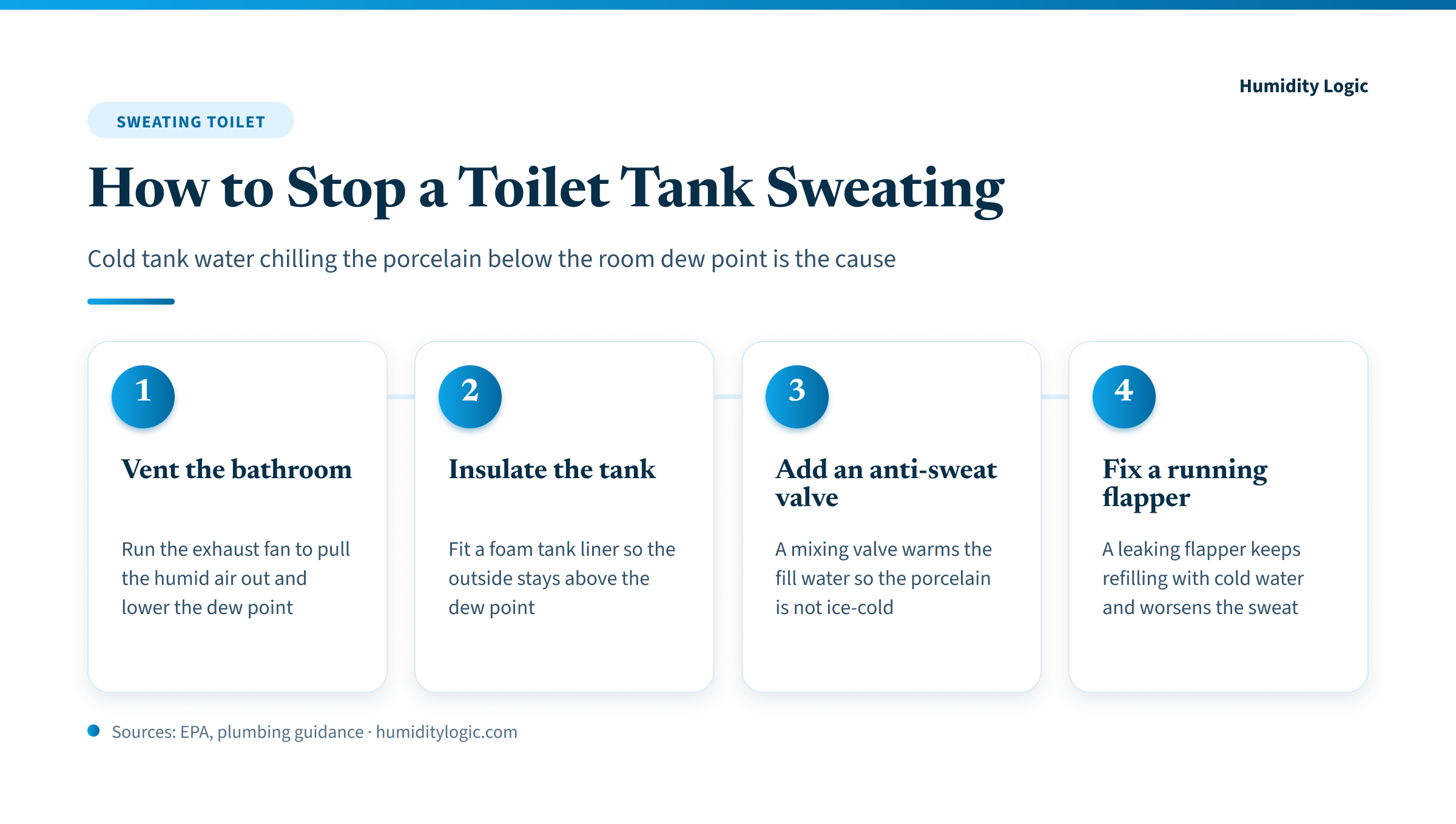
A toilet tank sweats because it fills with cold water straight from the supply line, and that cold water chills the porcelain below the bathroom air’s dew point — so the humid air condenses on the outside of the tank, exactly like a glass of ice water beading up on a summer day. It is not a leak or a crack. You stop it by working either side of that dew point: lowering the humidity in the room, insulating the tank so the outside stays warm, or adding an anti-sweat valve that warms the fill water. First, though, rule out a running flapper that keeps flooding the tank with cold water.
Why Does a Toilet Tank Sweat?
Condensation forms on any surface that falls below the dew point of the surrounding air — the temperature at which air can no longer hold all its water vapor, so the excess turns back into liquid. A toilet tank is a near-perfect candidate. It holds a couple of gallons of water that came straight from the municipal main or a well, often in the 50s °F, and porcelain conducts that cold right through to the outer surface. When the bathroom air is warm and moist, the vapor in it hits that chilled porcelain and condenses into the film of water you find pooling on the lid, running down the sides, and dripping onto the floor.
That is why the problem is worst in summer and in humid climates, and worst right after a hot shower. A shower can push a small bathroom’s humidity toward saturation in minutes, which drives the dew point up until it exceeds the temperature of the cold tank. This Old House frames the diagnosis around the incoming water itself — plumber Richard Trethewey notes that constantly bringing new cold water into the tank “would make any toilet tank condense.” If you want to see how close your bathroom’s air already is to condensing, our guide on dew point versus relative humidity explains what the numbers mean, and the condensation risk calculator estimates the surface temperature at which sweating begins for your conditions.
The good news is that a sweating tank is cosmetic in the short term — but only in the short term. The water dripping off it soaks the floor, the subfloor, and the base of the toilet day after day, which rots flooring and feeds mildew. It is worth fixing before the puddle becomes a repair bill.
Is Your Toilet Running First?
Before you buy anything, check whether the toilet is running. This is the single most common reason a tank sweats badly, and it is the cheapest to fix. A worn or warped flapper — the rubber seal at the bottom of the tank — lets water leak slowly into the bowl. The fill valve senses the drop and keeps topping the tank back up with fresh cold water. The tank never gets a chance to sit still and warm toward room temperature, so it stays permanently chilled and permanently sweating.
To test it, put a few drops of food coloring in the tank and wait 15 to 20 minutes without flushing. If color appears in the bowl, the flapper is leaking and needs replacing. A replacement flapper costs a few dollars and takes a few minutes to swap. As Bob Vila’s toilet-tank guide points out, a leaking flapper both wastes water and worsens condensation, so fixing it does double duty. Do this step first — every other fix below assumes the tank is holding still and not constantly refilling with cold water.
How Do You Lower the Bathroom Humidity?
Since sweating needs humid air to condense, drying the air out is the most direct fix and often the only one you need. Run the exhaust fan during every shower and for 20 to 30 minutes after, so the moisture leaves the room instead of settling on the cold tank. If the bathroom has no fan, cracking a window helps, though it is less reliable.
Where ventilation alone cannot keep up — a windowless bathroom, a damp basement half-bath, or a humid-climate home in July — a dehumidifier gives you direct control over the number. The EPA recommends keeping indoor relative humidity below 60 percent (and ideally between 30 and 50 percent); its mold and moisture guidance warns that humidity above 60 percent invites condensation and the mold that follows it. Drop the room into that band and the air simply cannot deposit water on the tank. A small unit sized for the space handles it — see our bathroom dehumidifier guide for picking one, and what counts as high humidity for why 60 percent is the line you do not want to cross. Because the same damp air that sweats the tank also feeds mildew on grout and caulk, drying the room out is the backbone of bathroom mold prevention too.
Should You Insulate the Tank?
If you cannot get the humidity down far enough — or you would rather stop the sweat at the source — insulate the tank so its outer surface never reaches the dew point. A foam tank liner kit is the standard approach: closed-cell foam panels that adhere to the inside walls of the tank and separate the cold water from the porcelain. With the cold water no longer in direct contact, the outside of the tank stays close to room temperature and stops beading up.
Liner kits are inexpensive and widely sold, and every source above lists insulation as a reliable fix. The one fussy part is installation: you have to shut off the supply, flush to empty the tank, and dry the inside completely so the adhesive bonds — any residual moisture and the foam peels off later. Some people improvise with bubble wrap, but a purpose-made kit fits better and lasts longer. Note that many newer toilets are sold as “insulated” models with this foam built into the tank from the factory; if you are replacing an old toilet anyway, choosing an insulated tank solves the problem permanently with no add-on.
What Is an Anti-Sweat Valve?
The most thorough fix warms the water itself. An anti-sweat valve — also called a mixing or tempering valve — ties into both the hot and cold water lines and blends a small amount of warm water into the tank each time it refills. Raising the fill water even a little lifts the porcelain’s temperature above the dew point, so condensation never starts. Because it treats the root cause rather than the symptom, it is the surest long-term cure.
The trade-off is installation. The valve needs a hot-water line within reach of the toilet, and as Boston Standard’s plumbers describe it, it “mixes a little warm water in with the cold when the tank refills.” Many models must be mounted vertically because their internal check valves only seal in that orientation, and the blend is adjustable for the seasons. For most homeowners this is a plumber’s job, not a weekend project — but it is the fix that reliably ends sweating even in the most humid bathrooms. One thing that does not work, worth mentioning so you do not waste money on it: a drip tray under the tank only catches the water; it does nothing to stop the condensation.
Whichever route you choose, the logic is the same. Sweating is a dew-point problem, so you either bring the humid air down to where it cannot condense, or keep the porcelain warm enough that it never invites condensation in the first place. Rule out a running flapper, then pick the fix that fits your bathroom.
Frequently asked questions
Why is my toilet tank sweating?
The tank fills with cold water straight from the supply line, and that cold water chills the porcelain. When the outside of the tank drops below the dew point of the humid bathroom air, water vapor condenses on it — the same way a glass of ice water beads up in summer. It is not a leak and not a crack; it is condensation from the temperature difference between cold water and warm, moist air.
How do I stop condensation on my toilet tank?
Attack it from either side of the dew point. Lower the bathroom humidity by running the exhaust fan and using a dehumidifier, so the air can no longer condense on a cold surface. Or keep the porcelain warmer than the dew point by insulating the tank with a foam liner kit, or by installing an anti-sweat mixing valve that adds a little warm water to the fill. Fixing a running flapper first is essential — nothing else works while cold water keeps pouring in.
Does insulating a toilet tank actually work?
Yes. A foam tank liner kit lines the inside walls of the tank so the cold water no longer chills the outer porcelain to the dew point. The outside surface stays close to room temperature and stops beading up. Liner kits are an inexpensive, common fix, though the tank has to be drained and fully dried for the adhesive to bond.
What is an anti-sweat valve?
An anti-sweat valve — also called a mixing or tempering valve — ties into both the hot and cold supply and blends a small amount of warm water into the tank as it refills. That raises the fill-water temperature enough that the porcelain no longer drops below the dew point. It treats the root cause but requires a nearby hot line and is usually a job for a plumber.
Can a running toilet cause condensation?
Yes, and it makes sweating far worse. A worn flapper lets water leak from the tank into the bowl, so the fill valve keeps topping the tank up with fresh cold water. That means the porcelain never gets a chance to warm up. Until you replace the flapper, no amount of ventilation or insulation will keep the tank dry.
Sources & references
Every figure on this page is checked against these published sources. Last reviewed July 29, 2026.