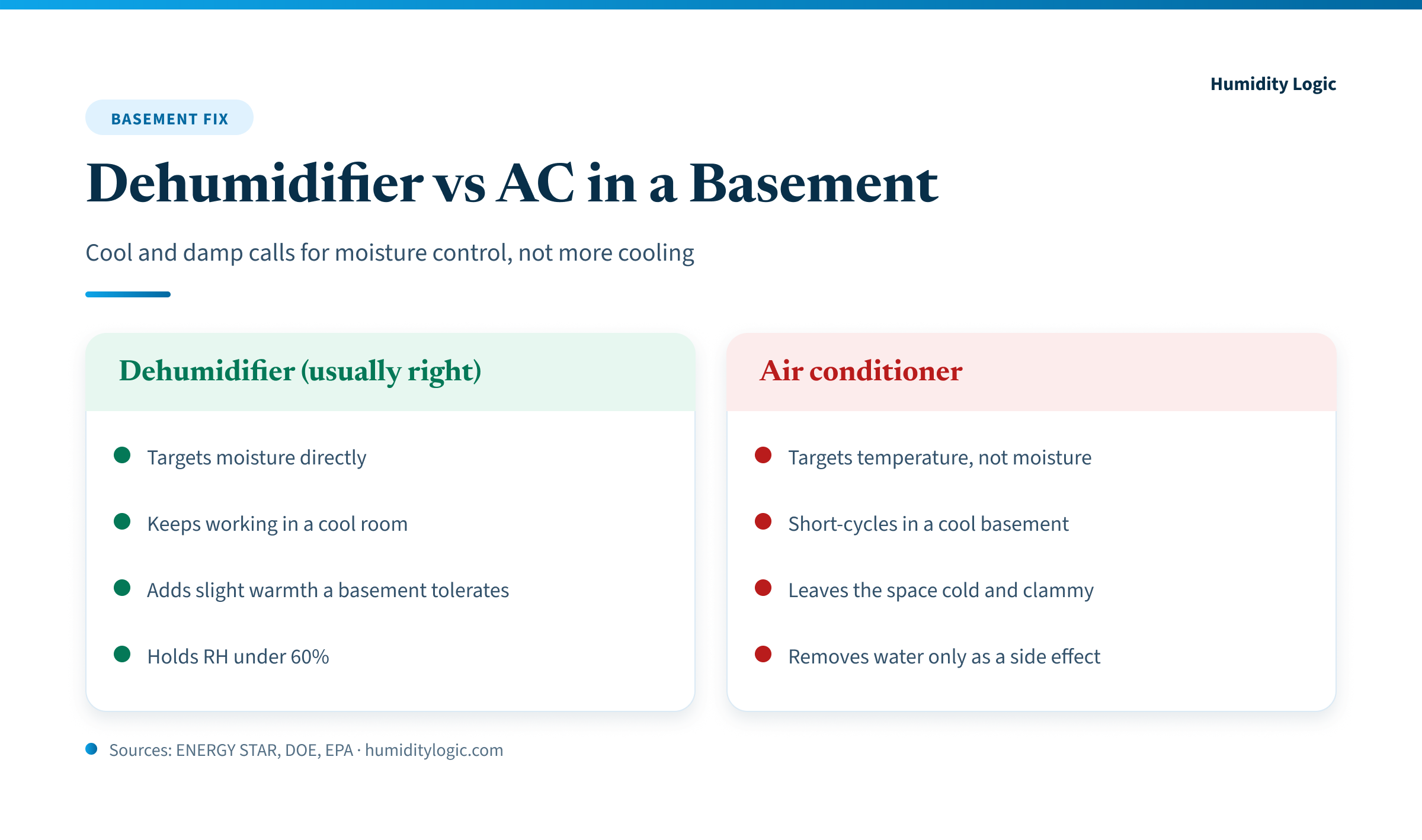
For a cool, damp basement, a dehumidifier is almost always the right tool, and an air conditioner is almost always the wrong one. The reason is simple physics: an AC chases temperature, not moisture. A basement is naturally cool to begin with, so the air conditioner satisfies its thermostat within a few short minutes, shuts off, and never runs long enough to wring real water out of the air. You end up with a space that is cold and clammy at the same time. A dehumidifier ignores temperature and targets moisture directly, which is exactly what a wet basement needs.
That single distinction settles most of this debate, but there are important wrinkles: how cold your basement gets, why the AC’s short-cycling is not a fault you can tune away, and the one scenario where you genuinely want both machines. This guide works through each.
Why is a basement cool and damp at the same time?
Most rooms get humid because they get hot. A basement breaks that rule. It sits partly or fully below grade, surrounded by earth that stays around 50 to 60°F year-round, so the space runs cooler than the floors above it. Yet it is often the dampest room in the house.
Two things feed that dampness. First, moisture wicks in through the foundation and slab from the surrounding soil, a slow, constant load the EPA notes is worst where bare earth or concrete meets humid air. Second, warm, humid summer air drifts down the stairs, hits those cool below-grade walls, and condenses, the same way a cold drink sweats on a hot day. The result is a room that is simultaneously chilly and wet, which is precisely the combination an air conditioner is worst at fixing. For the full picture of where basement moisture comes from, see our basement humidity guide.
Why does an AC leave a basement cold and clammy?
An air conditioner is a heat machine. It pulls air across a cold coil, and moisture condenses out as a byproduct, but its only goal is to hit the temperature you dialed in. Once the thermostat is satisfied, the compressor stops. Every bit of dehumidification stops with it.
In a warm upstairs room this works fine, because the AC has to run long, steady cycles to fight the heat, and it removes plenty of water along the way. In a cool basement the opposite happens. The room is already near the set temperature, so the compressor kicks on, runs for a few minutes, and shuts off. That short-cycling never gives the coil time to condense meaningful moisture. Worse, it drops the temperature of a room that was already too cool, so you trade a damp basement for a cold, damp basement.
This is not a sizing mistake you can dial out. Even a perfectly sized AC short-cycles in a space that does not need cooling. US DOE Building America research on low-load homes documented exactly this: as cooling operation drops, humidity removal drops with it, which is why building scientists recommend a separate dehumidifier that controls moisture without running the cooling system. A basement is the low-load room in almost every house.
Why does a dehumidifier fix what the AC can’t?
A dehumidifier uses the same condensing trick as an AC, but it does not care about the room’s temperature. It pulls air across a cold coil, drips the water into a tank or drain hose, then passes the dried air back over a warm coil and returns it to the room a few degrees warmer. It keeps doing this until the humidity target is met, not a temperature target. If you want the full walkthrough of that loop, see how a dehumidifier works.
Two features make it the basement’s natural match. It runs on a humidistat, so it works through the cool, rainy shoulder seasons when an AC would never switch on. And the slight warmth it adds, often just two or three degrees, is a non-issue in a cool basement and can even take the chill off. That waste heat is a nuisance in a hot bedroom but an afterthought below grade.
The EPA recommends keeping indoor relative humidity below 60 percent, ideally between 30 and 50 percent, and a dehumidifier is built to hold exactly that line. To match a unit to your square footage and dampness level, run the numbers through the dehumidifier size calculator rather than guessing, and see our basement dehumidifier guide for placement and drainage tips.
Dehumidifier or AC for a basement: a side-by-side
Use this to match the tool to what your basement is actually doing.
| Factor | Dehumidifier | Air conditioner |
|---|---|---|
| Primary job | Remove moisture | Remove heat |
| Controlled by | Humidistat (targets RH) | Thermostat (targets temperature) |
| Behavior in a cool room | Keeps running until air is dry | Short-cycles, then shuts off |
| Moisture removed | The whole point | Side effect, only while cooling |
| Effect on temperature | Adds a few degrees of warmth | Drops it further (often unwanted) |
| Works in spring/fall dampness | Yes, independent of temperature | No, rarely switches on |
| Holds RH under 60% | Yes, by design | Not reliably in a cool space |
| Best fit | Cool, damp basement | Genuinely hot basement |
What if my basement is colder than 65°F?
This is the one place where not all dehumidifiers are equal. A standard compressor dehumidifier depends on a coil that runs colder than the room air. That is easy in a 70°F basement, but as the room drops toward 60°F the coil starts to frost, extraction falls off, and the machine spends its runtime defrosting instead of drying. Standard units lose capacity below about 65°F and many shut off safely near 41°F.
If your basement stays below that line, reach for a desiccant dehumidifier instead. It uses a moisture-absorbing rotor rather than a cold coil, so there is no icing, and it works from roughly 33°F to 65°F at full output. It costs a bit more to run and adds more heat, but in a cold basement that is exactly the trade you want. Our compressor vs desiccant comparison lays out the full decision, but the short rule is: warm basement, compressor; cold basement, desiccant. An air conditioner, notably, has no answer here at all, since running it in a sub-65°F room just makes a cold problem colder.
When do you actually want both?
There is a real case for running an AC and a dehumidifier in a basement, but only when the space genuinely overheats, think a finished basement with a home theater, gym equipment, or west-facing windows that bake it in summer. There, the AC earns its keep by handling the heat load the dehumidifier cannot, while the dehumidifier holds moisture under 50 percent through the whole year, including the months the AC sits idle.
Think of it as a division of labor rather than a competition. The AC owns summer heat; the dehumidifier owns year-round dampness. For a basement that is merely cool and damp, which describes most of them, the dehumidifier alone does the job, and adding an AC would only fight the comfort you are trying to build. If you are still deciding between the two machines in general terms, our broader dehumidifier vs air conditioner guide covers the whole-house version of this question.
The bottom line
A basement is the rare room that is cool and wet at once, and that combination is kryptonite for an air conditioner. The AC chases a temperature the basement has already reached, short-cycles, and leaves the air clammy. A dehumidifier ignores temperature, targets the moisture, and holds humidity in the 30 to 50 percent range the EPA recommends. Pick a compressor model for a basement above 65°F and a desiccant model for anything colder, size it properly, and reserve the air conditioner for the rare basement that is honestly hot. Diagnose cool and damp correctly and the choice makes itself.
Frequently asked questions
Should I use a dehumidifier or an AC for a damp basement?
In almost every case, a dehumidifier. A basement is usually cool and damp at the same time, and an air conditioner is built to chase temperature, not moisture. Because the space is already cool, the AC satisfies its thermostat in minutes and shuts off before it removes much water, leaving the basement cold and clammy. A dehumidifier targets moisture directly and keeps pulling water no matter how cool the room is.
Will running the AC dry out my basement?
Only a little, and only while it runs. An AC removes moisture as a side effect of cooling, so once the basement hits the set temperature the compressor stops and dehumidification stops with it. In a naturally cool basement that happens fast, so the AC barely dries the air. DOE research on low-load homes found that reduced cooling operation directly diminishes humidity removal.
Does a basement dehumidifier need a minimum temperature to work?
Standard compressor dehumidifiers work best above about 65°F and start losing capacity below it, because their cold coils begin to frost. Many stop safely near 41°F. If your basement stays colder than about 65°F for much of the year, choose a desiccant dehumidifier, which works from roughly 33°F to 65°F without icing up.
What humidity level should a basement stay at?
Keep relative humidity below 60 percent at all times, and ideally between 30 and 50 percent. The EPA and ENERGY STAR both point to that range because mold, dust mites, and musty odors take hold once the air stays above roughly 60 percent. A basement that reads over 60 percent on a hygrometer needs active moisture control.
Do I need both a dehumidifier and an AC in a finished basement?
Sometimes, but they solve different problems. If the basement gets genuinely hot in summer, an AC handles the heat while a dehumidifier holds moisture in check year-round, including the cool spring and fall months when the AC never runs. For a basement that is merely cool and damp, the dehumidifier alone is usually enough.
Sources & references
Every figure on this page is checked against these published sources. Last reviewed July 27, 2026.