A swamp cooler and a dehumidifier are often confused, but they are opposite tools for opposite climates. A swamp cooler (an evaporative cooler) adds moisture to the air and only cools effectively in a hot, dry climate like the Southwest. A dehumidifier removes moisture from the air and is built for a humid climate or a damp room. Run the wrong one for your region and you make comfort worse, not better.
The reason they get mixed up is that both are pitched as ways to feel more comfortable in summer. But they attack the problem from opposite ends. One machine wants the air dry so it can throw moisture in; the other wants to pull moisture out. Get the climate match wrong and a swamp cooler leaves a humid house muggy, while a dehumidifier does nothing to cool a dry desert home.
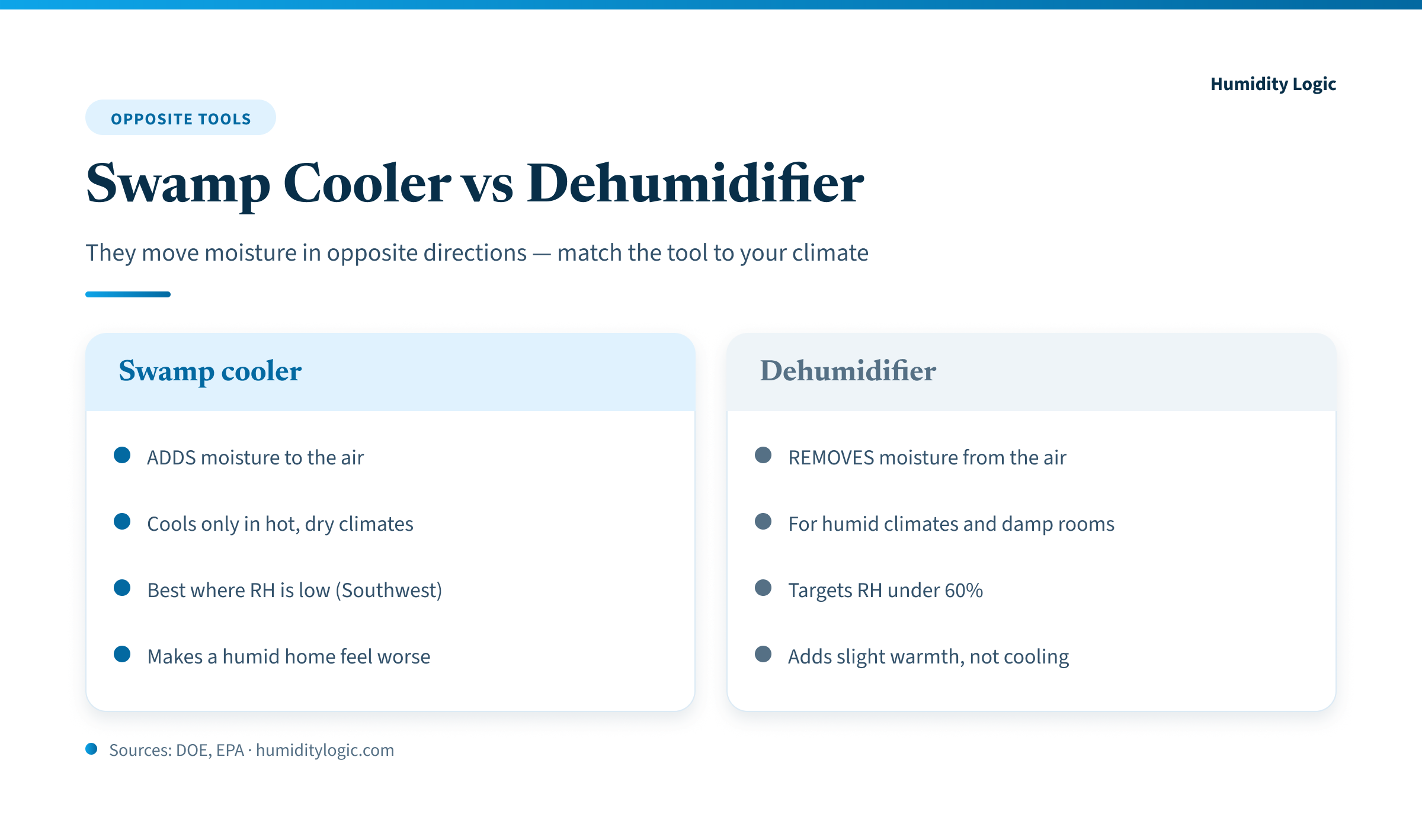
How does each machine treat moisture?
A swamp cooler pulls hot outdoor air across water-saturated pads. As the water evaporates, it absorbs heat from the air, and the US DOE notes this can lower the incoming air temperature by about 15° to 40°F before it enters the home. The catch is where that water goes: straight into the air you breathe. Evaporative coolers increase indoor humidity by design.
A dehumidifier does the reverse. It draws room air across a cold coil so water vapor condenses out, drains the water to a tank or hose, and returns the air slightly warmer and noticeably drier. It removes no heat from the home; if anything it adds a little, the same way any refrigeration cycle does. Its entire job is lowering humidity.
That single difference, adding water versus removing it, is why these two appliances belong in different parts of the country. It is also why the Building America Solution Center states plainly that direct evaporative coolers “increase rather than decrease” indoor moisture, unlike standard air conditioning.
Swamp cooler vs dehumidifier: the core comparison
| Factor | Swamp cooler | Dehumidifier |
|---|---|---|
| Effect on humidity | Adds moisture to the air | Removes moisture from the air |
| Cools the room? | Yes, 15–40°F in dry air | No, warms it slightly |
| Best climate | Hot and dry (low humidity) | Humid, or any damp space |
| Best US regions | Southwest and dry interior West | Southeast, Midwest, coasts, damp basements |
| Fails when | Humidity is high | (Works in any humid condition) |
| Target indoor humidity | Not a humidity tool | Under 60%, ideally 30–50% |
| Energy use | ~¼ of central AC | Modest; ENERGY STAR saves ~20% |
When is a swamp cooler the right choice?
A swamp cooler earns its keep only in genuinely dry heat. The DOE recommends evaporative cooling for dry climates, and the Building America guide is more specific: they perform best where the 1% summer design wet-bulb temperature is below about 70°F, which describes the Southwest and dry interior West. In those conditions a swamp cooler is cheap to run, using roughly one-quarter the energy of central air conditioning.
The physics are unforgiving, though. Evaporative cooling depends on the air being dry enough to accept more water vapor. As humidity rises, the cooling effect shrinks; around 50 percent relative humidity the temperature drop is modest, and when the air approaches saturation, evaporative cooling stops working altogether because the water can no longer evaporate. To see whether your local air is dry enough for this to matter, the difference between temperature and moisture content is worth understanding, and our explainer on dew point vs humidity covers exactly that.
There is also an upkeep cost that dry-climate owners accept in exchange for the low energy bill. Because a swamp cooler runs on standing water and wet pads, it needs seasonal service: a spring startup to clean or replace the pads, and a winter shutdown to drain and cover the unit. The Building America guide also warns that stagnant water left in the pan can breed bacteria, so pans should be emptied when the cooler sits idle for several days.
The failure case is the whole point of this comparison: run a swamp cooler in a humid climate and you add moisture to air that is already too wet. You get little cooling and a clammier house. That is the opposite of comfort, and it is why these units are rare east of the dry line.
When do you need a dehumidifier instead?
If you live where summers are humid, or you have a space that stays damp regardless of season, the dehumidifier is your tool. The tells are a home that feels sticky, smells musty, or grows mildew even when the temperature is reasonable. Those are moisture problems, not heat problems, and adding more moisture with a swamp cooler would only deepen them.
The EPA recommends keeping indoor relative humidity below 60 percent, ideally between 30 and 50 percent. A hygrometer reading consistently above that line is your signal to dehumidify. If you are not sure what counts as too high, our guide to what is considered high humidity puts numbers to it, and you can gauge your own comfort zone quickly with the humidity comfort checker.
A dehumidifier will not cool a hot room, and that is not a flaw. In a humid climate the discomfort is largely the moisture itself; drop the humidity and the same temperature feels far more tolerable. An ENERGY STAR certified dehumidifier removes the same water as a conventional unit while using about 20 percent less energy, so holding a basement under 50 percent need not be expensive.
What about cooling a humid home?
Here is where people reach for a swamp cooler and regret it. If your problem is heat and humidity, a swamp cooler is the wrong machine because it adds to the humidity half of the problem. The appliance that cools while also wringing out some moisture is a standard air conditioner, which sends dried, chilled air back into the room and dumps the heat and water outdoors.
So in a humid climate the real decision is usually between an air conditioner and a dehumidifier, not a swamp cooler at all. That comparison has its own nuances, including why an oversized AC can leave a house cold but still clammy, and we walk through it in dehumidifier vs air conditioner. Many humid-climate homes end up running both: the AC handles the heat, and a dehumidifier guards the cool, damp zones the AC never dries.
Is a humidifier the same as a swamp cooler?
Not quite, though both add moisture. A humidifier’s only job is raising indoor humidity, usually in dry winter air, with no cooling involved. A swamp cooler adds moisture as a side effect of cooling. If you are weighing tools that add versus remove humidity, dehumidifier vs humidifier lays out that pairing directly. The through-line across all of these is simple: know whether your air is too wet or too dry before you buy, and if you want to see how your region stacks up, the US humidity map shows where the country runs dry enough for evaporative cooling to make sense.
The bottom line
A swamp cooler and a dehumidifier are not competitors, because they serve opposite climates. The swamp cooler adds moisture and only cools in hot, dry air, so it belongs in the Southwest and dry West. The dehumidifier removes moisture and works anywhere the air is too wet, from a Gulf Coast summer to a cool northern basement. Match the tool to your climate, aim for indoor humidity between 30 and 50 percent, and you will never install the wrong box for your region.
Frequently asked questions
Can I use a swamp cooler in a humid climate?
No. A swamp cooler adds moisture to the air, so in a humid climate it makes your home feel muggier while barely lowering the temperature. Evaporative cooling depends on dry air to work, which is why the DOE recommends it only for dry regions like the Southwest. In a humid home, you want a dehumidifier instead.
At what humidity does a swamp cooler stop working?
Performance falls as humidity climbs. Evaporative coolers do best where the summer wet-bulb temperature stays below about 70°F, which lines up with low daytime relative humidity. Around 50 percent relative humidity the temperature drop shrinks sharply, and near saturation, evaporative cooling stops working entirely because the air cannot absorb more moisture.
Does a swamp cooler or a dehumidifier cool a room?
A swamp cooler actively cools, dropping incoming air by about 15 to 40 degrees in dry conditions. A dehumidifier does not cool at all; it removes moisture and returns the air a few degrees warmer. A dehumidifier makes a humid room feel more comfortable by lowering humidity, not by lowering the temperature.
Can one appliance both cool and dehumidify?
Not a swamp cooler or a dehumidifier, because they move moisture in opposite directions. A standard air conditioner is the appliance that both cools and removes some moisture at once. If your problem is heat plus stickiness in a humid climate, an AC, or an AC paired with a dehumidifier, is the usual answer.
What indoor humidity should I aim for?
The EPA recommends keeping indoor relative humidity below 60 percent, ideally between 30 and 50 percent. Above roughly 60 percent, mold, dust mites, and musty odors take hold. A swamp cooler can push a home past that line, while a dehumidifier is designed to hold humidity inside the healthy range.
Sources & references
Every figure on this page is checked against these published sources. Last reviewed July 27, 2026.