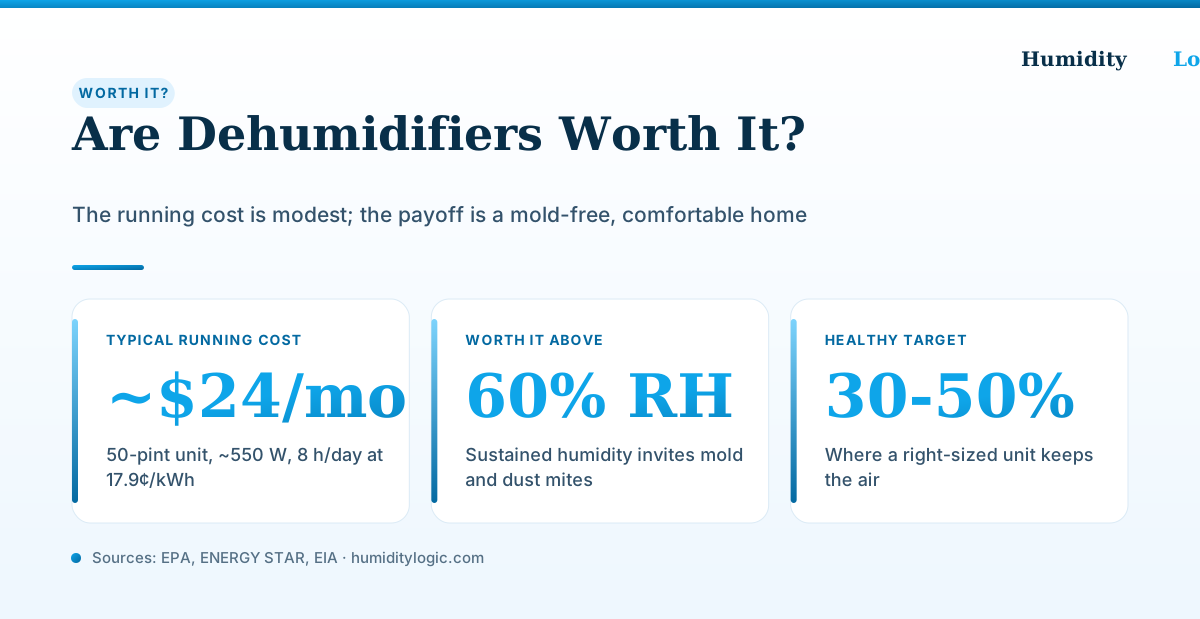
A dehumidifier is worth it whenever a room or basement regularly sits above about 60% relative humidity — and in that situation the running cost is smaller than most people fear. A typical 50-pint unit draws around 550 watts, so running it 8 hours a day works out to roughly $0.79 a day, or about $24 a month at the US average electricity rate of 17.9¢/kWh. For that modest bill you get mold prevention, dust-mite control, and real protection for your drywall, furniture, and stored belongings. In a home that already sits in a healthy 30-50% range, though, the same machine mostly just adds to your power bill without doing much useful work.
The honest answer, in other words, depends on your specific space. The rest of this guide does the actual cost math, weighs it against the benefits, and lays out exactly when a dehumidifier earns its keep and when it does not.
What does a dehumidifier actually cost to run?
Start with the electricity, because that is the number people worry about most. A right-sized 50-pint unit draws about 550 watts when the compressor is running. If it cycles for 8 hours a day, that is 0.55 kW × 8 h = 4.4 kWh a day. At the US average residential price of 17.9¢/kWh, that is about $0.79 a day, or roughly $24 a month — the same figure our guide to how long to run a dehumidifier arrives at. You can plug your own wattage, run hours, and local rate into our electricity cost calculator to see what it costs where you live, since rates range from under 12¢ in some states to well over 30¢ in others.
Two things push that number around. First, run hours: a unit that only kicks on during a humid spell costs far less than one grinding away in a wet basement most of the year. Second, size and efficiency: a compact 20-pint unit for a bathroom or closet might draw only 300 watts, while an ENERGY STAR certified model does the same drying job on roughly 15% less power. The upfront price of the appliance itself — usually $150 to $300 for a quality portable — spreads across a 5-to-10-year service life, so it adds only a few dollars a month when amortized.
What do you get for that $24 a month?
This is where the value case lives, because the benefits are mostly about avoiding expensive problems. The single biggest one is mold. The EPA is blunt about the mechanism: in its mold guidance, it advises that “indoor relative humidity (RH) should be kept below 60 percent – ideally between 30 percent and 50 percent, if possible.” Above that 60% line, moisture condenses on cool surfaces and mold can take hold in as little as a day or two. A remediation job runs into the hundreds or thousands of dollars, so a machine that costs $24 a month to keep a chronically damp basement under control is cheap insurance. If you already have a musty smell or visible growth, pair the unit with the steps in our dehumidifier for mold guide.
The health benefits follow the same logic. The EPA notes that low humidity “may also discourage pests (such as cockroaches) and dust mites” — the two most common indoor allergy triggers, both of which need humid air to thrive. Bringing a damp room down into the 30-50% band removes the conditions they depend on, which is why humidity control is a standard recommendation for households dealing with allergies or asthma.
Then there is comfort and the house itself. Damp air feels warmer and stickier than dry air at the same temperature, so pulling moisture out can make a basement or bedroom feel more comfortable without touching the thermostat. Sustained high humidity also warps hardwood floors and doors, peels wallpaper, rusts tools, and rots stored cardboard and fabric. ENERGY STAR summarizes the payoff plainly: proper dehumidification “can save you energy, increase indoor comfort, and prevent mildew and bacterial growth.”
Weigh those avoided costs against the roughly $24 monthly bill and the comparison stops being close. A single warped hardwood floor, a rusted set of tools, or one professional mold cleanup easily exceeds a full year of running the machine. The dehumidifier is not really competing with $24 a month of comfort — it is competing with the far larger cost of the damage humid air does when nothing holds it in check.
When is a dehumidifier clearly worth it?
There are a few situations where the math is not close — the benefits comfortably outweigh the running cost:
- A damp or musty basement. Below-grade spaces trap moisture year-round, and a basement that reads above 60% is the textbook case for a dehumidifier. This is where a unit often runs the most hours, but also where it prevents the most expensive damage.
- A humid climate. In the Southeast, Gulf Coast, and other muggy regions, indoor humidity can stay high for months even with air conditioning running. A dehumidifier fills the gap the AC leaves.
- Allergy or asthma households. If someone reacts to dust mites or mold, holding humidity in the 30-50% range is a low-effort, evidence-backed way to cut their exposure.
- A specific moisture problem. A room over a crawlspace, a laundry area, a home gym, or a spot where condensation keeps appearing all benefit from targeted drying.
In each of these, the key is matching the unit to the load. An undersized machine runs constantly and still loses, while an oversized one short-cycles and wastes money — our guide on what size dehumidifier you need walks through the sizing so you buy the right capacity the first time.
When is a dehumidifier NOT worth it?
Just as important is knowing when to skip it. A dehumidifier is a poor investment in these cases:
- Your home is already dry. If a hygrometer shows your space sitting comfortably in the 30-50% range most of the year, a dehumidifier has almost nothing to remove. Running one anyway just adds cost and can push the air uncomfortably dry. Measure before you buy — a $10 to $15 humidity gauge settles the question. Our ideal indoor humidity guide explains what the readings mean.
- A cold space below about 65°F. Standard compressor dehumidifiers lose efficiency in chilly air and can even frost over. For an unheated basement, garage, or crawlspace that stays cold, a desiccant unit or simply better ventilation and drainage often works better than fighting a compressor model.
- The real fix is elsewhere. If moisture is coming from a specific source — a leaking pipe, poor grading that channels rainwater toward the foundation, an unvented dryer, or missing bathroom and kitchen exhaust fans — a dehumidifier only masks the symptom. The EPA’s indoor air quality guide stresses fixing moisture sources first. Solve the leak, and you may not need the appliance at all.
- Very light seasonal use. A unit that runs a few weeks a year in an already-comfortable home saves so little that it is hard to justify buying, storing, and maintaining it.
So, are dehumidifiers worth it?
For the millions of US homes with a damp basement, a humid climate, or an allergy sufferer under the roof, the answer is a clear yes: about $24 a month to run a typical 50-pint unit is a small price against mold remediation, ruined belongings, and worse indoor air. The decision hinges on one measurable fact — whether your space regularly climbs above 60% relative humidity. Buy a cheap hygrometer, check a few rooms across a week, and let the reading decide. If the number keeps landing above 60%, a right-sized dehumidifier is one of the better-value appliances you can own. If it already sits in the healthy 30-50% band, save your money and skip it.
Frequently asked questions
Are dehumidifiers worth the money?
For a space that regularly sits above 60% relative humidity, yes. A typical 50-pint unit costs about $24 a month to run at the US average electricity rate, and in return it prevents mold, controls dust mites, and protects furniture, drywall, and stored belongings. In a home that is already dry, the same machine mostly just adds to your power bill.
How much does it cost to run a dehumidifier?
A right-sized 50-pint unit draws about 550 watts. Running 8 hours a day, that is 4.4 kWh, which at the US average of 17.9 cents per kWh is roughly $0.79 a day, or about $24 a month. A smaller unit or fewer run hours costs proportionally less.
When is a dehumidifier not worth it?
If your indoor humidity already sits in the 30-50% range, a dehumidifier has little to do and mostly adds cost. It is also the wrong tool for a cold space below about 65°F, where a standard compressor unit loses efficiency and a desiccant model or better ventilation may serve you better.
Do dehumidifiers really help with mold and allergies?
Indirectly but meaningfully. Mold, dust mites, and many bacteria need moisture to thrive, and the EPA advises keeping indoor humidity below 60%. Holding a damp room in the 30-50% range removes the conditions those triggers depend on, which is why doctors often recommend humidity control for allergy and asthma sufferers.
What humidity level should I set a dehumidifier to?
Aim for 30-50% relative humidity, the range the EPA and ENERGY STAR both point to. Set the humidistat to about 50% as a starting point; if you still see condensation or musty smells, drop it toward 45%. Going below 30% wastes energy and can make the air uncomfortably dry.
Sources & references
Every figure on this page is checked against these published sources. Last reviewed July 28, 2026.