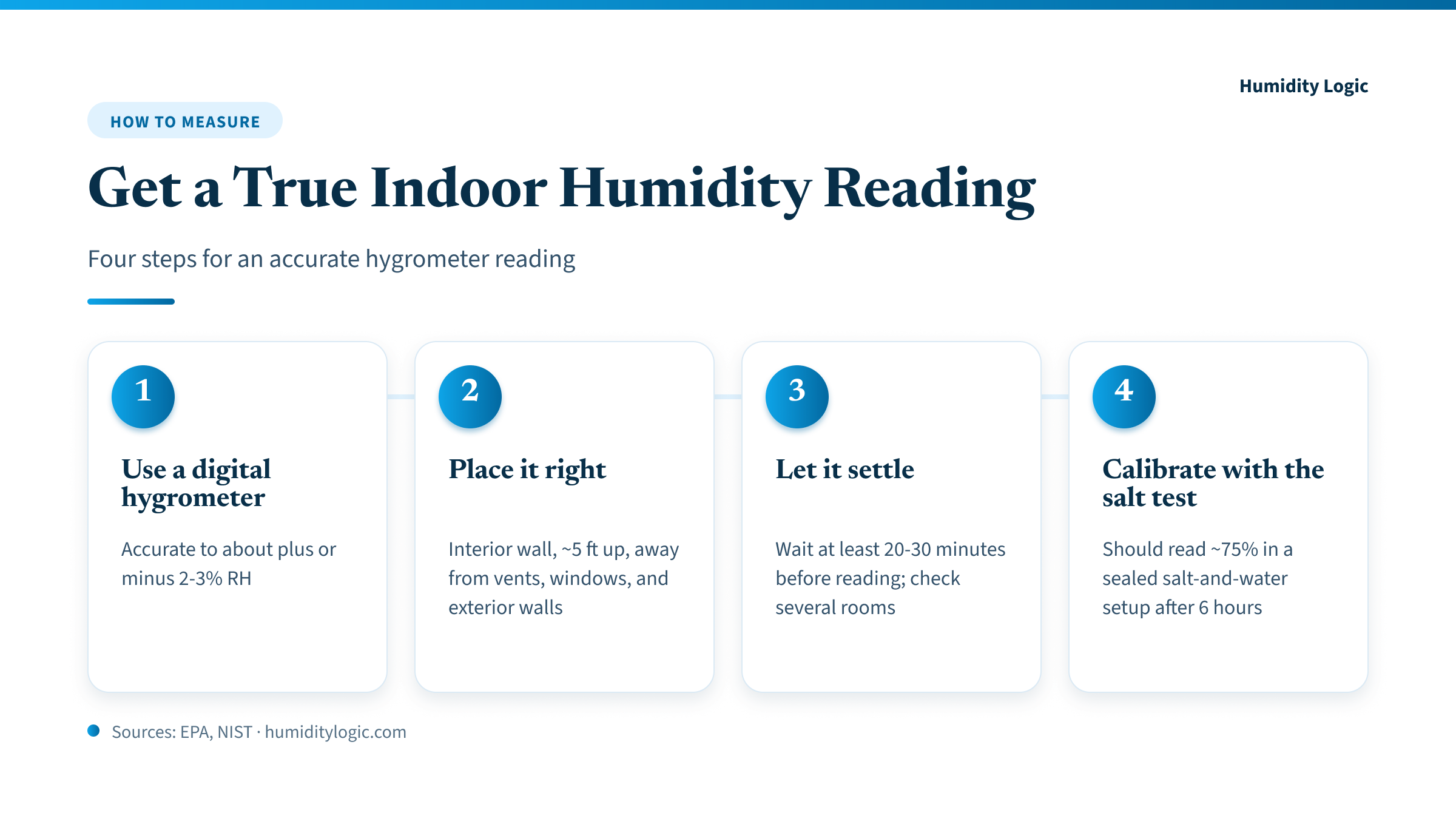
To measure the humidity in your house, place a digital hygrometer on an interior wall about 5 feet off the floor, keep it away from vents, windows, and exterior walls, and give it 20-30 minutes to settle before reading. A good digital sensor is accurate to about ±2-3% RH. Aim for a healthy range of 30-50% relative humidity and stay under 60% — the level the EPA links to mold, dust mites, and a clammy home. Check more than one room, because humidity varies floor to floor.
What tool do you use to measure humidity in a house?
You use a hygrometer — a device built specifically to read the relative humidity of the air. Relative humidity (RH) is the percentage of moisture the air holds compared with the most it could hold at that temperature, and it is the single number that governs comfort and household moisture risk.
For home use, a digital hygrometer is the right choice. It reads within about ±2-3% RH, shows a clear number (usually with temperature), and often logs a running high and low so you can see overnight spikes. The EPA notes that a humidity meter is “a small, inexpensive ($10-$50) instrument available at many hardware stores,” so accuracy does not require a big spend. Analog dial hygrometers exist, but they typically carry a ±5% tolerance and drift over time, so they are best kept for rough, glance-and-go tracking. If you want to compare styles before buying, our guide to humidity meters breaks down analog versus digital in detail.
One thing a standard air hygrometer does not do is measure moisture inside materials. A pin-type moisture meter reads the water content of wood, drywall, or concrete for leak hunting — a different tool for a different job. This guide is strictly about the air.
Where should you place a hygrometer for an accurate reading?
Put it on an interior wall, about 5 feet off the floor, in a main living area, and keep it clear of anything that locally heats, cools, or wets the air. Even a perfectly accurate meter reports the wrong number if it sits in a bad spot, so placement matters as much as the device.
Specifically, keep the hygrometer away from:
- HVAC supply vents — the blast of conditioned air is drier or warmer than the room and drags the reading with it.
- Sunny windows and direct sunlight — solar heat raises the sensor’s local temperature and drops the RH it reports.
- Exterior walls and doors — these run closer to outdoor temperature and swap room air for outside air each time a door opens.
- Kitchens and bathrooms — cooking and showering spike humidity briefly, so a meter there tracks events, not your home’s baseline. Keep it in a drier room unless you specifically want to watch those swings.
Chest height on an interior wall, in the middle of a room the family actually uses, gives the most representative picture. HVAC manufacturer Daikin recommends a spot away from vents, windows, and exterior walls for exactly this reason — those surfaces sit at the boundary between indoor and outdoor conditions and read differently from the air you live in.
How long should you wait before reading the meter?
Give the hygrometer at least 20-30 minutes to acclimate after you place or move it. The sensor needs time to reach the room’s actual temperature and moisture level, and a fresh reading taken the moment you set it down will be off — sometimes by several points.
The gap is largest when you carry the meter between very different environments — say, from a cold garage into a warm living room. In that case, wait closer to an hour before treating the number as your home’s true baseline. If the reading is still drifting when you check it, it has not settled yet. Patience here is free and it is the difference between a number you can act on and a guess.
Should you measure humidity in more than one room?
Yes. Humidity is not uniform across a house, so a single reading in the living room can hide a moisture problem elsewhere. Cool, below-grade spaces trap moisture, which is why a muggy basement can read far higher than the bedroom directly above it.
Take readings in the rooms that matter most: main living areas, bedrooms, and any space prone to dampness like a basement, crawl space, or a bathroom you are trying to dry out. The cheapest way to do this is to buy two or three inexpensive digital hygrometers and leave one in each problem area, rather than shuttling a single meter around and waiting for it to re-settle every time. Watching several rooms at once also reveals patterns — a bedroom that spikes overnight, or a basement that stays stubbornly high — that a one-room snapshot would miss. Once you have your numbers, you can sanity-check them against comfort with our humidity comfort checker.
What humidity reading is normal, and when should you act?
Aim for 30-50% RH and treat a reading that stays above 60% as a problem. That upper limit is where mold risk climbs and the air turns clammy and dust-mite-friendly; the EPA advises keeping indoor humidity “below 60 percent (ideally between 30 and 50 percent).” On the dry side, sustained readings under 30% bring dry skin, static shocks, and irritated sinuses.
A single high reading after a shower or on a rainy day is normal and nothing to chase. A baseline that stays high is the signal to act. If your meter regularly shows 60% or more, work through what counts as high humidity and the target indoor humidity range, then address the source — better ventilation, leak repairs, and often a dehumidifier.
Keep one limitation in mind: because RH depends on temperature, the same amount of moisture reads differently as a room warms and cools. For condensation and “how muggy does it actually feel” questions, dew point is the more reliable lens. The National Weather Service points out that “the higher the dew point rises, the greater the amount of moisture in the air” — a steadier gauge of moisture than RH alone.
How do you check that your hygrometer is accurate?
Run the saturated salt test. A saturated table-salt solution holds relative humidity near 75% in a sealed space — the reference point behind the standard ASTM E104 salt-solution method — which gives you a free, repeatable accuracy check at home.
The procedure is simple:
- Dampen the salt. Put a tablespoon or so of table salt in a bottle cap or small dish and add a few drops of water — enough to make a wet slush, not enough to dissolve it into standing liquid.
- Seal it with the meter. Place the cap and the hygrometer together in an airtight container or zip bag, without letting the sensor touch the salt.
- Wait for it to stabilize. Keep it at a steady room temperature. Small sensors can settle in as little as 6 hours, but for a confident result leave it longer — overnight, or up to a full day.
- Read and correct. The meter should read about 75%. Ambient Weather notes that “the sensor should read 75% plus or minus the sensor’s rated margin of error,” so a device rated ±5% reading anywhere from 70-80% is fine. If it reads outside that band, that gap is its offset — subtract it going forward, or set an adjustable model to read 75%.
This home method is not lab-grade or traceable to a national standard, but for household use it is more than accurate enough. Repeat it about once a year to account for electronic drift.
The bottom line
Measuring the humidity in your house is easy once the basics are right: use a digital hygrometer accurate to about ±2-3%, mount it on an interior wall roughly 5 feet up and away from vents, windows, and doors, and give it 20-30 minutes to settle. Check several rooms rather than trusting one, aim for the EPA’s 30-50% band, and treat a stubborn reading above 60% as a moisture problem worth fixing. A yearly salt test keeps the meter honest — and once you trust the number, managing your home’s air becomes a measurable task instead of a guess.
Frequently asked questions
What is the best tool to measure humidity in a house?
A digital hygrometer is the best tool for measuring indoor humidity. These small, inexpensive devices read relative humidity to within about plus or minus 2-3% and usually cost under $20. The EPA describes a humidity meter as a small, inexpensive ($10-$50) instrument available at many hardware stores.
Where should I place a hygrometer for an accurate reading?
Place it on an interior wall about 5 feet off the floor, away from HVAC vents, sunny windows, exterior walls and doors, and the moisture of a kitchen or bathroom. Any nearby heat, draft, or moisture source will skew the number even on an accurate device.
What is a healthy indoor humidity level?
The EPA recommends keeping indoor relative humidity below 60%, ideally between 30% and 50%. Readings that stay above 60% raise the risk of mold, dust mites, and a clammy, uncomfortable home, while very dry air below 30% can cause dry skin, static, and irritated airways.
How long does a hygrometer take to give an accurate reading?
Give a digital hygrometer at least 20-30 minutes to acclimate after you place or move it, since the sensor needs time to reach the room's true temperature and moisture. If you carried it in from a very different environment, wait closer to an hour before trusting the number.
How do I check if my hygrometer is accurate?
Use the saturated salt test. Seal the hygrometer in an airtight bag with a cap of table salt dampened into a slush. A saturated salt solution holds about 75% relative humidity, so once the air inside stabilizes the meter should read roughly 75%. Any gap is the sensor's offset.
Sources & references
Every figure on this page is checked against these published sources. Last reviewed July 27, 2026.
- EPA — A Brief Guide to Mold, Moisture and Your Home
- National Weather Service (NOAA) — Dew Point vs. Humidity
- Ambient Weather — Testing the Accuracy of a Hygrometer (Saturated Salt Test)
- ASTM E104 — Maintaining Constant Relative Humidity by Means of Aqueous Solutions
- Daikin — How to Measure Indoor Humidity