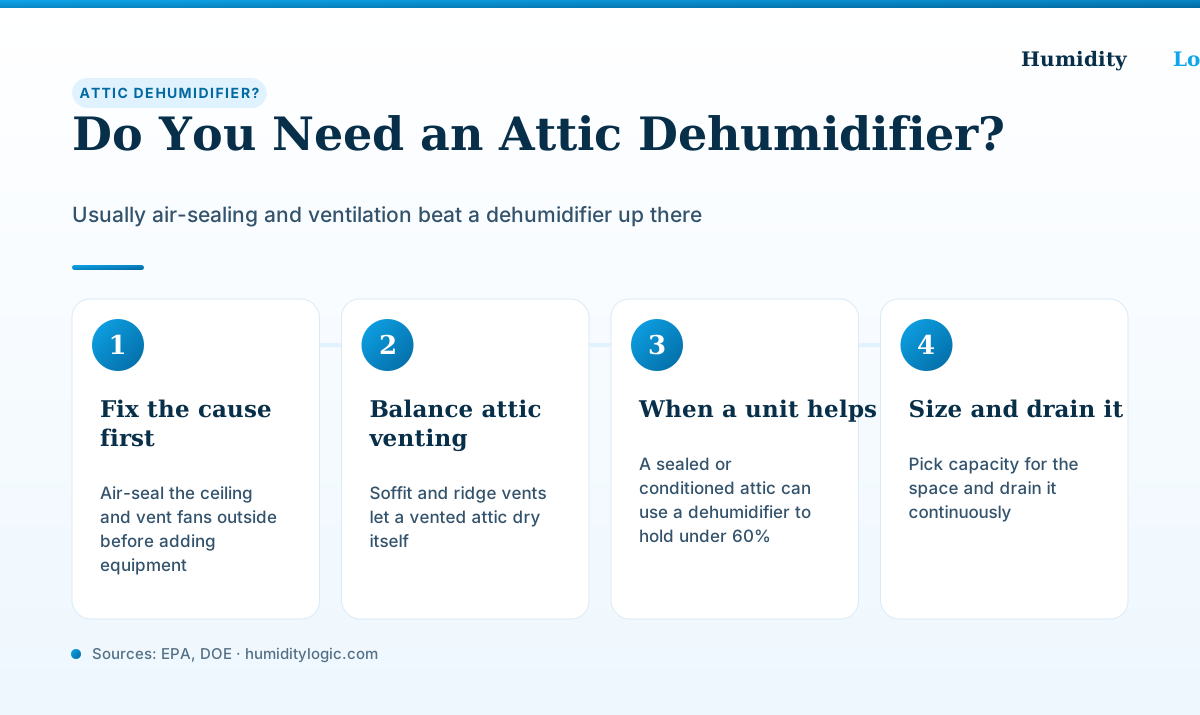
The short answer: most attics need air-sealing and ventilation, not a dehumidifier — a dehumidifier only fits a sealed, conditioned (unvented) attic that is closed to outdoor air and held under 60% relative humidity. A standard vented attic is deliberately open to the outdoors, so a dehumidifier there behaves like one running outside with the windows wide open. If your attic is damp, the durable fixes are to air-seal the ceiling plane, vent bathroom and kitchen fans to the outside, and balance the soffit-to-ridge ventilation so the attic dries itself. Equipment comes last, and only in the specific case where the attic has been sealed and brought inside the building envelope.
Why Won’t a Dehumidifier Work in a Normal Attic?
Because a vented attic is not a room — it is a buffer zone that is intentionally connected to the outdoors. Building codes require it. Under the International Residential Code, a vented attic needs a minimum net free ventilating area of 1/150 of the vented space, which can be reduced to 1/300 only when a vapor retarder is installed and 40 to 50 percent of the venting sits high near the ridge. Those soffit and ridge vents pull a continuous stream of outdoor air through the attic by design.
That is exactly why a dehumidifier cannot win up there. Anything it removes is immediately replaced by the next cubic foot of outdoor air coming through the vents. You would effectively be trying to dehumidify the outdoors. A vented attic sits outside the home’s conditioned, air-sealed envelope, so its humidity simply tracks the outdoor dew point — it rises and falls with the weather, not with any appliance you place inside it. Running a portable unit there wastes electricity and gives a false sense that the moisture problem is handled.
What Actually Dries a Vented Attic?
Three things, in order, and none of them is a dehumidifier.
Air-seal the ceiling plane first. Most attic moisture is not weather — it is warm, humid household air leaking upward from the living space. The DOE Building America Solution Center is explicit that in a vented attic “the ceiling provides the air barrier,” and that every penetration through it — “wiring, electrical boxes, light fixtures, flue and chimney pipes, duct chases” — must be sealed before insulation goes in. Seal those gaps and you cut off the indoor moisture that condenses on cold roof sheathing in winter. Our guide to attic moisture problems walks through where that leakage typically starts.
Vent every moisture-producing fan to the outside. Bathroom and kitchen exhaust fans that dump into the attic instead of through the roof or a gable wall are a classic hidden cause of attic dampness. The EPA advises homeowners to vent appliances that produce moisture — clothes dryers, stoves, and similar — to the outside rather than into an interior space. A single bath fan discharging into the attic can add gallons of water vapor a week.
Balance the ventilation. With the ceiling sealed and fans routed outside, the attic’s own soffit-to-ridge airflow carries away the small amount of moisture that remains. Baffles at the eaves keep insulation from blocking the intake, maintaining a clear path from the soffit vents up under the roof deck to the ridge. A balanced system — roughly half the vent area low at the soffits and half high near the ridge — lets a vented attic dry itself the way it was meant to. For the full picture of what drives readings up and down, see our attic humidity guide.
When Does an Attic Dehumidifier Make Sense?
There is one real case: a sealed, conditioned (unvented) attic. This is an attic insulated at the underside of the roof deck — usually with spray foam — with the soffit and ridge vents closed off. The attic is no longer a buffer zone open to the weather; it has been pulled inside the building’s thermal and air boundary, so it can hold living-space storage or HVAC equipment in a tempered environment.
Because that space is now closed, it needs a deliberate way to shed moisture, and this is where mechanical drying finally belongs. DOE’s code compliance brief on controlling moisture in unvented attics lists three accepted options for a sealed attic: supplying conditioned air to the space at a set flow rate, exhausting attic air to the outside with a fan, or providing “mechanical dehumidification” to the attic. A dedicated dehumidifier is the third of those — and in a closed attic it works, because it is drying a fixed volume of air rather than the whole outdoors.
The same logic applies below the house. A sealed crawl space needs a drying mechanism for the identical reason, which is why our crawl space encapsulation and dehumidifier guide treats sealing and dehumidification as two halves of one system. Seal the space, then add the equipment — never the reverse.
What Humidity Target Should a Sealed Attic Hold?
Under 60% relative humidity. The EPA recommends keeping indoor humidity below 60 percent, ideally between 30 and 50 percent, to prevent mold, and a conditioned attic is now indoor space subject to that same rule. Setting a dehumidifier’s humidistat around 55% RH keeps the framing and stored contents safely dry without over-drying the wood or wasting energy.
A vented attic, by contrast, has no achievable target — it will read whatever the outdoor air reads, sometimes 80% or higher on a muggy summer night, and that is normal for an attic outside the envelope. If your readings alarm you, the question to ask is whether the attic is genuinely wet at the sheathing, or just tracking humid outdoor air. Our explainer on what counts as high humidity helps you tell a real problem from a normal seasonal swing.
How to Size and Drain a Sealed-Attic Dehumidifier
If your attic is sealed and you have decided a dehumidifier is the drying method, size it the way you would for any enclosed space: by square footage and by how damp the space runs. A tight, conditioned attic usually needs fairly modest capacity, because the sealed roof deck has already cut the moisture load before the unit ever cycles on. Oversizing wastes money and short-cycles the compressor; undersizing leaves the space above 60%. Run your numbers through our dehumidifier size calculator to get a pints-per-day target, and cross-check the method in what size dehumidifier do I need.
Two practical points for attic installs:
- Drain it continuously. No one wants to climb into an attic to empty a bucket, and a full tank means the unit stops drying. Route the condensate to a gravity drain, or use a model with a built-in condensate pump so it can lift water to a drain line. A continuous drain is what makes an attic dehumidifier a set-and-forget device rather than a maintenance chore.
- Give it real airflow and a reachable humidistat. Place the unit where its intake and exhaust are not blocked by insulation or stored boxes, and where you can read and adjust the setting without a full attic expedition.
The Bottom Line
For the vast majority of homes, the honest answer to “do you need a dehumidifier in the attic” is no. A vented attic is open to the outdoors, so the fixes that actually work are air-sealing the ceiling, venting fans outside, and balancing the soffit-to-ridge ventilation — the same measures DOE and the EPA point to. A dehumidifier earns its place only after an attic has been deliberately sealed and conditioned, where it becomes one of the code-accepted ways to hold that closed space under 60% RH. Fix the cause first; reach for equipment only in the one case where the space is closed enough for it to work.
Frequently asked questions
Do you need a dehumidifier in the attic?
Usually no. Most attics are vented and open to outdoor air, so a dehumidifier there runs like one left outside with the windows open — it can never win. The real fixes are air-sealing the ceiling, venting bath and kitchen fans outside, and balancing soffit-to-ridge ventilation. A dehumidifier only makes sense in a sealed, conditioned (unvented) attic that is closed to outdoor air.
Why will a dehumidifier not work in a normal vented attic?
A vented attic is deliberately open to the outdoors through soffit and ridge vents, so it sits outside the home's conditioned envelope. Any moisture a dehumidifier removes is instantly replaced by outdoor air flowing through the vents. You would be trying to dry all the air passing over your roofline, which no portable unit can do.
When does an attic dehumidifier actually make sense?
In a sealed, conditioned attic — one insulated at the roof deck with the vents closed, so the space is part of the building envelope. DOE lists mechanical dehumidification as one accepted way to control moisture in an unvented attic, alongside supplying conditioned air or exhausting attic air. In that closed space a dehumidifier can hold humidity under 60%.
What size dehumidifier does a sealed attic need?
Size it to the attic's square footage and how damp it runs, the same way you would size for a basement or crawl space. A tight, conditioned attic usually needs modest capacity because the sealed roof deck cuts the moisture load first. Run the numbers with a sizing calculator, and set the unit to drain continuously.
Will an attic dehumidifier stop condensation on the roof sheathing?
Only if the attic is sealed. Roof-deck condensation in a vented attic is almost always caused by warm, moist household air leaking up through the ceiling and hitting cold sheathing. Air-sealing the ceiling and venting fans outside removes that moisture at the source; a dehumidifier in an open attic does not.
Sources & references
Every figure on this page is checked against these published sources. Last reviewed September 10, 2026.
- DOE Building America Solution Center — Air Sealing and Insulating Ceilings in Vented Attics
- DOE Building America Solution Center — Controlling Moisture in Unvented Attics (Code Compliance Brief)
- EPA — A Brief Guide to Mold, Moisture and Your Home
- International Residential Code R806 — Roof Ventilation (via UpCodes)