Attic mold almost always grows because moist indoor air leaks up into the attic and condenses on the cold roof deck in winter, and poor ventilation lets that moisture linger — not because the attic needs a dehumidifier. The durable fix is to air-seal the ceiling plane, vent bath, kitchen, and dryer fans outdoors, and set up balanced soffit-and-ridge ventilation so the roof sheathing stays dry. Once the moisture source is gone, clean small areas with detergent and water; the EPA calls anything over about 10 square feet a job for a professional. A vented attic is the wrong place for a dehumidifier — it is too big and too leaky to dry that way.
Why does mold grow in my attic?
Attic mold is a moisture problem in disguise. Mold needs a food source (the wood of the roof sheathing supplies plenty), spores (always present in the air), and — the only variable you can actually control — water. As the US EPA puts it, “The key to mold control is moisture control.” So the real question is where the water on your roof deck comes from.
In winter, the answer is condensation. Your heated house is full of moisture from showering, cooking, laundry, dishwashing, and simply breathing. Warm air holds more water vapor than cold air, and warm air is buoyant, so it rises. Every unsealed gap in your ceiling becomes a chimney: recessed lights, the attic hatch, plumbing stacks, wiring holes, and the top plates of interior walls all leak warm, humid air up into the attic. When that air reaches the underside of the roof sheathing — which can sit at or below freezing on a cold night — the vapor gives up its moisture as condensation or frost. Repeat that cycle for weeks and the sheathing stays damp enough for mold to establish. It is the same physics that fogs a cold window, just hidden above your ceiling.
The DOE’s Building America program spells out the recipe precisely. Their guide on condensation control in attics lists four conditions that must combine: a cold surface below the dew point, a pressure difference plus a hole in the air barrier that drives air leakage, high humidity in the warm indoor air, and a lack of ventilation or drying potential. Remove any one and the condensation stops. Notice what is not on that list: a missing dehumidifier.
Is attic mold really from humidity, or from a roof leak?
Both are possible, and telling them apart changes the fix. Condensation-driven mold tends to spread evenly across the underside of the roof sheathing, often worst on the north-facing slope and near the eaves and ridge, and it shows up in cold weather. A roof leak, by contrast, usually leaves localized staining that traces a path from a specific point — around a vent boot, a nail pop, flashing, or a valley — and it worsens after rain rather than after cold snaps.
If you see water stains that spread from one spot downward, inspect the roof and flashing first. If the whole deck is peppered with dark spots, mildew, or a musty smell — and especially if you find frost on the nails or sheathing on a cold morning — you are almost certainly looking at a condensation problem driven by indoor humidity and air leakage rather than a breach in the roof itself. Our guide on what mold smells like can help you confirm that damp, earthy odor is in fact mold. Either way, the EPA’s rule holds: fix the water source before you clean, or the mold comes back.
Why not just put a dehumidifier in the attic?
A dehumidifier feels like the obvious tool, but a standard vented attic defeats it. By design, a vented attic is connected to the outdoors through the soffit and ridge vents — that airflow is what keeps the roof deck cold and dry the rest of the time. Drop a dehumidifier into that space and it runs constantly, pulling moisture out of an effectively unlimited supply of outdoor and indoor air that keeps leaking back in. You pay for the electricity and never reach a stable target. It treats a symptom while the real driver, warm moist air rising from the house, keeps flowing.
Dehumidifiers earn their keep in sealed, conditioned spaces — a finished basement or a tight crawl space — not in a ventilated attic. If your actual problem is high humidity in the living space below, that is worth solving directly; see how to lower humidity in your house, and if you do need to size a unit for a room downstairs, the dehumidifier size calculator will get you close. But for the attic itself, the fix is air and vapor management, not a machine. We go deeper on this in our guide to dehumidifiers for mold.
How do I stop attic mold for good?
The durable fix works from the bottom up, cutting off the moisture before it ever reaches the cold deck.
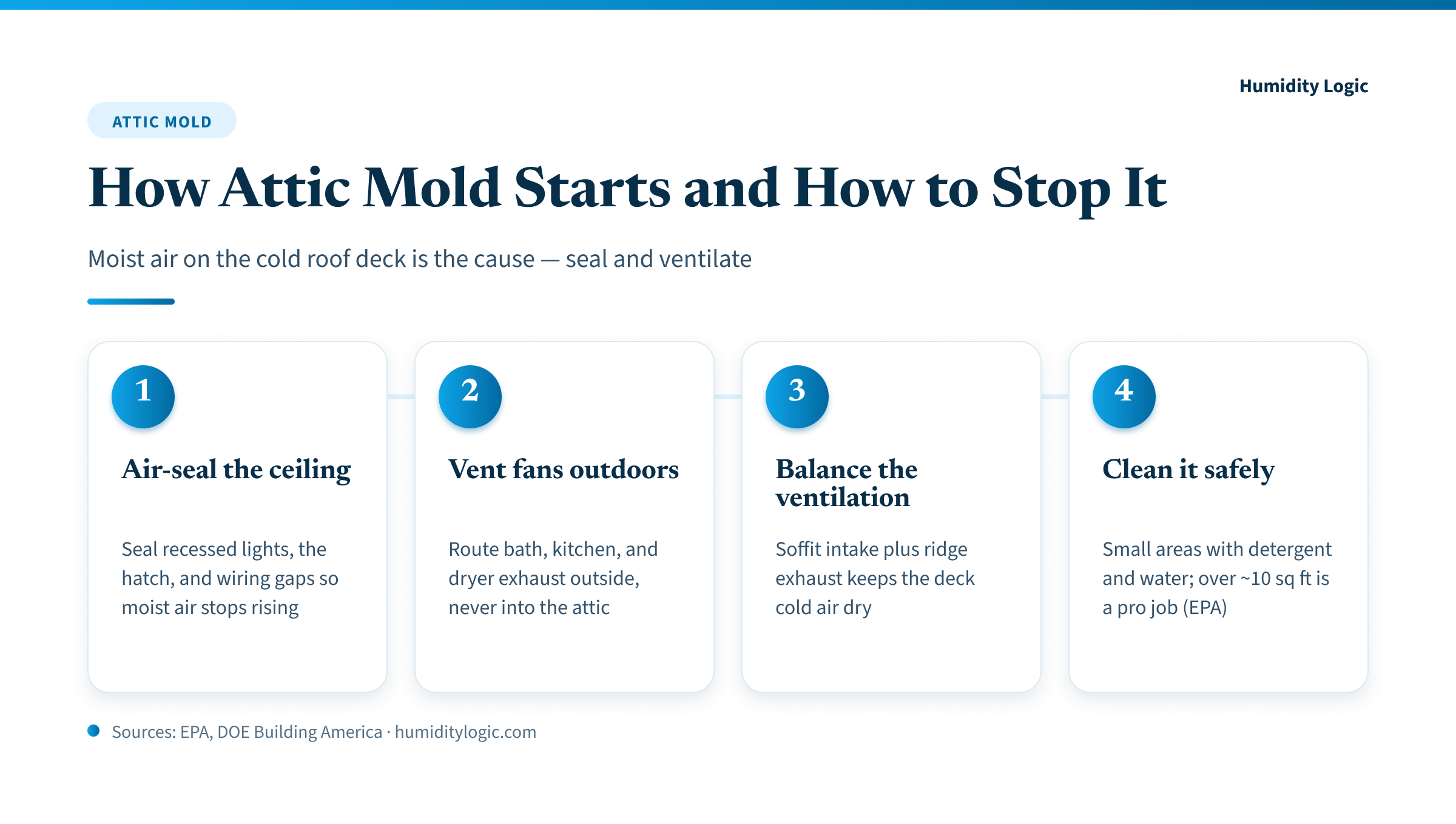
Air-seal the ceiling plane first. This is the single most effective step and where ENERGY STAR tells homeowners to start. Their seal-and-insulate methodology directs you to “seal air leaks throughout the house, focusing on leaks to the attic space.” Get into the attic and seal around recessed light housings (use airtight, IC-rated fixtures or covers), the attic hatch, bath fan housings, plumbing and wiring penetrations, and the wall top plates with caulk, canned foam, or gaskets. Stopping the warm-air leak is what removes the fuel for condensation.
Vent every moisture source outdoors. Bath fans, the kitchen range hood, and the clothes dryer must exhaust all the way to the exterior, never into the attic or just under the roof. The EPA specifically advises venting appliances that produce moisture, such as clothes dryers, to the outside. A bath fan dumping humid air into the attic is a mold machine.
Balance the ventilation. Once the ceiling is sealed, the attic should breathe evenly. Building America recommends continuous intake at the soffits paired with exhaust at the ridge, with baffles keeping about a 2-inch air gap between the insulation and the roof deck so the airflow is not blocked. Balanced passive ventilation keeps the deck cold and dry; avoid powered attic fans, which can depressurize the attic and pull even more humid house air up through any remaining gaps.
Keep indoor humidity in range. Lowering the house’s relative humidity to the EPA’s recommended 30 to 50 percent lowers the dew point, so the roof deck has to get colder before condensation forms. For the mechanics of this indoor–attic connection, our attic humidity guide and the deep dive on attic condensation walk through the details.
When should I clean it myself, and when is it a pro job?
Once the moisture source is addressed, the cleanup is straightforward for small areas. The EPA says that if the moldy patch is “less than about 10 square feet (less than roughly a 3 ft. by 3 ft. patch),” most homeowners can handle it: scrub hard surfaces like sheathing and rafters with detergent and water, then dry completely. Wear an N-95 mask, gloves, and eye protection, because disturbing mold releases spores.
Call a professional when the mold covers more than about 10 square feet, when it followed roof-leak water damage, or when it keeps returning despite your repairs — recurrence means the moisture problem is not solved. A qualified remediation contractor can clean the wood safely and, just as importantly, help confirm that the air-sealing and ventilation are actually keeping the deck dry. Cleaning without fixing the moisture, the EPA warns, only buys you time before the mold grows back.
Frequently asked questions
What causes mold to grow in an attic?
Most attic mold grows on the roof sheathing because warm, moist indoor air leaks up through gaps in the ceiling and condenses on the cold underside of the roof deck in winter. Poor attic ventilation lets that moisture linger long enough for mold to take hold. It is a moisture and air-leak problem, not a sign you need a dehumidifier in the attic.
Will a dehumidifier stop attic mold?
No, not in a standard vented attic. A vented attic is large and open to outdoor air, so a dehumidifier runs endlessly while humid air keeps leaking in from the house and from the soffits. The durable fix is to air-seal the ceiling plane, vent bath and dryer fans outdoors, and balance the attic ventilation so the roof deck can dry.
Is attic mold on the roof sheathing dangerous?
Surface mold on roof sheathing is mostly a moisture warning sign, but any mold indoors can affect air quality and, left unchecked, can degrade the wood. The EPA advises fixing the moisture source first, then cleaning small areas. Mold covering more than about 10 square feet, or following roof-leak water damage, is a job for a professional.
How do I know if my attic has a moisture problem?
Look for frost or water droplets on the underside of the roof deck and nails in winter, dark or black staining on the sheathing, damp or matted insulation, rusty nail tips, and a musty smell. Condensation on the coldest surfaces is usually the earliest sign before visible mold appears.
Can I clean attic mold myself?
For a small area on hard surfaces like sheathing or rafters, the EPA says you can scrub it with detergent and water and dry it completely, wearing a mask, gloves, and eye protection. Larger areas over roughly 10 square feet, or mold after a roof leak, should be handled by a remediation professional who can also confirm the moisture source is fixed.
Sources & references
Every figure on this page is checked against these published sources. Last reviewed August 1, 2026.