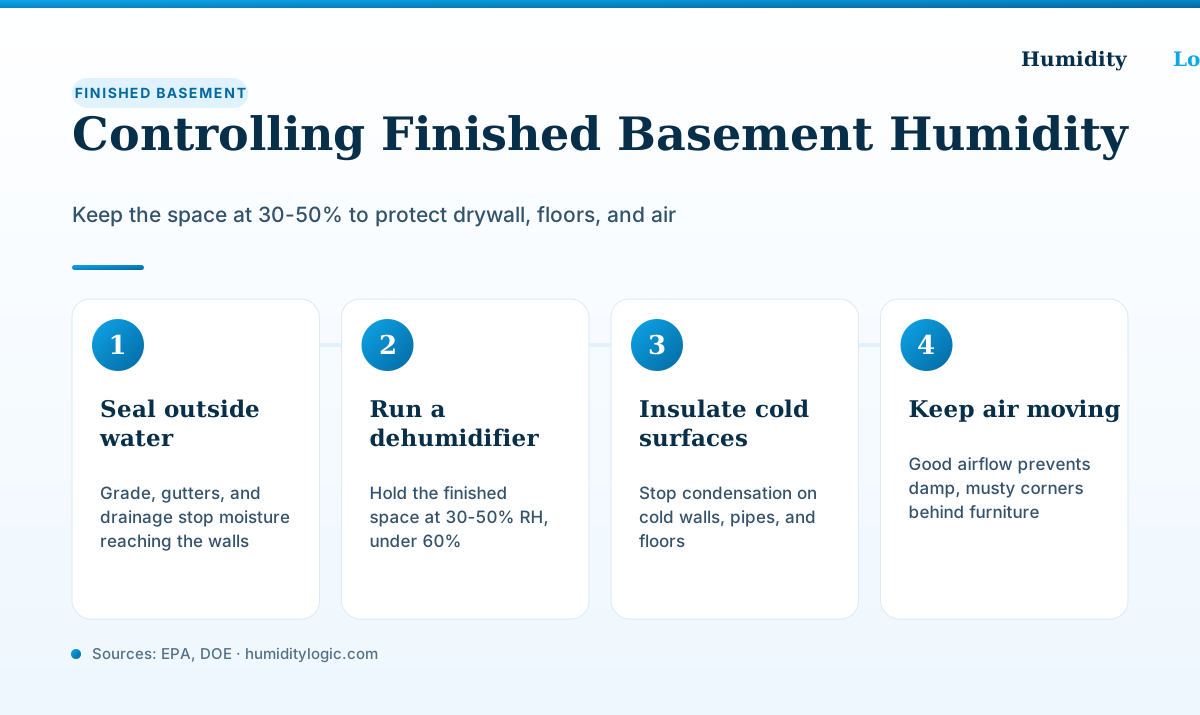
Hold a finished basement at 30-50% relative humidity — fix outside water first, dehumidify, and insulate cold surfaces — to protect drywall, floors, and the air you breathe. The catch that makes a finished basement different from a bare one is that the finishes hide the moisture. Water that would once have evaporated off open concrete now sits behind drywall, under flooring, and inside wall cavities, so the space can be quietly damp long before anything looks wrong.
What humidity level should a finished basement hold?
The EPA is clear on the target: keep indoor relative humidity below 60% at all times, and between 30% and 50% where possible. That band prevents mold, dust mites, and the musty smell that signals microbial growth. It applies to a finished basement the same as to any other room — with one adjustment. Because the finishes trap moisture out of sight, aim for the lower half of the range, closer to 45%, so you have margin before hidden surfaces get damp enough to grow mold.
A finished basement is also harder to read by feel. An unfinished basement telegraphs trouble — you see damp concrete, you smell it, you spot efflorescence on the wall. Cover those walls with drywall and lay flooring over the slab, and the same moisture load becomes invisible. That is why the number matters more here, not less. For the broader logic behind these targets, our guide to basement humidity walks through why below-grade air behaves the way it does.
Why does a finished basement trap moisture?
Every basement fights the same moisture sources: vapor diffusing through porous concrete, condensation where warm air meets cold surfaces, and bulk water from rain and drainage. The DOE Building America program ranks bulk water — liquid flow from rain, snow, and groundwater — as “the most damaging moisture transport mechanism confronted by a building,” ahead of capillary wicking, air-transported vapor, and diffusion.
Finishing the space does not remove any of those sources. It just covers them. A bare foundation wall can dry inward, letting vapor evaporate into the room where a dehumidifier collects it. Frame that wall, insulate it, and hang drywall, and the moisture now has to travel through the assembly — and if warm, humid basement air leaks into the wall cavity and reaches the cold concrete, it condenses inside the wall where nothing dries it out. The DOE notes that interior basement wall assemblies “are subjected to potentially significant moisture loads from vapor driven from both the exterior and interior at different times of the year.” That trapped water is what feeds mold on paper-faced drywall and wood framing.
There is a second reason finished spaces run damp: the finishes themselves add moisture at first. Fresh concrete releases construction water for months, and new framing, drywall mud, and paint all give off moisture as they cure. In an open basement that dries into a room the dehumidifier is already handling. Sealed inside a finished assembly, it has to find its way out through the wall — which is exactly why a newly finished basement often needs the most aggressive dehumidification in its first year, before the materials reach equilibrium with the space.
In what order should I fix it?
Work from the outside in, cheapest and most fundamental first. Each step handles a different moisture source, and doing them out of order wastes money.
1. Seal outside water. Bulk water is the loudest problem and usually the cheapest to fix. Clean the gutters, extend downspouts several feet past the foundation, and re-grade soil so it slopes away from the house. If water still reaches the wall, the drainage — footing drains, a working sump — needs attention before anything else. A dehumidifier cannot outrun rain being funneled against the foundation, so this comes first. Our guide to damp basement solutions covers the drainage side in detail.
2. Run a right-sized dehumidifier. Once bulk water is handled, a dehumidifier manages the residual vapor that migrates through concrete year-round. The EPA advises to “use air conditioners and/or de-humidifiers when needed” and to keep humidity in the 30-50% band. Set the humidistat and let the unit cycle. Below-grade spaces run cooler and damper than rooms of the same size upstairs, so size up: our dehumidifier sizing calculator applies a below-grade adjustment once you enter the floor area and dampness level, and the companion guide on what size dehumidifier you need explains the math.
3. Insulate cold surfaces. Condensation forms, in the EPA’s words, “when warm, humid air contacts a cold surface.” In a finished basement the cold surfaces are the foundation walls, cold-water pipes, and the slab. The DOE’s guidance on air-sealed, insulated basements is to install rigid or spray foam tight against the concrete as a thermal break and to air-seal the assembly so moist basement air never reaches the cold wall to condense. The EPA offers the simplest version of the same rule: “cover cold surfaces, such as cold water pipes, with insulation.” Warmer interior surfaces do not sweat.
4. Keep air moving. Stagnant pockets behind furniture, inside closets, and in finished corners hold moisture and turn musty even when the room average looks fine. Leave gaps behind large furniture against exterior walls, run a ceiling or floor fan, and avoid sealing off sections of the basement from conditioned airflow. Movement keeps the humidity you measured on the meter roughly the same as the humidity in the corners you cannot reach.
How do I keep tabs on a space that hides moisture?
Because a finished basement will not show you it is damp, you have to measure. Put an inexpensive hygrometer in the space — the EPA notes relative humidity “can be measured with a moisture or humidity meter, a small, inexpensive ($10-$50) instrument available at many hardware stores.” Set it where air is still, not next to the dehumidifier’s outlet, and check it across a full week of weather. Early summer is the hardest test, when the ground is still cold but outdoor air has turned muggy.
Pair the meter with continuous dehumidifier drainage. A finished basement is exactly the situation where a bucket fills, the unit stops, and humidity climbs for two days before anyone notices and empties it. Run a hose from the dehumidifier to a floor drain or sump so it drains on its own, or use a model with a built-in pump if the drain is higher than the unit. That turns the dehumidifier from something you have to babysit into something that quietly holds the set point.
If condensation keeps appearing on the slab under flooring or on the walls despite a dehumidifier, that points to a cold-surface or bulk-water problem the dehumidifier alone cannot solve — our guide to condensation on a concrete floor helps sort out which. And if the damp air is drifting upstairs, the whole-home approach in how to lower humidity in your house ties the basement fix into the rest of the building.
The short version
A finished basement carries the same moisture load as a bare one, but hides it behind drywall and flooring where you cannot see damage coming. Hold the space at 30-50% relative humidity. Fix outside water first, because bulk water is the most damaging source and no amount of dehumidification outruns it. Then run a right-sized dehumidifier with continuous drainage, insulate the cold foundation walls and pipes so warm air stops condensing on them, and keep air moving into the corners. A cheap hygrometer confirms it is working — in a space that will not tell you itself, the meter is the only honest report you get.
Frequently asked questions
What humidity level should a finished basement be?
Hold a finished basement between 30% and 50% relative humidity, and never let it sit above 60%. The EPA recommends that band for every indoor space to prevent mold, dust mites, and musty odors. In a finished basement the lower half of the range is safer, because carpet, drywall, and stored belongings all absorb moisture and hide it until damage shows.
Why is my finished basement humid even though it looks dry?
A finished basement can read damp on a hygrometer while every visible surface looks fine, because the moisture is trapped behind drywall, under flooring, and inside wall cavities where you cannot see it. Vapor also migrates through the concrete year-round. Put a hygrometer in the space and run a dehumidifier to a set point rather than trusting how the room looks or feels.
Can I put a dehumidifier in a finished basement?
Yes, and it is usually the core of the fix. Set it to hold 30-50% relative humidity and, wherever possible, run a hose to a floor drain or sump so it drains continuously instead of stopping when a bucket fills. A finished space is easy to under-serve, so size the unit for the square footage and the below-grade dampness, not for a room that size upstairs.
Will a finished basement get mold behind the drywall?
It can, if humid basement air reaches the cold foundation wall and condenses inside the wall cavity, or if bulk water gets in from outside. Mold grows on paper-faced drywall, wood framing, and carpet whenever moisture and oxygen are present. Air-sealing and insulating the foundation wall keeps warm indoor air off the cold concrete, which is what prevents that hidden condensation.
Do I need to fix outside water before finishing a basement?
Yes. Grading, gutters, downspouts, and foundation drainage should be handled before or alongside finishing, because bulk water is the most damaging moisture source a building faces. A dehumidifier only removes water already in the air; it cannot keep up with rain being funneled against the foundation. Fix the water path first, then let equipment manage the residual vapor.
Sources & references
Every figure on this page is checked against these published sources. Last reviewed August 9, 2026.