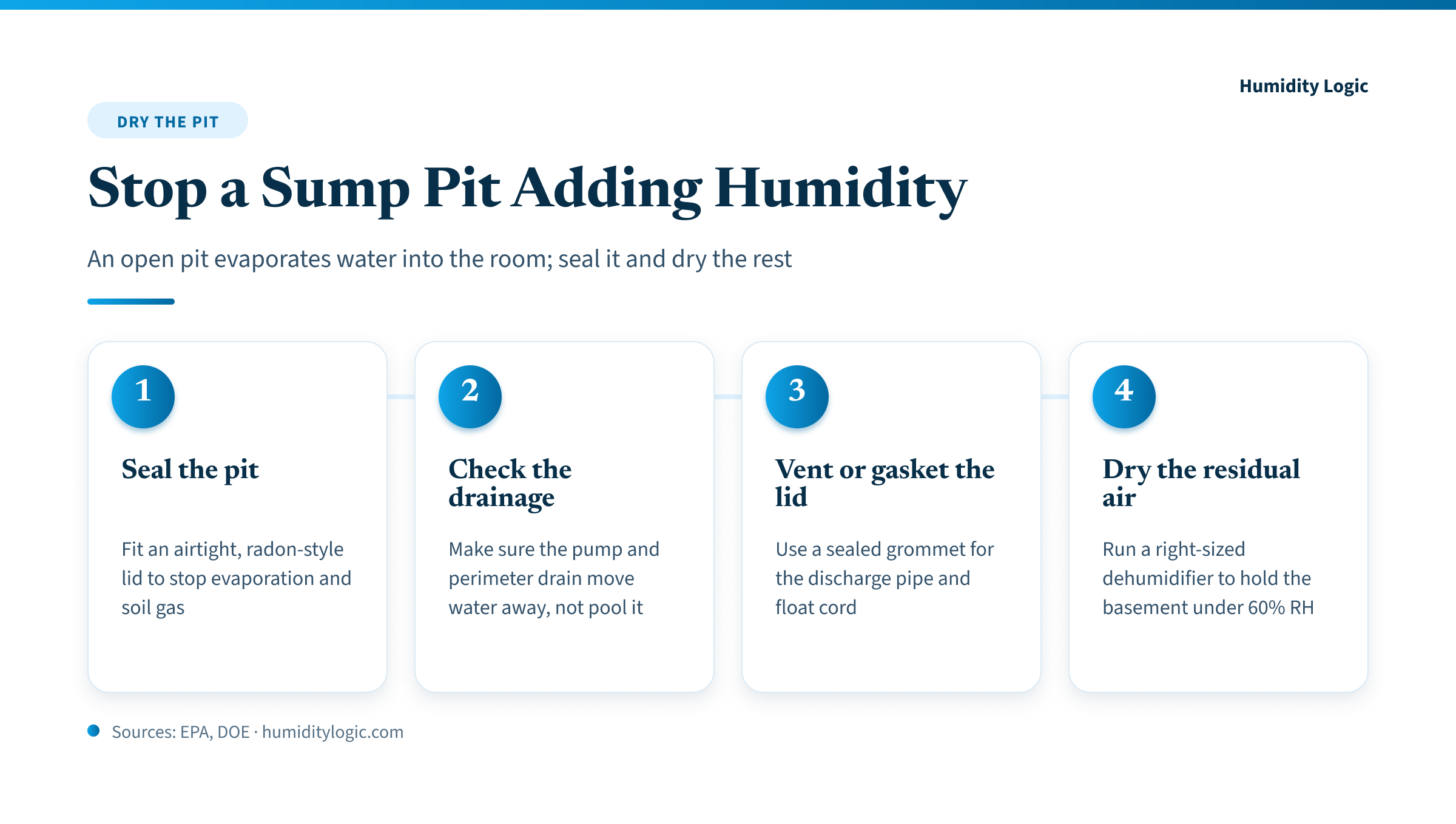
An open sump pit is a pool of standing water sitting in your basement, and that water evaporates straight into the room air, raising humidity day and night. The DOE Building America Solution Center confirms that an open or loosely covered pit lets water evaporate and raise the relative humidity of the whole house. Fitting an airtight, gasketed lid — the same kind used for radon control — puts a barrier between the water and the air, sharply cutting that evaporation and blocking soil gas at the same time. Then let a right-sized dehumidifier hold the rest of the basement under 60% relative humidity, ideally between 30% and 50%.
Does an open sump pit really raise basement humidity?
Yes, and the reason is simple physics. A sump pit is a hole in the slab that fills with groundwater from your foundation drains, and an open pit leaves that water surface exposed to the room. Warm basement air — typically 65°F to 75°F — passes over cooler groundwater, picks up moisture, and carries it out into the space. The Building America Solution Center states plainly that if the pit “is open or has a loose-fitting lid, this water can evaporate into the air, raising the relative humidity inside the home, basement, and crawlspace.”
That evaporation runs continuously, refilled every time the perimeter drain feeds the pit. It is easy to miss because there is no puddle on the floor and no dramatic leak — just a persistently high hygrometer reading, a clammy feel, and often a musty smell. If your basement stays damp even though the walls look dry and it has not rained, an uncovered pit is one of the first suspects. This is a humidity-level problem rather than a bulk-water problem, and it belongs in the same bucket as the causes covered in our basement humidity guide.
The knock-on effects are the usual moisture problems. Building America warns that the elevated humidity “can encourage the growth of mold, which is a health concern, and can increase the moisture level of wood framing, inviting fungal decay and wood-eating pests.” Keeping humidity in check is the whole point of the EPA’s mold guidance, which we will get to below.
How does the sump connect to the rest of my basement’s moisture?
The sump is the endpoint of your foundation’s drainage system, so it is tied directly to how water moves around your house. Building America’s guidance on drains and sump pumps describes the intended path: a perimeter drain or sub-slab gravel field feeds the pit through a perforated liner or through-footing pipes, the pump lifts the water out, and the discharge line carries it away from the house. “The drain or sump keeps ground water levels below interior floor levels.”
Two things in that chain drive basement humidity. First, the pit itself — the exposed water surface we just covered. Second, the discharge: if the pump dumps water right next to the foundation, it soaks back into the soil and gets recycled straight back through the drain, keeping the pit full and the soil around your walls saturated. Building America specifically warns against “recycling the water in and out through the foundation drainage system.” Extend the discharge line well away from the wall, the same principle that fixes most seepage in our wet basement guide.
So the pit is both a symptom and a source. A sealed lid handles the evaporation, correct discharge handles the recycling, and a dehumidifier handles whatever humidity is left from damp walls and humid outdoor air. Treat them as one system, not three separate chores. It also helps to know which problem you actually have: a pit that stays nearly empty and dry between storms contributes far less humidity than one that holds standing water year-round. If yours is always wet, the sealed lid is the highest-value step; if it only runs after heavy rain, focus more on the discharge line and the dehumidifier.
What kind of lid actually stops the evaporation?
An airtight, gasketed cover that is mechanically fastened — not the loose plastic disc that came with a builder-grade basin. Building America’s specification is precise: “Mechanically fasten the cover in place with screws or other means that will maintain tight contact between the lid, the gasket, and the rim of the crock.” The seal is what does the work; a cover you can lift off with one finger is not sealing anything.
The lid also has to seal every penetration. A working sump has a discharge pipe rising out of it and a power cord for the pump, and a radon system adds a vent pipe. Building America calls for covers “with built-in air-sealing grommets around all penetrations for electrical wiring, water ejection pipes, or radon vent pipes.” A rubber grommet around the discharge pipe and a sealed pass-through for the float cord keep the barrier continuous while the pump operates normally underneath.
This is not a fringe upgrade. The 2009, 2012, and 2015 International Residential Codes require a gas-tight, removable cover on interior sump pits, and ENERGY STAR’s single-family new-home program requires a mechanically attached lid with a full gasket seal. If your basement predates those codes, retrofitting a sealed cover is one of the cheapest moisture improvements you can make.
Does sealing the sump help with radon too?
It does, and this is the reason building science treats sump covers so seriously. An open pit connects your basement air directly to the sub-slab soil, which is exactly where radon — a naturally occurring radioactive soil gas — collects. Building America is explicit that an uncovered sump “can allow soil gases (including radon, water vapor, herbicides, termiticides, methane, etc.) into the home.” The same opening that leaks humidity leaks soil gas.
The EPA recommends fixing a home when radon reaches “4 pCi/L (picocuries per liter) or more,” and notes there is no known safe level. A gas-tight sump lid is standard equipment in radon mitigation, and installers often use the sealed pit as the suction point for the mitigation fan — the cover lets the system draw soil gas from under the slab and vent it outdoors while the pump keeps managing water. If you have not tested for radon, a sealed sump lid is worth pairing with a test; the two problems share the same fix. For a broader plan of attack on damp air, our guide to lowering humidity in the house covers the whole-home picture.
How do I size the dehumidifier once the pit is sealed?
Cap the pit first, then size the dehumidifier for what is left — you want the machine handling residual humidity, not fighting an open pool of water. With the biggest single moisture source removed, a correctly sized unit can actually hold a stable relative humidity instead of running non-stop and never catching up.
The EPA’s mold guidance sets the target: indoor relative humidity “should be kept below 60 percent – ideally between 30 percent and 50 percent, if possible.” Staying under 60% is the line that matters most, because that is where mold growth is suppressed; the 30-to-50% band is the comfort sweet spot to aim for once the space is under control. To pick a capacity, run the space through our dehumidifier sizing calculator and add roughly 5 pints per day because a basement is below grade and damper than the living space. Route the dehumidifier’s output to the sump or a floor drain so you are not emptying a bucket, and give it a hygrometer so you can confirm the number rather than guess. Our basement dehumidifier buying guide walks through pint capacity, placement, and continuous drainage in detail.
One last check: if the basement still smells musty after the pit is sealed and the dehumidifier is holding under 60%, the odor is usually coming from something that already absorbed moisture — carpet, stored cardboard, or framing that stayed damp. Our guide to a musty smell in the basement covers tracking down and clearing those lingering sources so the space smells as dry as the hygrometer says it is.
Frequently asked questions
Does an open sump pit make a basement more humid?
Yes. An open pit, or one with a loose-fitting lid, holds standing water with an exposed surface, and the DOE Building America Solution Center confirms that water can evaporate into the air and raise the relative humidity of the basement and the whole house. Warm basement air passing over cool groundwater is an efficient little humidifier running around the clock. Fitting an airtight, gasketed cover puts a physical barrier between the water and the room air and largely shuts that evaporation off.
Should I seal my sump pump pit?
For most finished or conditioned basements, yes. A gasketed, mechanically fastened lid cuts evaporation into the room and, just as importantly, blocks radon and other soil gases that use the open pit as an entry point. The 2009, 2012, and 2015 International Residential Codes require a gas-tight, removable cover, and ENERGY STAR requires a mechanically attached lid with a full gasket seal. The pump keeps working normally underneath a properly gasketed cover.
Will covering the sump pump stop the pump from working?
No. A correct cover is removable and sealed around every penetration, so the discharge pipe, the power cord, and any radon vent pass through gasketed grommets while the float switch and pump operate exactly as before. You lose nothing but the open water surface. Choose a lid rated for your basin and fasten it with screws that keep the gasket tight against the rim of the crock.
Can a sump pit let radon into my basement?
Yes. An uncovered or poorly sealed pit connects directly to the sub-slab soil, which is exactly where radon collects, so it acts as an open pathway for radon and other soil gases into the living space. The EPA recommends fixing a home when radon reaches 4 pCi/L or higher. A gas-tight sump lid is a standard part of radon control, and the sealed pit can even double as the suction point for a mitigation fan.
Do I still need a dehumidifier if I seal the sump pit?
Usually yes, but it has far less work to do. Sealing the pit removes one continuous moisture source; the rest of the basement still gains humidity from damp walls, humid outdoor air, and everyday activities. A right-sized dehumidifier holds the space under 60% relative humidity once the pit is capped, and it no longer fights a constantly evaporating pool of water.
Sources & references
Every figure on this page is checked against these published sources. Last reviewed July 27, 2026.