Condensation on ductwork happens when a cold air-conditioning supply duct runs through a warm, humid, unconditioned space — an attic, crawl space, or basement — and its surface temperature falls below the dew point of the air around it. Water vapor then condenses onto the duct, beads up, and drips, exactly like a sweating glass of iced water. It looks like a leak but it is not. The fix is to insulate the ducts so their surface stays warm, seal the leaks that chill the outside, and lower the humidity in the space around them so the dew point drops below the duct temperature.
Why Is My Ductwork Sweating?
Air can only hold so much water vapor at a given temperature. Cool it down and it reaches saturation at a temperature called the dew point, where the excess moisture must condense into liquid. When your air conditioner is running, the supply ducts carry air in the 50s, and the metal or flex-duct surface tracks close to that temperature. If those ducts sit in an attic or crawl space where the air is 80 degrees and muggy, that humid air brushes a surface far below its dew point — and condenses on it. Keep feeding humid air past the cold duct and the film grows into beads that run down and drip.
The reason ducts are so prone to this is where they live. Ducts are routinely run through the hottest, dampest parts of the house, and they are made of thin materials that conduct heat easily. ENERGY STAR notes that ducts commonly pass through attics, crawl spaces, unfinished basements, and garages — precisely the unconditioned spaces where summer air is warm and loaded with moisture. A cold duct is the first surface in that space to reach the dew point, so it is the first thing to sweat.
This is the same mechanism behind condensation on pipes, sweating windows, and a cold toilet tank. If you want the underlying temperature-and-moisture relationship spelled out, our dew point vs. humidity explainer walks through why the dew point, not the humidity percentage alone, is the number that predicts a wet surface.
The ducts that sweat most are the ones with the biggest temperature gap and the least protection: bare or thinly wrapped supply trunks in a hot attic, flex runs and boots feeding upstairs registers, and any duct passing through a damp, vented crawl space. Because it depends on warm, moist air, duct sweating is seasonal — it shows up during summer cooling and disappears once the weather cools, the AC stops running, and indoor dew points fall.
Is It Condensation or a Real Leak?
Before you tear anything apart, confirm you are dealing with condensation and not a plumbing leak or a clogged AC condensate line. A few tells point to condensation: the moisture appears only when the air conditioner is running, it shows up in hot, humid weather and vanishes in winter, and it wets the outside of the duct fairly evenly rather than trickling from one fitting. Wipe the duct dry and watch it — if a film re-forms across the whole cold surface within an hour of the AC running, that is sweating.
Water pooling near the air handler or dripping from the drain line is a different problem: that is usually a blocked or overflowing condensate drain, which needs the drain cleared rather than the duct insulated. And genuine dripping from a ceiling below an attic can be either, so trace the water back to its source before deciding.
How Do I Stop Ducts From Sweating?
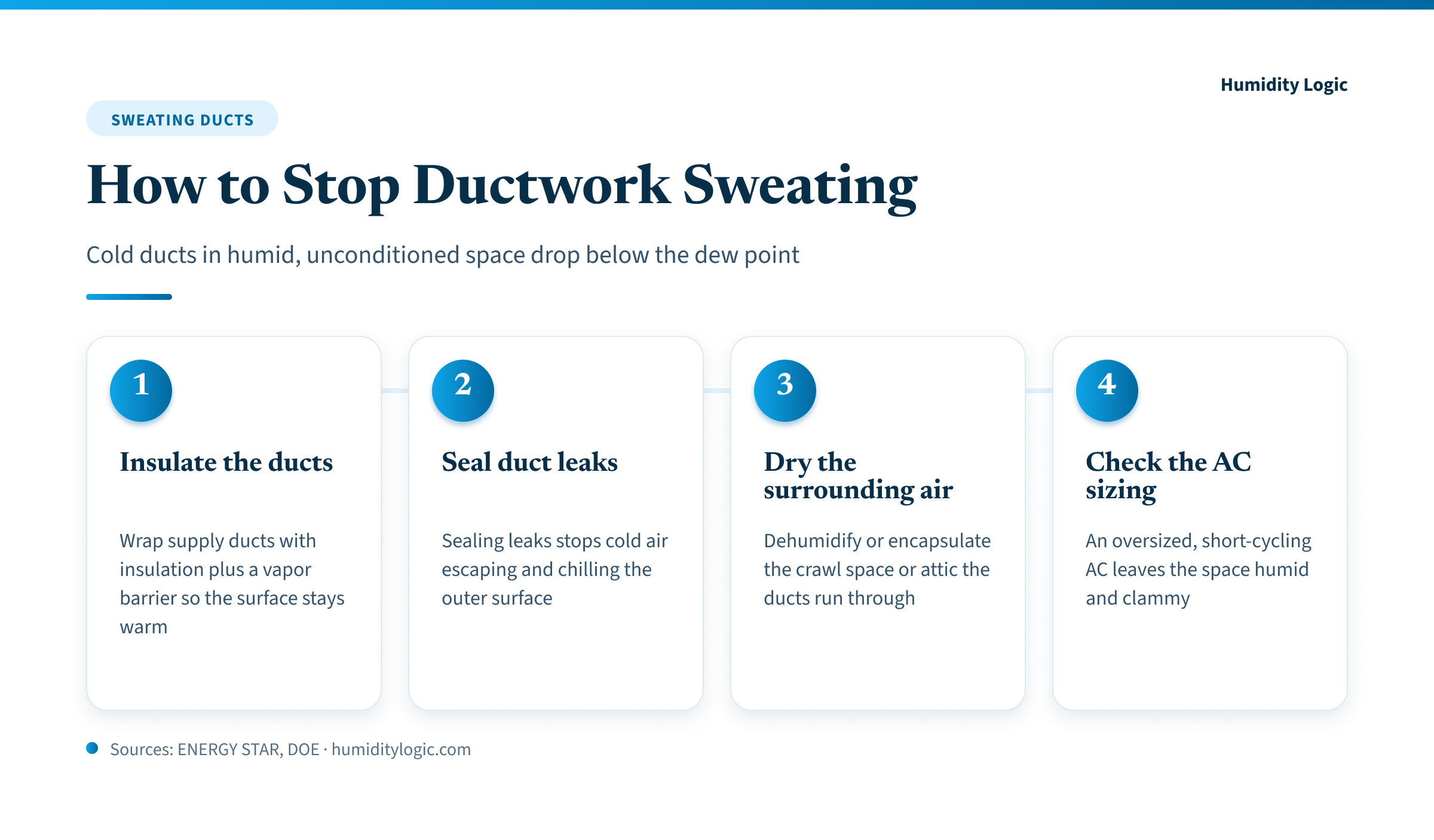
Work through these in order. The first two steps solve most cases, and the humidity step backs them up.
1. Insulate the ducts
Insulating the ductwork is the core fix. Insulation keeps the duct’s outer surface close to the temperature of the space around it, above the dew point, so humid air never finds a cold surface to condense on. For ducts in unconditioned space, DOE’s Building America program and modern energy codes call for R-8 on supply ducts and at least R-6 on returns.
Just as important as the R-value is the vapor barrier — the foil or plastic facing on the outside of the insulation. The Building America Solution Center is blunt about it: whenever ducts are in unconditioned space, thermal insulation with a vapor barrier is a must … to prevent condensation from forming on the ducts themselves. If that facing is torn, gapped, or missing, humid air reaches the cold surface underneath and condenses there, so seal every seam and joint end to end. Do not leave bare metal at boots, collars, or elbows — those cold gaps sweat and undo the work everywhere else.
2. Seal the duct leaks
Leaky ducts make sweating worse in two ways: escaping cold air chills the outer surface and the space around it, and leaks pull humid attic or crawl-space air toward the ductwork. Sealing them keeps the cold air inside the duct where it belongs. ENERGY STAR recommends using mastic sealant or metal tape on the seams and connections — and specifically warns against ordinary duct tape, which does not last. Seal first, then insulate over the sealed joints. The broader seal and insulate approach tightens the whole system so the cooled air is delivered efficiently instead of leaking into a hot attic.
3. Lower the humidity around the ducts
Insulation keeps the duct from reaching the dew point; drying the space brings the dew point down to meet it from the other side. The most durable fix is to control moisture in the space the ducts run through. In a crawl space that means sealing and encapsulating it and adding a dehumidifier — the same playbook in our crawl space humidity guide. In an attic it means air-sealing and ventilating to cut the moisture load, covered in our attic humidity guide, and in a below-grade utility area the steps in our basement humidity guide apply. Hold relative humidity under 50% where you can; the EPA advises keeping indoor humidity below 60 percent, ideally 30 to 50 percent. Less moisture in the air means a lower dew point, so the ducts stay dry. Not sure whether your numbers put a surface at risk? Plug the space’s temperature and humidity into the condensation risk calculator to see the dew point and how close your ducts are to it.
4. Check the AC sizing and airflow
An air conditioner that is too big for the house cools the air quickly, short-cycles off, and never runs long enough to pull humidity out of the space. That leaves cold ducts sitting in clammy, humid air — a guaranteed sweat. A right-sized unit runs longer, gentler cycles that dehumidify as they cool. A dirty filter causes the same problem by starving airflow and over-chilling the coil and ducts, so keep the filter clean and the registers open. If your system short-cycles or the space stays humid no matter what, have an HVAC professional check the sizing and charge rather than guessing.
Does Duct Condensation Actually Cause Damage?
Yes, if you ignore it. The constant drip keeps nearby insulation, framing, and drywall damp, and sustained moisture is what mold needs to grow. The EPA describes how condensation forms when warm, humid air contacts a cold surface and lists it among the building-moisture problems that lead to mold. In an attic, drips onto the ceiling below can stain and eventually rot the drywall. None of that is expensive to prevent: a well-insulated, sealed duct with an intact vapor barrier, in a space kept under 50% humidity, stays dry all summer and keeps the structure around it sound.
Frequently asked questions
Why is water dripping off my AC ducts in the attic?
That water is condensation, not a leak. When your air conditioner runs, the supply ducts fill with cold air and their outer surface drops below the dew point of the warm, humid attic air around them. Moisture in that air condenses onto the cold metal or duct wrap, beads up, and drips. It is the same physics as a sweating glass of iced tea, just spread along the length of the duct.
What R-value insulation stops duct sweating?
For ducts in an unconditioned attic, crawl space, or garage, aim for R-8 on supply ducts and at least R-6 on returns, which matches the levels DOE and modern energy codes call for. Just as important as the R-value is an intact vapor barrier over the insulation, because that outer facing is what keeps humid air from reaching the cold surface underneath and condensing there.
Can duct condensation cause mold or ceiling damage?
Yes. Water dripping off ducts keeps the surrounding insulation, framing, and drywall damp, and sustained moisture is exactly what mold needs to grow. Over time the drips can stain and rot a ceiling below an attic run. The EPA lists condensation on cold surfaces among the common moisture problems that lead to mold, so it is worth fixing promptly rather than mopping up each summer.
Why do my ducts only sweat in summer?
Duct sweating depends on humid air, and indoor and attic dew points climb into the 60s and 70s in summer while the air inside a cooling duct stays much colder. That gap guarantees condensation. In winter the air is far drier, its dew point falls below the duct temperature, the AC is not running, and the sweating stops on its own.
Does a bigger AC fix sweating ducts?
No, an oversized unit usually makes it worse. An AC that is too large cools the air fast, short-cycles off, and never runs long enough to wring humidity out of the space. The result is cold ducts sitting in air that is still clammy, which is the recipe for condensation. Right-sizing the system and keeping the filter clean lets it run longer and dehumidify properly.
Sources & references
Every figure on this page is checked against these published sources. Last reviewed August 1, 2026.