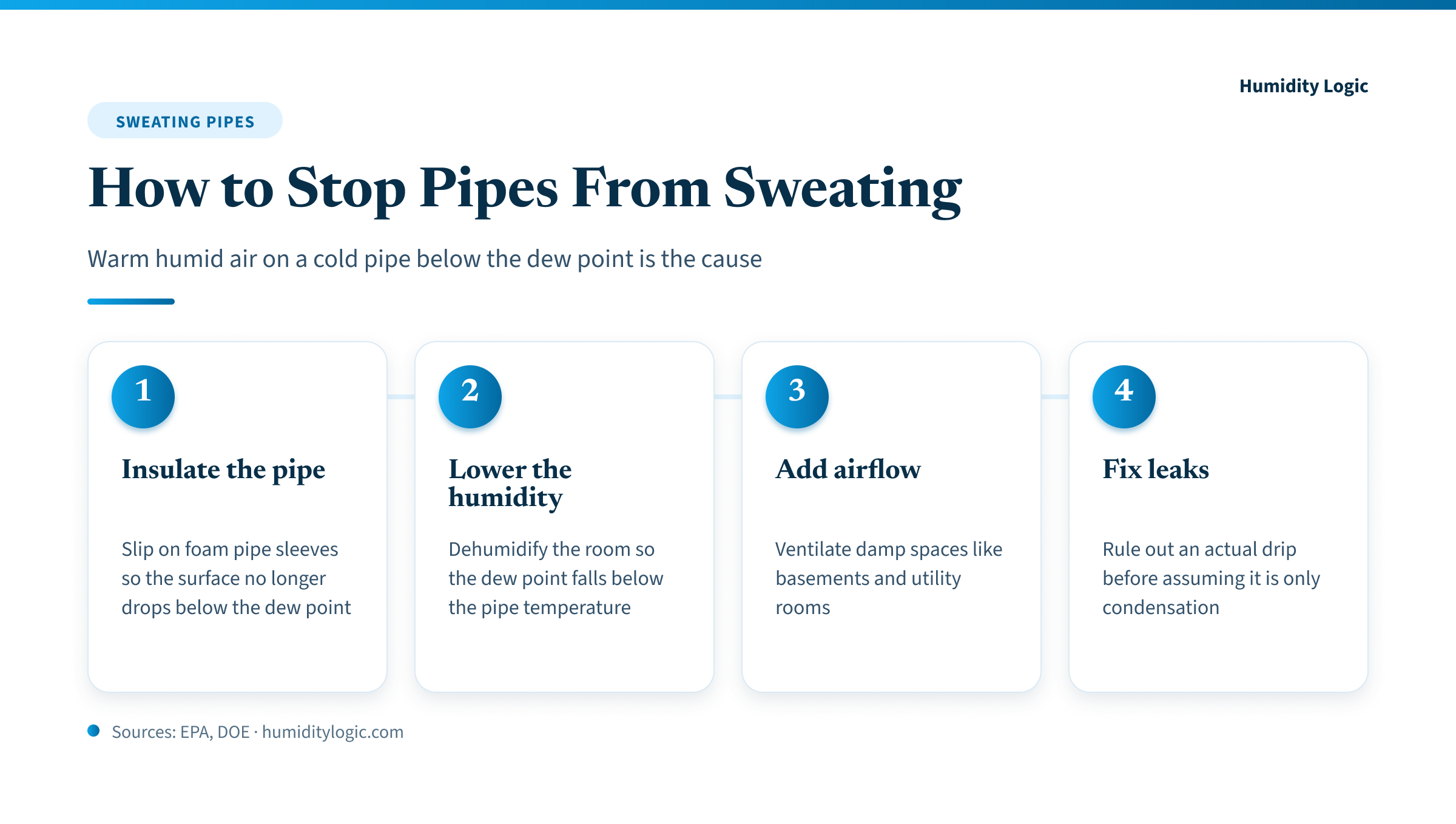
Condensation on pipes happens when warm, humid room air touches a cold pipe whose surface sits below the air’s dew point, so water vapor condenses out onto the metal, beads up, and drips. It looks like a leak but it is not — it is the same physics as a sweating glass of iced water. The fix, in order, is to wrap the pipe in foam insulation so its surface stays above the dew point, then lower the room’s humidity so the dew point drops below the pipe temperature. Add airflow to damp spaces and rule out a real leak, and the dripping stops.
Why Do My Pipes Sweat?
Cold-water pipes carry water straight from the main, often in the 50s year-round. The air around them in a basement or utility room can be much warmer and carry a lot of moisture, especially in summer. Air can only hold so much water vapor at a given temperature; cool it down and it reaches a point of saturation called the dew point, where the excess vapor must condense into liquid. When room air brushes against a pipe that is colder than that dew point, a thin film of water forms on the pipe. Keep feeding humid air past it and the film grows into beads that run down and drip.
The EPA describes the mechanism plainly: when warm, humid air contacts a cold surface, condensation may form, using the everyday example of a cold water bottle sweating on a hot day. Your pipe is that bottle. This is the identical process that fogs your windows in the morning — if you want the underlying temperature-and-moisture relationship spelled out, our dew point vs. humidity explainer walks through why the dew point, not the humidity percentage alone, is the number that predicts a wet surface. The same idea drives condensation on walls and cool below-grade surfaces.
Because it depends on warm, moist air, pipe sweating is usually seasonal. In summer, indoor dew points climb into the 60s and 70s while the pipe stays in the 50s, and the gap guarantees condensation. In winter the indoor air is drier, its dew point falls below the pipe temperature, and the sweating stops on its own.
The pipes that sweat most are the ones carrying the coldest water through the most humid air: the incoming main and cold-water risers in an unconditioned basement, crawl space, or garage, and toilet tank supply lines in a steamy bathroom. Exposed runs in these rooms have nothing between the cold metal and the moisture-laden air, so they are the first surfaces to reach the dew point and the first to drip.
Is It Condensation or a Real Leak?
Before you insulate anything, make sure you are chasing condensation and not a slow leak, because the fixes are completely different. Three quick checks settle it:
- Wipe and watch. Dry the whole pipe with a rag. Condensation re-forms as an even film along the entire cold run within an hour. A leak re-wets from one specific spot — a joint, a valve, or a fitting — and traces back to that point.
- Follow the water. Condensation drips off the lowest point of a horizontal pipe and leaves a diffuse damp trail. A leak usually drips from a single coupling or threaded connection and may spray a fine mist under pressure.
- Check the calendar and the pipe. Only the cold-water lines sweat; the hot-water line beside them stays dry. And the problem tracks humid weather. A leak does not care about the season.
If the water is condensation, everything below will stop it. If it is a leak, insulation only hides the drip and traps moisture against the metal — fix the plumbing first.
How Do I Stop Pipes From Sweating?
Work through these in order. The first step alone solves most cases.
1. Insulate the pipe (cheapest, most effective)
Slip foam pipe-insulation sleeves over every cold-water line that sweats. The foam is a thermal barrier: it keeps the pipe’s outer surface close to room temperature, above the dew point, so vapor never has a cold surface to condense on. The EPA’s home moisture guide explicitly advises to cover cold surfaces, such as cold water pipes, with insulation, and the U.S. Department of Energy’s Building America program confirms that insulating pipes reduces the risk of condensation forming on the pipes, which can lead to mold and moisture damage.
Choose closed-cell foam rather than fiberglass or open-cell foam. Closed-cell material resists soaking up moisture and keeps working in a humid basement; a wicking material on a cold pipe just gets wet and stops insulating. Buy sleeves sized to the pipe’s outside diameter, split them along the pre-cut seam, snap them over the pipe, and seal the seam and every joint so no humid air can sneak in behind the foam. Dry the pipe completely first — never clamp foam over a pipe that is already wet.
Do not skip the awkward spots. The elbows, tees, and valves are where condensation collects most, because they are often the last bare metal left after someone insulates the straight runs. Use pre-formed foam fittings or wrap those joints in self-adhesive insulating tape so the cold surface is covered end to end. A single inch of bare pipe at a valve can keep dripping and undo the work everywhere else.
2. Lower the room’s humidity
Insulation stops the pipe from reaching the dew point; lowering humidity brings the dew point down to meet it from the other side. Run a dehumidifier in the space and hold relative humidity under 50%. The EPA recommends keeping indoor humidity below 60 percent and ideally between 30 and 50 percent. Less moisture in the air means a lower dew point, so pipes — and walls, and windows — stay dry. Our guide to lowering humidity in your house covers sizing a dehumidifier and the other moisture sources worth cutting. Not sure whether your numbers put a pipe at risk? Plug your room temperature and humidity into the condensation risk calculator to see the dew point and how close your surfaces are to it.
3. Add airflow to damp spaces
Stagnant, humid air pools around pipes in basements, crawl spaces, and utility closets. Moving that air — a fan, an open door, or a vent — keeps humidity from concentrating against the coldest surfaces and helps a dehumidifier reach the whole room. Since pipes usually sweat in the same below-grade rooms that stay damp, the ventilation and moisture-control steps in our basement humidity guide apply directly, and they overlap with the fixes for basement condensation on walls and floors.
4. Rule out and fix any actual leak
If any surface stays wet after you have insulated and dried the space, go back to the leak checks above. Condensation and a slow drip can coexist, and no amount of foam or dehumidifying will stop water that is actually escaping the pipe. Repair the fitting, then re-insulate the dried line.
Does Pipe Condensation Actually Cause Damage?
Yes, if you ignore it. The constant drip keeps the floor, joists, and any nearby drywall or insulation damp, and sustained moisture is what mold needs to grow. The EPA lists condensing water pipes, especially pipes inside wall cavities or pipe chases, among the common building-moisture problems that lead to mold. Water pooling under a pipe can also rust metal, swell wood, and stain finishes. None of that is expensive to prevent — a few dollars of foam sleeve and a dehumidifier set to 50% will keep your pipes dry and the surrounding structure sound.
Frequently asked questions
Why are my cold-water pipes dripping when there is no leak?
That drip is almost always condensation, not a leak. A cold-water pipe carries water in the 50s, which sits below the dew point of warm, humid room air. Moisture condenses out of the air onto the pipe, beads up, and drips onto the floor. Wipe the pipe dry and watch it: if it re-wets evenly along its whole length within an hour, it is sweating, not leaking.
What is the cheapest way to stop pipes from sweating?
Foam pipe insulation sleeves. They cost a few dollars per length, slip on by hand, and split lengthwise so you can wrap a pipe already in place. The foam keeps the pipe surface above the room air's dew point, so vapor never condenses on it. The EPA recommends covering cold surfaces such as cold water pipes with insulation for exactly this reason.
What humidity level stops pipe condensation?
Aim to hold indoor relative humidity under 50%, and never let it climb past 60%. The EPA advises keeping indoor humidity below 60 percent, ideally 30 to 50 percent. Lower humidity pulls the air's dew point below the pipe's surface temperature, so the pipe stays dry even without insulation.
Do I need insulation if I run a dehumidifier?
Insulation is still the more reliable fix. A dehumidifier lowers the dew point across the whole room, but a very cold pipe in a very humid corner can still sweat during a heat wave. Foam sleeves protect the pipe directly regardless of what the room air is doing, so the best results come from doing both: insulate the pipes and keep humidity in check.
Can I insulate a pipe that is already sweating?
Wipe it completely dry first. If you clamp foam over a wet pipe you trap moisture against the metal, which invites corrosion and mold inside the sleeve. Dry the pipe, let it sit a few minutes to confirm it is not an actual leak, then fit closed-cell foam and seal the seam so humid air cannot reach the surface underneath.
Sources & references
Every figure on this page is checked against these published sources. Last reviewed July 29, 2026.