Damp walls come from one of four causes that look almost identical on the surface but need completely different fixes: condensation, penetrating damp, rising damp, or a plumbing leak. The cause decides the fix — and a dehumidifier only helps one of them. Before you spend a dollar, work out which problem you actually have, because treating condensation like a leak (or a leak like condensation) wastes money and lets the real damage continue.
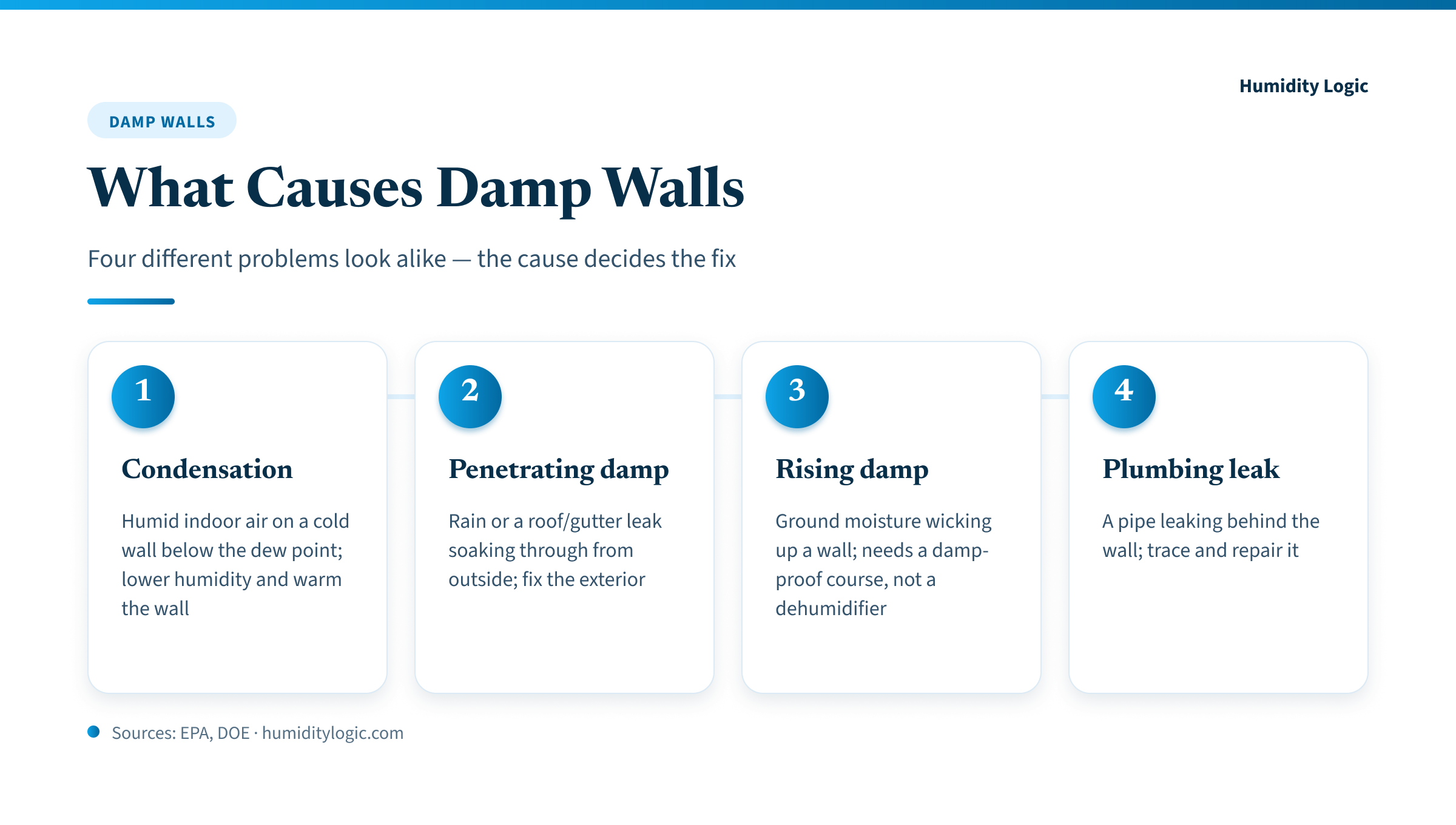
What are the four causes of damp walls?
The Department of Energy’s Building America program groups the ways moisture moves through a building into a few mechanisms, and each maps to one of the damp-wall problems homeowners run into. Bulk water movement — rain and groundwater — drives penetrating damp and, when a footing sits in wet soil, feeds rising damp through capillary action. Air carrying water vapor deposits moisture on cold surfaces below the dew point, which is condensation. A burst or weeping pipe is simply bulk water arriving from inside your own plumbing.
Building America is blunt about which of these does the most harm: “Bulk moisture movement (or liquid flow) has the potential to be the most damaging moisture transport mechanism confronted by a building.” That is worth remembering, because the cause people reach for first — high indoor humidity — is often not the one doing the structural damage. Here is how to tell the four apart.
How do I know if it’s condensation?
Condensation is the only one of the four caused by the air inside your home rather than water coming from somewhere else. It forms when a wall surface drops below the dew point of the room air — the temperature at which water vapor must turn back into liquid. The EPA describes the mechanism plainly: when warm, humid indoor air contacts a cold surface, condensation forms on it.
The tells: the damp is a broad film of fine droplets, worst on cold exterior walls, north-facing walls, corners, and spots behind furniture, and it comes and goes with the weather and with how humid the house is. It is usually a cold-season problem. If you put a hygrometer in the room and the reading sits above 55–60%, the air is carrying more moisture than your cold walls can tolerate. (Not sure what counts as high? Our guide to what is considered high humidity sets the thresholds.)
This is the only case a dehumidifier fixes. The EPA lists three ways to stop condensation: reduce the humidity, increase air temperature and circulation, and cover cold surfaces with insulation. In practice that means lowering indoor humidity to 30–50%, warming the wall, and moving air across it. You can estimate exactly how cold a wall has to be to start sweating at your temperature and humidity with our condensation risk calculator. For a deeper walkthrough of the cold-wall case specifically, see condensation on walls.
What is penetrating damp and how is it different?
Penetrating damp is rainwater or roof/gutter water soaking through the wall from outside. Unlike condensation, it has nothing to do with your indoor humidity — you cannot dehumidify it away, because the water is arriving from the weather.
The tells: the damp appears or worsens after rain, shows up as a localized patch rather than an even film, and often sits directly below or beside the failure point — a cracked render, failed pointing, a leaking gutter, damaged flashing, or a roof defect. It can appear at any height on the wall, which helps separate it from rising damp (see below). Building America’s guidance on bulk water control is that the first line of defense is keeping water away from the building in the first place: functioning gutters and downspouts that discharge well clear of the wall, and final grade that slopes away from the foundation so water does not collect against it.
The fix is always on the exterior. Clean and repair gutters, redirect downspouts, reseal or repoint the wall, replace failed flashing, and correct grading. The EPA gives the same short list: “Clean and repair roof gutters regularly. Make sure the ground slopes away from the building foundation.” No amount of indoor drying substitutes for stopping the water getting in.
How do I recognize rising damp?
Rising damp is ground moisture wicking up a wall by capillary action, most common in older masonry homes whose damp-proof course has failed or was never installed. Building America explains the physics: small pores in porous materials like brick and concrete “provide excellent paths for such wicking action to occur,” pulling water upward against gravity.
The tells: a damp band along the base of a ground-floor wall, typically stopping around two to three feet up where the rising water can no longer overcome gravity and evaporation. You often see a horizontal “tide mark” at that upper limit and a fluffy white salt deposit — efflorescence — left behind as the moisture evaporates and drops its dissolved salts at the surface. Because the source is the ground, rising damp is present year-round and, again, does not respond to a dehumidifier.
The fix is a physical or chemical damp-proof course, usually installed by a specialist, paired with the same exterior water management that helps penetrating damp: keeping ground water and surface water away from the base of the wall. This is the case people most often misdiagnose as “just a humid basement,” so if the damp is confined to the bottom of the wall, read our basement humidity guide alongside this one to separate a true ground-moisture problem from ordinary condensation.
Could it be a plumbing leak?
The fourth cause is the simplest to state and the easiest to overlook: a supply or drain pipe leaking inside or behind the wall. It is bulk water, like penetrating damp, but the source is your plumbing rather than the weather.
The tells: a persistent damp patch that has no relationship to rain or to indoor humidity, often tracking the line of a pipe run, sometimes warm (a hot-water line), and frequently worst near a bathroom, kitchen, or laundry wall. Unlike condensation, it does not dry out when the weather turns or when you run a dehumidifier; unlike penetrating damp, it does not spike after a storm. If the damp is localized, constant, and near plumbing, suspect a leak.
The fix is to trace and repair the pipe — a plumber’s job once the location is confirmed. Whatever the cause, act fast: the EPA notes that “if wet or damp materials or areas are dried 24–48 hours after a leak or spill happens, in most cases mold will not grow.” Beyond that window you are managing mold as well as moisture, and the agency advises professional help once affected areas exceed roughly 10 square feet.
Putting it together
Run the four checks in order before you buy anything. Does the damp come and go with indoor humidity and cluster on cold surfaces? Condensation — lower the humidity and warm the wall. Does it worsen after rain and sit near a gutter, roof, or cracked wall? Penetrating damp — fix the exterior. Is it a band at the base of an old masonry wall with a tide mark and salt? Rising damp — you need a damp-proof course. Is it a constant, localized patch near plumbing that ignores both weather and humidity? A leak — trace and repair the pipe.
The single most useful thing to internalize is that a dehumidifier only earns its keep against condensation. For the other three, the water is coming from outside the room air, so the fix has to meet the water where it enters — the roof, the ground, the wall, or the pipe. Match the fix to the cause and a damp wall becomes a solved problem instead of a recurring one.
Frequently asked questions
Will a dehumidifier fix damp walls?
Only if the cause is condensation. A dehumidifier lowers indoor humidity, which raises your air's dew point clearance so moisture stops forming on cold walls. It does nothing for rain soaking through from outside, ground moisture wicking up from the footing, or a leaking pipe — those are water sources a dehumidifier cannot reach. Identify the cause first; reach for a dehumidifier only once you have confirmed condensation.
How do I tell condensation from a leak?
Condensation appears as a broad film of tiny droplets across a cold surface and comes and goes with the weather and indoor humidity. A leak produces a localized stain that grows over time, often worsens after rain (roof or gutter) or tracks a pipe run (plumbing), and does not respond to lowering indoor humidity. If a patch keeps spreading regardless of your hygrometer reading, you are chasing water intrusion, not condensation.
What does rising damp look like?
Rising damp shows as a damp band along the bottom of a ground-floor wall, usually no higher than about three feet, often with a stained "tide mark" and a crumbly white salt deposit (efflorescence) where the moisture evaporates. It is most common in older masonry homes with no working damp-proof course. Because the water comes up from the ground by capillary action, drying the air will not stop it.
Can high indoor humidity alone cause damp walls?
Yes — that is condensation. When indoor relative humidity is high, the dew point of your air rises, and any wall surface colder than that dew point collects moisture. The EPA advises keeping indoor humidity below 60%, ideally 30–50%. If your walls are wet only in winter, only on cold exterior walls, and only when the house is humid, high humidity is the likely driver.
Which damp problem needs a professional?
Condensation and minor gutter or grading fixes are often DIY. Rising damp usually needs a specialist to install or repair a damp-proof course. Penetrating damp from roof, flashing, or structural cracks and any hidden plumbing leak inside a wall generally call for a roofer, mason, or plumber. The EPA also advises professional help for mold covering more than about 10 square feet.
Sources & references
Every figure on this page is checked against these published sources. Last reviewed August 1, 2026.