If your dehumidifier is flashing a code, the odds are it points to one of four everyday things: a full or badly seated water bucket, a clogged filter or dusty humidity sensor, a defrost cycle, or a room that is simply too cold. The specific letters vary from brand to brand — an “AS” on one unit and an “E1” on another can mean the same sensor problem — so treat the code as a clue, not a verdict, and let your model’s manual have the final word. The table and steps below cover the codes you are most likely to see and what to actually do about each one.
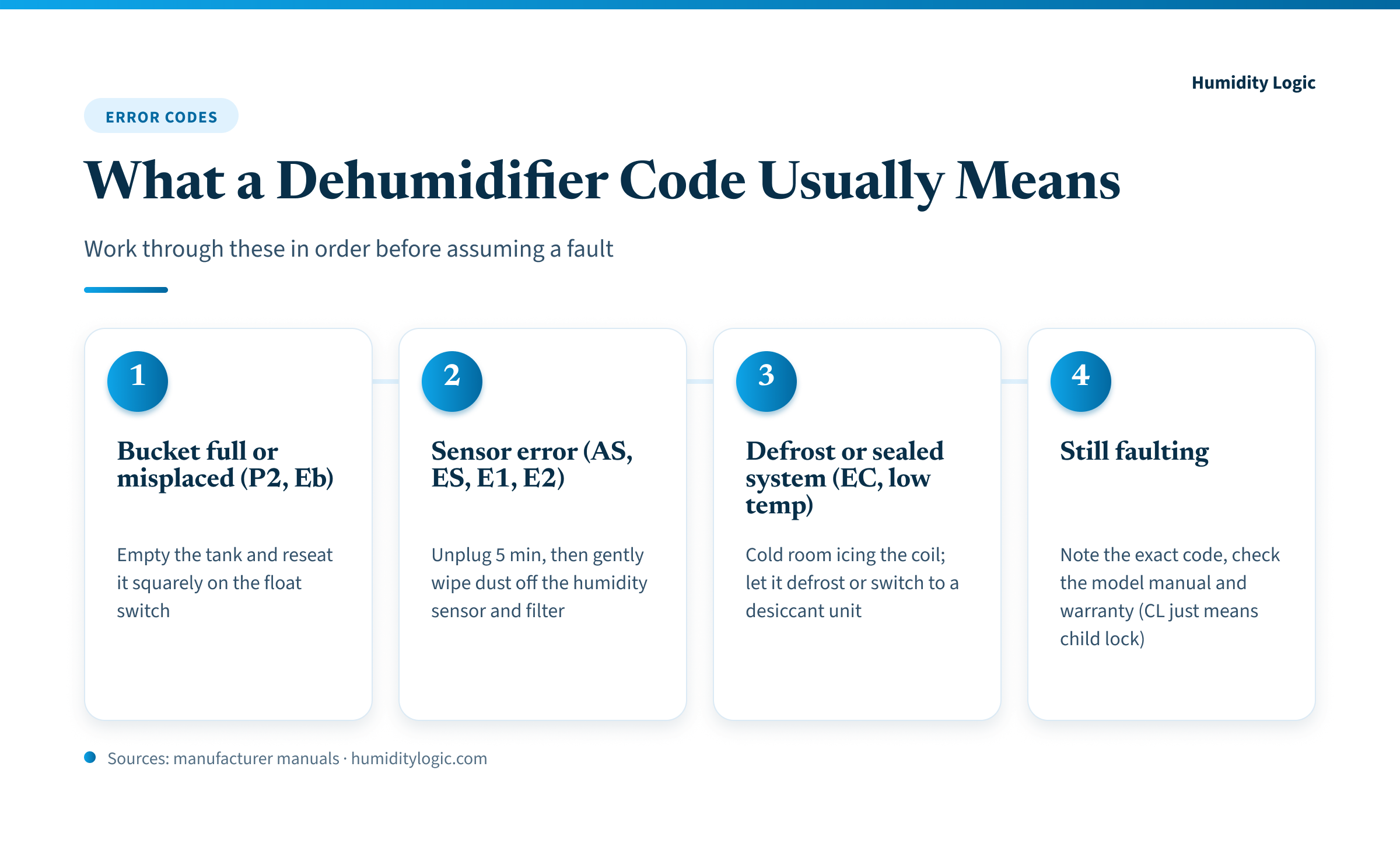
What do the most common dehumidifier error codes mean?
There is no universal standard for dehumidifier codes, which is exactly why they cause so much confusion. Frigidaire, GE, LG, Midea (which builds hOmeLabs and many store brands), and others each use their own letters. That said, the underlying faults are shared across the whole category, so a short cross-brand table gets you most of the way there.
| Code / display | Likely meaning (varies by brand) | What to do |
|---|---|---|
| P2 (Frigidaire, hOmeLabs/Midea) | Bucket full, or tank not seated on the float switch | Empty the tank, dry the rim, and reseat it squarely; make sure the float moves freely |
| Eb (hOmeLabs pump models) | Bucket removed or out of position | Slide the tank fully back until it clicks into place |
| AS (hOmeLabs/Midea) | Humidity sensor error | Unplug ~5 min; if it returns, the sensor likely needs service |
| ES (hOmeLabs/Midea) | Temperature sensor error | Power-cycle; a persistent code means service |
| E1 (Frigidaire, GE) | Humidity sensor or control fault; on some GE units a full-bucket sensor | Power-cycle, reseat the bucket, gently clean the sensor |
| E2 (GE) | Temperature/thermistor sensor fault | Power-cycle; if it persists, have it serviced |
| P1 (Frigidaire) | Unit won’t start dehumidifying (often defrost or low-temp related) | Confirm the room is above ~65°F and let any frost thaw |
| EC (Frigidaire) | Sealed-system fault (compressor/refrigerant) | Do not open it; check warranty and call a technician |
| CL (LG) | Child Lock is ON — not a fault at all | Hold the Humidity Up (▲) button ~3 seconds to clear |
Use this as a map, not gospel. Appliance Parts Pros notes that the same two letters can mean different things across models, so always confirm against your unit’s manual.
Why does my dehumidifier show a full-bucket code when the bucket is empty?
Because the machine isn’t measuring water — it’s watching a float switch, and a stuck or lifted float reads the same as a full tank.
Codes like Frigidaire’s P2 or hOmeLabs’ Eb trigger from a small float that rides on the water surface. When the float rises to the top, the unit shuts off and lights the code to protect against overflow. But the same signal fires if the tank is pushed in crooked, if the float is jammed with debris, or if the switch it presses against is bent. According to the hOmeLabs HME100 manual, P2 specifically means the bucket is full or not in the right position — the two are indistinguishable to the sensor.
Empty the tank even if it looks empty, wipe the rim, and slide it back in until it seats with a firm, even push. Nudge the float with a finger to confirm it swings freely. If you run a hose for continuous drainage, a kinked or uphill hose backs water up and trips the same code, so check the drain path too. When the tank genuinely fills faster than you expect, the unit may be oversized or undersized for the space — the dehumidifier size calculator helps you match capacity to the room.
What does a sensor error code (AS, ES, E1, E2) mean?
Sensor codes mean the control board has lost a believable reading from the part that measures humidity or temperature — and that is often dust, not death.
Every dehumidifier decides when to run by reading a humidity sensor and a temperature sensor (thermistor). When a reading drifts out of range or the connection flickers, the board flags it: AS for the humidity sensor and ES for the temperature sensor on hOmeLabs/Midea units, or E1 and E2 on many GE models. On some GE dehumidifiers, E1 is even tied to the bucket-full sensor rather than humidity, which is a perfect example of why brand matters.
Start gentle. Unplug the unit for about five minutes so the board resets, then restart. If the code clears, it was a transient hiccup. If it comes back, unplug again and softly wipe or vacuum dust off the sensor and surrounding grille — a dust film is the most common cause of a false reading. A code that survives cleaning and a power cycle points to a failed sensor or loose wiring, which is a service call rather than a countertop fix. Keeping the filter clean prevents many of these; see our dehumidifier maintenance guide for the monthly routine.
Is “EC” or a defrost code a sign my dehumidifier is broken?
Sometimes yes, sometimes no — and the difference is whether the code involves the sealed refrigerant system or just a cold coil.
Frigidaire’s EC is the serious one. As PartSelect explains, EC signals a sealed-system fault — a problem with the compressor, condenser coils, or refrigerant charge — and the unit shuts down to protect itself. The sealed system contains pressurized refrigerant and must never be opened by anyone but an EPA-certified technician, so there is no safe DIY fix. If the unit is under warranty, contact Frigidaire first; out of warranty, sealed-system repair on a portable unit usually costs more than a replacement.
Defrost-related displays are far less alarming. Many units briefly pause the compressor and light an indicator while the fan melts frost off the coil, then resume on their own — that is normal cold-weather behavior, not a fault. Frigidaire’s P1 commonly shows when the unit won’t start dehumidifying, often because the room is cold. Remember that compressor dehumidifiers lose capacity below about 65°F and can ice over entirely in a chilly basement or garage. If your coil keeps frosting, work through our guide on a dehumidifier freezing up, and if it hums but the tank stays dry, see why a dehumidifier isn’t collecting water. Understanding the refrigeration cycle in how a dehumidifier works makes these codes far less mysterious.
Is “CL” an error at all?
No — and this one trips up a surprising number of people. On LG dehumidifiers, CL means Child Lock is switched on. The buttons stop responding on purpose, and the display shows CL to tell you why. Per LG’s owner documentation, you clear it by pressing and holding the Humidity Up (▲) button for about three seconds until it beeps and the CL disappears. Nothing is wrong with the machine.
This is the clearest illustration of the golden rule: never assume a two-letter display is a fault. A code that means “child lock” on one brand could mean “clean the filter” on another and “sensor error” on a third. Check the manual before you reach for a screwdriver.
How do I reset a dehumidifier showing an error code?
A clean power cycle clears most one-off codes, and it costs nothing to try first.
Work through this order before assuming a real failure:
- Unplug the unit at the wall and leave it off for about five minutes so the control board fully powers down. A quick off-on tap often isn’t enough.
- Empty and reseat the water tank, drying the rim and confirming the float moves freely. If you drain by hose, straighten it and check for a downhill path.
- Clean the filter. Slide it out, rinse it with lukewarm water, and let it dry completely before reinstalling. A clogged filter starves the coil and skews sensor readings.
- Gently clear dust from the sensor and coil with the unit unplugged, using a soft brush or vacuum — never water on the electronics.
- Confirm the room is above ~65°F for the retest. A code that only appears in a cold garage is usually the room, not the machine.
- Plug in and run for an hour at a moderate 45–55% setting, then recheck. If the code stays gone, you’re done.
If a code returns immediately after all of that — especially a sealed-system code like EC — note the exact characters, your model number, and warranty status; that’s what a technician or the support line needs. Leaking around the tank instead of a code? That’s a separate path — see dehumidifier leaking water.
When is a coded fault worth repairing versus replacing?
Match the cost of the fix to the value of the machine. A full-bucket code, a dirty sensor, a child-lock display, or a cold-room defrost pause all cost nothing to resolve, and they account for most codes people panic over. A failed sensor is sometimes a reasonable repair on a larger or higher-end unit. But a genuine sealed-system fault — refrigerant or compressor — on a typical portable dehumidifier almost always costs more to fix than to replace, so warranty status becomes the deciding factor. When in doubt, decode the letters, try the reset sequence, and let the price of the actual repair make the call.
Frequently asked questions
What do most dehumidifier error codes mean?
Most codes fall into four buckets: a full or misplaced water tank, a dirty filter or humidity sensor, a defrost cycle or sealed-system fault, and a room that is simply too cold for a compressor unit. The exact letters differ by brand, so the code on your display is only a starting point — your model's own manual is the authority on what it means.
What does the AS code mean on a dehumidifier?
On hOmeLabs and other Midea-built units, AS is a humidity sensor error and ES is a temperature sensor error. Unplug the unit for about five minutes and restart it. If the code clears, it was a glitch; if it returns, the sensor or its wiring likely needs service rather than cleaning.
Is CL an error code on my dehumidifier?
No. On LG dehumidifiers, CL means Child Lock is switched on, not that anything is broken. Press and hold the Humidity Up (▲) button for about three seconds to turn it off, and the buttons will respond again.
What does the EC code on a Frigidaire dehumidifier mean?
EC indicates a sealed-system fault involving the compressor, coils, or refrigerant. This is not a DIY repair — the sealed system should only be opened by a qualified technician. If the unit is still under warranty, contact Frigidaire before spending money on service.
How do I reset a dehumidifier that is showing an error code?
Unplug it at the wall, wait about five minutes so the control board fully powers down, then plug it back in. Reseat the water tank and clean the filter while you wait. A power cycle clears many one-off sensor and protection codes; a code that returns immediately points to a real fault.
Sources & references
Every figure on this page is checked against these published sources. Last reviewed July 27, 2026.