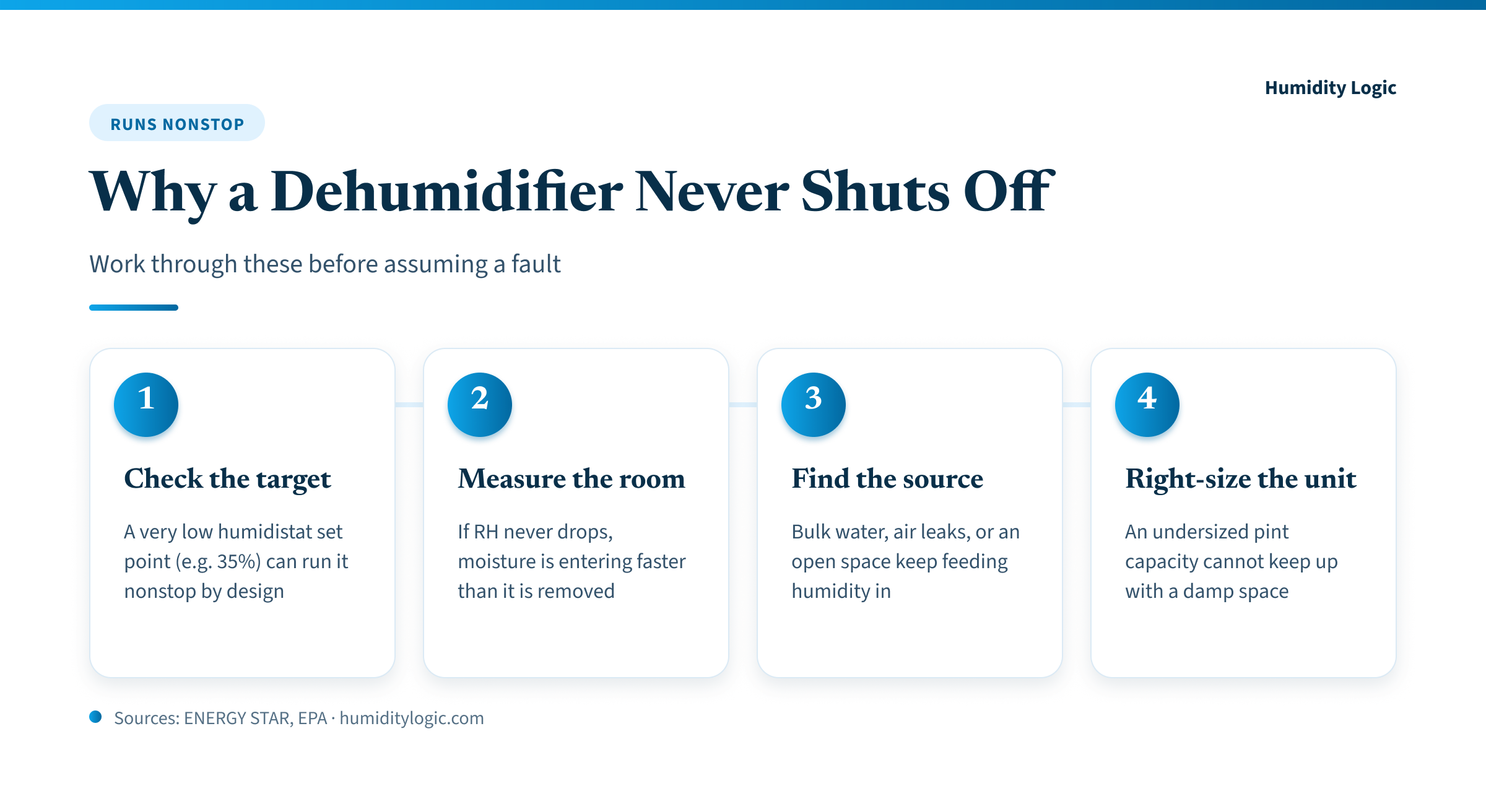
A dehumidifier that runs constantly is often completely normal: when the moisture load is high — a damp basement, a freshly wet or newly finished space, humid summer air, or a humidistat set very low — the unit is simply working hard to reach and hold your target. It becomes a problem only when the room never actually reaches that target no matter how long it runs. That almost always traces back to one of three things: bulk water the unit can’t outpace, air leaks pulling humid air in as fast as it’s removed, or an undersized unit that can’t keep up with the space. A hygrometer tells you which situation you’re in within a day.
Is constant running normal or a problem?
The single question that settles it: is the room reaching your target humidity?
Buy a cheap hygrometer and set it near the dehumidifier. If relative humidity is steadily falling toward your set point over hours and days, the unit is winning — constant running is just the cost of a heavy moisture load, and nothing is broken. If the reading sits stubbornly high day after day while the machine hums nonstop, moisture is entering the space as fast as, or faster than, the unit removes it. That is the dividing line between normal and faulty.
Meaco’s support guidance makes the normal case explicit: in a home that has never been dried out, a dehumidifier can run continuously for roughly two to four weeks while wood, furniture, drywall, and fabrics release stored moisture. During that break-in period, constant operation is expected, not a fault. Only once the air and its contents dry should the unit begin cycling — Meaco’s controls switch off around 3% below the set point and resume a few percent above it.
Seasonal load matters too. In a humid summer, outdoor air can sit well above 70% RH for weeks, and every time a door opens or air infiltrates the space, that moisture comes with it. A unit holding a comfortable indoor level against constant outdoor pressure will naturally run far more than it does in a dry winter. That’s the same machine behaving correctly under a heavier load — not a sign it has developed a fault between June and August.
Why won’t my dehumidifier ever shut off?
Under normal control logic, a compressor dehumidifier shuts off when the room hits the humidistat’s target. So if yours never stops, one of these is true.
It’s in continuous or non-stop mode. Most units have a max-dry or continuous setting that ignores the humidistat entirely. As GE Appliances notes, in this mode “it is perfectly normal that it runs all the time and never shuts off.” Check the control panel first — this is the most common false alarm.
The set point is very low. A target of 35% in a humid climate can run the unit indefinitely, because indoor and outdoor moisture keep nudging the room back above 35% the moment the compressor stops. This is running-by-design, not a defect.
The moisture load genuinely exceeds capacity. Here the humidity really won’t fall, and that’s the case worth digging into below.
Where is all the moisture coming from?
If the room never reaches target, stop blaming the machine and find the water. Three sources dominate.
Bulk water intrusion. A dehumidifier removes moisture from air, not standing water. If a basement floor stays wet from seepage, a leaking foundation, a failed sump, or groundwater pushing through cracks, the unit is fighting an evaporating puddle it can never outpace. This is the classic scenario in a wet basement: the dehumidifier runs 24/7 and the slab is still damp. The fix is waterproofing and drainage, not more dehumidification. Our guide to basement humidity covers how to tell diffuse dampness apart from an active leak.
Air leaks bringing in humid air. An open basement door, an unsealed rim joist, a window cracked in summer, or ducted air from a humid crawl space continuously feeds new moisture into the room. The dehumidifier ends up trying to dry the outdoors. Close the space off, seal obvious gaps, and keep windows and doors shut while it runs — this is a core step in lowering humidity in a house.
An open or oversized space. A unit rated for a single room can’t hold target across an open floor plan or a whole basement with the stairwell open. Contain the area or move up in capacity.
A quick way to separate a moisture-source problem from a sizing problem: check the tank or drain output against the humidity trend. If the unit is pulling plenty of water yet the room stays humid, moisture is pouring in from somewhere — hunt for the leak or the open air path. If the output is modest and humidity barely moves, the unit is simply outmatched by the space. The first is a plumbing-and-sealing fix; the second is a capacity fix.
Could my dehumidifier be the wrong size?
Very possibly. If the unit collects water steadily and the room slowly improves but never quite reaches target, the capacity is likely too small for the load.
ENERGY STAR sizes dehumidifiers by two factors together: the square footage of the space and how damp it is. A merely damp room (musty smell, 50–75% RH) needs far less capacity than a wet one with sweating walls or visible seepage (90–100% RH), where ENERGY STAR points to 50-pint-plus units for larger areas. People routinely put a small 20-pint unit in a large, genuinely wet basement and then wonder why it never stops.
Run your numbers through the dehumidifier sizing calculator to check whether the pint capacity matches your space and dampness level. Our deeper explainer on what size dehumidifier you need walks through the same sizing logic. If the space is large or very wet, a single correctly sized unit — or two units — will cycle normally where an undersized one never rests.
What if it runs constantly but the tank stays empty?
This is a different failure, and an important one to separate out. Constant running with a full tank means the unit is extracting hard — a high-load situation. Constant running with an empty tank means it isn’t extracting at all, and the humidity you’re reading is beside the point.
The usual culprits are a frozen evaporator coil, a clogged filter or blocked intake starving the coil of airflow, or a low-refrigerant or failed-compressor fault. Note the temperature dependency, too: compressor dehumidifiers lose extraction capacity below about 65°F, so in a cold basement or garage the unit can run flat out and still barely fill the tank. If your unit runs but the bucket stays dry, work through the dehumidifier not collecting water guide before assuming a moisture-load problem.
When constant running is fine, and when to act
Pulling it together:
- Leave it running if a hygrometer shows humidity falling toward target, if you’re in the first few weeks of drying out a space, if it’s set to continuous mode on purpose, or if your target is set very low. This is normal, expected behavior.
- Take action if the room never reaches target after a day or two of nonstop running. Rule out bulk water and air leaks first, then confirm the unit is correctly sized. If it runs but collects no water, treat it as an extraction fault, not a load problem.
The healthiest target for most homes is 45–50% RH — comfortably inside the EPA’s guidance to keep indoor humidity below 60% and ideally between 30% and 50%. Set it there, fix the moisture source, match the capacity to the space, and a dehumidifier that “never shuts off” will start cycling the way it’s meant to.
Frequently asked questions
Is it bad if my dehumidifier runs constantly?
Not necessarily. Constant running is normal when the moisture load is high — a damp basement, a freshly wet space, humid summer weather, or a very low humidistat set point will all keep the compressor going by design. It only signals a problem when the room never reaches your target relative humidity despite hours or days of running. That points to bulk water, air leaks feeding in humid air, or a unit that is too small for the space.
How long should a dehumidifier run before it cycles off?
In a space that has never been dried out, it can run continuously for two to four weeks while building materials, furniture, and fabrics give up stored moisture, according to Meaco. Once the air and contents dry, the unit should cycle off when it reaches roughly 3% below your set point and cycle back on a few percent above it. If weeks pass with no cycling and a hygrometer shows humidity is not dropping, investigate the moisture source and the unit's capacity.
Does a lower humidistat setting make a dehumidifier run more?
Yes. The lower your target, the longer the compressor runs to reach and hold it. Setting 35% in a humid climate can keep the unit running nonstop simply because outdoor and indoor moisture keep pushing the room above that level. The EPA recommends keeping indoor humidity below 60% and ideally 30–50%. Setting your target to 45–50% often stops the constant running without leaving the room damp.
Can an undersized dehumidifier cause constant running?
Yes. If the pint capacity is too low for the room's size and dampness, the unit removes water slower than the space produces it, so it never catches up and runs continuously. ENERGY STAR sizes units by both square footage and dampness level, with wet spaces needing far more capacity than merely damp ones. Use the sizing calculator to check whether your unit is matched to the space, or add a second unit for large or very wet areas.
Why does my dehumidifier run all the time but the tank stays empty?
If it runs constantly but collects little or no water, the problem is usually not high humidity at all. A frozen coil, a dirty filter choking airflow, or a refrigerant or compressor fault can leave the unit running without extracting water. That is a different failure from a genuine high-load situation, so check the coil and filter first, then see our guide on a dehumidifier that is not collecting water.
Sources & references
Every figure on this page is checked against these published sources. Last reviewed July 27, 2026.